

Health care providers, others, discuss opioid epidemic
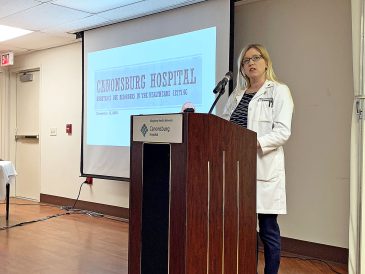
On days when he’s feeling discouraged, Erich Curnow, director of clinical and case management services for the Washington County Drug and Alcohol Commission, describes his job as “wading through a sea of human misery and witnessing the occasional miracle.”
But Curnow, who addressed health care providers who attended an opioid forum hosted by Allegheny Health Network at Canonsburg Hospital on Monday, is committed to providing treatment for people suffering from substance use disorders – and, ultimately, ending the opioid epidemic sweeping the country.
“The people we see, in many ways, are some of the bravest and most courageous people I’ve ever met,” said Curnow. “The addicts I’ve met who have recovered are the most intelligent, sensitive, caring, resourceful, creative people I’ve ever known in my life, and I try to remember that when I’m dealing with what they’re presenting to me, which is challenging, which is, in many ways, like a cornered animal.”
The forum, “Substance Use Disorders in Health Care,” provided an opportunity for members of the Washington County Medical Society and other health care workers on the front lines of the opioid battle to address the challenges they face and to discuss strategies for serving those patients with opioid addiction.
State Sen. Camera Bartolotta, R-Carroll, and state Rep. Tim O’Neal, R-South Strabane, also attended, and described efforts at the government level to increase services to address the opioid crisis.
Dr. Jennifer Lewis, a physician at Canonsburg Hospital and president of the Washington County Medical Society, provided an overview of AHN’s Center of Excellence for Opioid Use Disorder, which includes behavioral health, a medication-assisted treatment program, harm-reduction based services and social welfare assistance.
Launched with a $1 million state grant, the MAT program, available at AHN facilities throughout Southwestern Pennsylvania, provides medications such as Suboxone and Vivitrol combined with onsite behavioral therapy to reduce urges and withdrawal symptoms.
“The opioid crisis and the opioid epidemic is fast becoming a huge killer in this country, in our state and in our county,” said Lewis. “Almost every one of us here probably knows or has been touched by the opioid epidemic and the crisis going on. We as health care providers and legislators, and doctors, social workers and whoever else may be in the room, we all have an obligation to serve our community and help end, or at least address, this crisis. We all need to come together … to figure out how we can better serve this population and figure out what the barriers are, what the resources are, and how we can get them all together to best serve our community.”
Lewis voiced frustration that opioid addicts have access to heroin and synthetic opioids on the street, and Canonsburg Mayor David Rhome said until those sources are eliminated, the opioid crisis will continue.
Washington County has been hard hit by the opioid epidemic, but efforts by many groups and organizations, including the Washington County Opioid Overdose Coalition, are making a difference. Washington County had a decrease in overdose deaths from 2016 to 2017.
Curnow, who also addressed the financial and social toll the opioid crisis has had on the county, said on Monday that the county’s efforts to make naloxone kits available to first responders, pharmacies, schools and other groups, has contributed to a decline in the number of overdose fatalities.
Eliminating the stigma associated with substance use and recognizing substance abuse as a chronic disease would make it more likely that people would seek the help they need, Curnow pointed out.
Said Bartolotta, “No 4-year old ever said, ‘When I grow up, I want to be a heroin addict.’ Every single person afflicted is someone’s son or daughter, mother, father, brother or sister. They had hopes, dreams, aspirations, jobs, loved ones. It’s an illness. We don’t scorn someone after their third heart attack and say, ‘We’re not going to use the paddles today, you ate that Twinkie yesterday, you deserve it.’ We’d never do that. Drug addiction should be treated the same way.”
Cheryl Andrews, executive director of Washington County Drug and Alcohol Commission, said she has seen progress in efforts to coordinate groups in the fight against opioid addiction.
“I can honestly say in my tenure in this field I see things happening and it’s encouraging because before, everyone was doing their own thing and it seems like it’s so much more coordinated,” said Andrews, noting much work needs to be done.
And, said Curnow, it’s important to remain optimistic.
“It’s real easy to look at all the things that are broken,” he said. “But the thing that has kept me focused is the person right in front of me. It’s real easy to say, ‘Oh, we’re never going to solve this if this doesn’t happen, or there’s no money for this, or how are we ever going to deal with that.’ But I try to remember that I’m not going to be able to save the 70,000 people that died last year, but if I get that one in front of me today, I might be able to keep them from dying tomorrow.”