

Washington County coalition shows progress in opioid epidemic
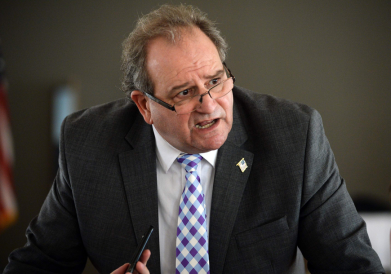
Washington County District Attorney Gene Vittone recalled the 24-hour period in August 2015 when 18 people overdosed on heroin – three fatally – making national news.
But since the formation of the Washington County Opioid Overdose Coalition in October 2016, the difference in the county’s approach to the opioid epidemic that continues to ravage the country has been “night and day,” he said.
The coalition is made up of representatives from Vittone’s office, Washington Drug & Alcohol Commission, the local bar association, faith-based organizations, government, addicts in recovery and the county’s Children and Youth Services and jail and legal aid organizations, among others.
The group has worked with Pitt Pharmacy PERU, an organization that collects and analyzes data and other evidence, to develop a three-year strategic plan to address opioid overdoses and criminality associated with opioids.
“We were doing all kinds of different things, but nothing was tied to a coordinated strategy. We were putting out fires,” said Vittone. “When (Washington Drug & Alcohol Commission executive director) Cheryl Andrews said Pitt wanted to have a round table to talk about developing an approach to the epidemic, I said the last thing I wanted to do was to sit down to another round table. But once I went, and saw what they were doing, I said, ‘Oh, this is the approach that needs to happen.’ The most important thing is working from data, working from numbers to see the strategies that would best work to solve those issues.”
Washington County had a decrease in overdose deaths from 2016 to 2017. According to the Washington County coroner’s office, 97 people died of drug overdoses last year, a majority from heroin and fentanyl, compared to a record 110 deaths in 2016.
Vittone believes the coalition’s efforts, including the implementation of a number of programs and initiatives, have contributed to the decline.
For example, data showed high death rates among opiate-dependent inmates released from jail and patients released from treatment centers.
So, the Washington County jail implemented a Vivitrol program in which inmates voluntarily receive a monthly shot of the injectable, which dulls the brain’s receptors and prevents users from getting high.
Preliminary statistics show the Vivitrol program is “looking very promising,” Vittone said.
In 2017, there were no reports of overdoses among inmates released from the jail; in 2016, there were 7 such reported deaths.
The use of naloxone also has played a role in reducing the number of deaths, according to the data. The county has distributed more than 2,129 naloxone kits, which have saved at least 364 lives over the past three years, according to the most recent figures.
“If we didn’t have Narcan available, there are people who would have died,” said Vittone.
Drug & Alcohol Commission implemented a “warm handoff” program at Mon Valley, Canonsburg and Washington hospitals, where people who receive Narcan can immediately access a counselor who can get them bed space for detox and get them into treatment.
Other factors Vittone believes have impacted the number of overdose deaths is a substantial increase in both treatment assessments and the average length of stay for substance treatment for drug users.
“Studies show that anything less than 90 days, you’re wasting your time,” said Vittone.
Additionally, a growing number of recovery houses in Washington for people dealing with addiction have been reporting progress in helping their residents stay sober.
Erich Curnow, director of clinical and case management services at the commission, said the houses in the city have become “a vital, valuable piece of the puzzle for people who are trying to put their lives back together.”
Nicole Durley, who lived in recovery houses during her return to sobriety, now works for the commission and manages a caseload of recovery house residents.
“They are beneficial for the people going through them,” she said.
Vittone’s office also has partnered on heroin investigations with the U.S. attorney’s office in Pittsburgh, and the partnership has resulted in 28 arrests of suspected mid- to- high-level drug dealers, Vittone said.
The partnership has been successful enough for the U.S. attorney’s office to consider forming them in other counties, said Margaret Philbin, spokeswoman for U.S. Attorney Scott W. Brady in Pittsburgh.
“Our state sentencing guidelines don’t have (dealers) much of a sentence, and these are dangerous people who need to be separated from the population. Having the ability to take them federally, where they have the ability to put them away for a decade or more, makes a difference,” said Vittone.
He also credits the Washington County Drug Task Force, the state and local police departments, federal agencies and other law enforcement agencies for cooperating on investigations.
Still, Vittone sees room for improvement in the county’s battle against opioids.
In April, at a coalition meeting, PERU’s Dr. Lynn Mirigian commended the coalition for the reduction in fatalities, but noted the county’s rate of overdose deaths – 57 per 100,000 in 2017 – remains higher than the state average of 37.
So far, in 2018, 286 opioid overdoses have been reported to 911, resulting in 35 fatalities.
“You’re doing awesome work in decreasing overdoses, but there’s still a long way to go. So, I want to be sure we’re balancing, ‘This is super exciting,’ with the fact that we still have a lot of work to be done. But there shouldn’t be any loss of hope. You guys are showing you can do this,” she said.
Vittone acknowledges the challenges, but believes the county can achieve more.
“Once you stamp out one thing, another thing pops up. Lately, we’ve recognized 40, 50 and 60-year-olds are dying. It gets frustrating,” said Vittone. “Our overdose numbers overall are down, but we’re still having deaths. We will just keep looking at the data, keep working with people who are experts in public health to identify where we can make an impact and address it as quickly as we can.”
Perhaps most importantly, Vittone believes the stigma that exists for opioid addicts must change.
“It’s a stigma issue. Not all addicts are involved in the criminal justice system. A lot of these people have had no contact with us,” he said. “A lot of them are veterans who have served their country. No community in Washington County is immune to this. Rich or poor, it doesn’t discriminate.”
Vittone recalled attending an opioid conference where a law enforcement officer summarized his position on the opioid epidemic. The words, Vittone said, have stuck with him.
“His philosophy was, ‘Incarcerate the people you’re afraid of, and treat the ones you’re mad at.'”
Staff writer Scott Beveridge contributed to this story.