

Consol, CNX and affiliates donate property for bat conservation area in Greene County
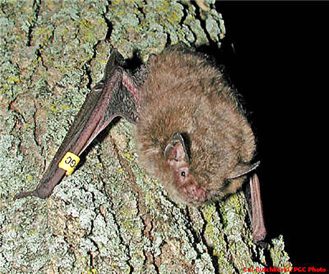
Consol Energy, CNX Resources and affiliated companies have donated more than 1,500 acres of property in Richhill Township to the Pennsylvania Game Commission to expand existing state game lands and develop a bat conservation area.
About 1,236 of the 1,536 acres of land adjoin State Game Lands 302 in the northwestern corner of Greene County. The properties are bisected by Consol Energy’s overland coal conveyor belt that runs between Crabapple and Enon and are known as an Indiana bat habitat, according to the game commission. The remaining 300 acres are just southeast of the game lands.
As part of the transaction, the companies also agreed to donate $580,000 to the commission for a stewardship fund for the perpetual management of the land, including payment in lieu of taxes on the property.
“The companies are glad to be part of such an important project and be afforded the opportunity to provide a perpetual conservation area in Greene County,” Consol spokesman Zackery Smith said in an email explaining the donation.
“The combined coordination with the local, state and federal agencies was focused on a common goal: to protect our threatened and endangered species and allow for future public enjoyment of natural areas within our beautiful state,” he said.
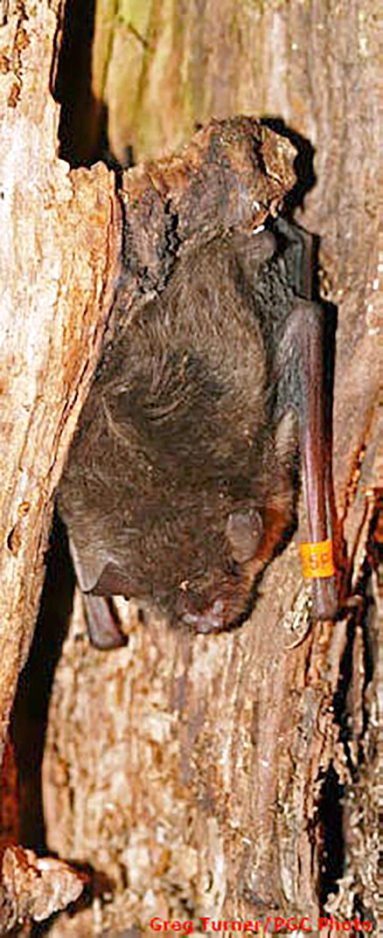
Photo courtesy of Pennsylvania Game Commission
Photo courtesy of Pennsylvania Game Commission
Indiana bat
The transaction is a good deal for the game commission, said Dennis Neideigh, game commission chief of real estate. The commission “looked at it from the perspective of future hunting opportunities and wildlife management,” he said. With the acquisition, “about 1,500 acres will be open to public hunting and wildlife management,” he said.
The area is also known to be an Indiana bat roosting and foraging area, Neideigh said. It’s management as a bat conservation area coincides well with the game commission’s roll in managing wildlife.
What also makes the property important to the commission is that it adjoins existing game lands, said Travis Lau, game commission spokesman.
“That takes it to another level,” he said, adding the commission is always looking to expand games lands where it is possible.
The property is being donated to the commission to address regulations that require the companies to mitigate impacts created by mining or natural gas development to forested areas known to provide habitat to Indiana bats, a federally endangered species, Smith said.
As part of a mitigation plan developed through the U.S. Fish and Wildlife Service, the companies are required to compensate, or provide an offset for, any forested land cleared in a known Indiana bat occupation area. These impacts could, for example, result from the construction of the conveyor belt line or the development of a natural gas well site, Smith said.
Consol could simply have paid into a mitigation fund, which would then be used to purchase property to offset any impacted land. Instead, the company and its subsidiaries chose to consider a plan that would provide a more “direct benefit” to the community and the state for the protection of the bats, Smith said.
“To our knowledge, bat conservation and a state partnership of this type have not been used in Pennsylvania before,” Smith said. “Historically, mitigation money was paid into mitigation funds and the state and federal agencies would attempt to secure lands. In this scenario, the companies donated the highest value bat habitat to a state agency for management, along with a stewardship fund to help them manage the property. “
A wildlife management plan will be developed for the property that will take into account the fact it is an Indiana bat habitat, the commission said.
The stewardship fund will be used to cover management activities, including payment in lieu of taxes. According to Neideigh, the commission pays $1.20 an acre to each of the three taxing bodies, the county, school district and municipality, in lieu of taxes. Of the $1.20 an acre payment, 40 cents comes from game commission funds and 80 cents from the gaming board that controls gambling revenue.