

Legislation for local police to use radar guns remains in flux
Trista Thurston/Observer-Reporter
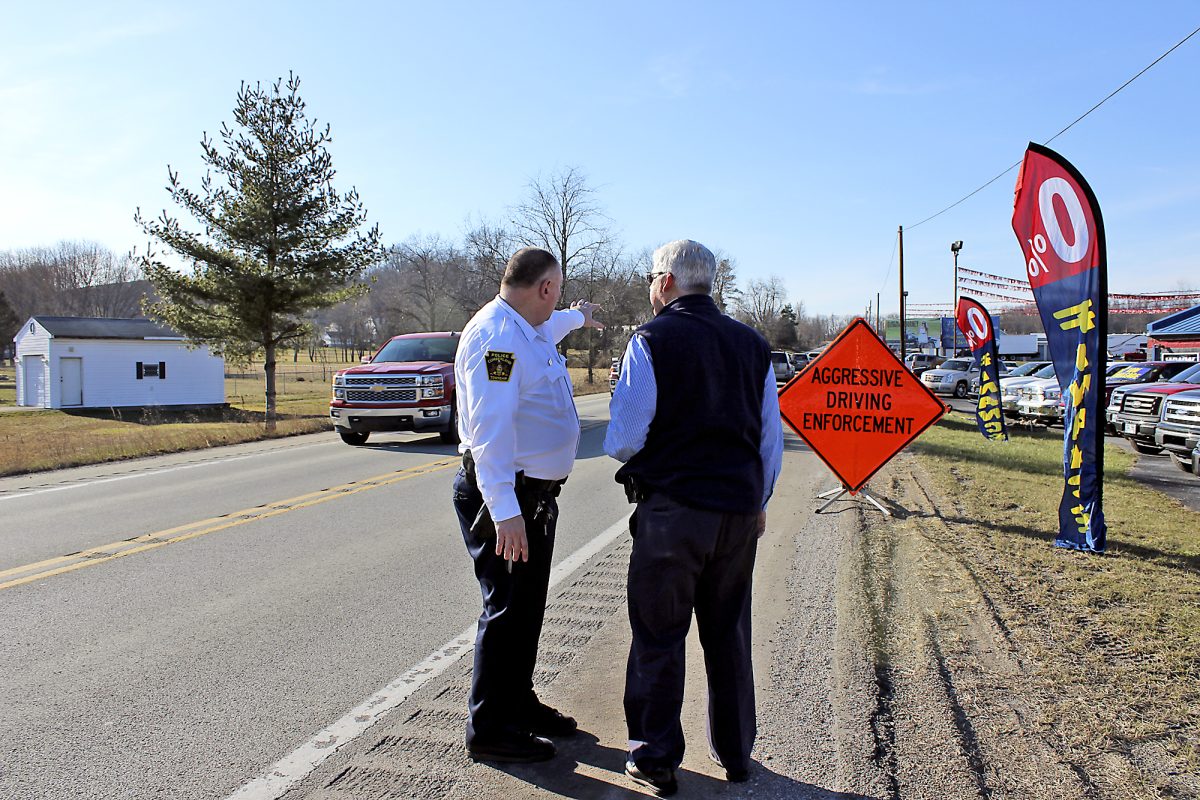
Cumberland Township police Chief James Vogel, left, points out the area officers covered in a recent aggressive driving detail. His department partnered with local state police to target Route 21 near Bailey’s Crossroads.
Trista Thurston/Observer-Reporter
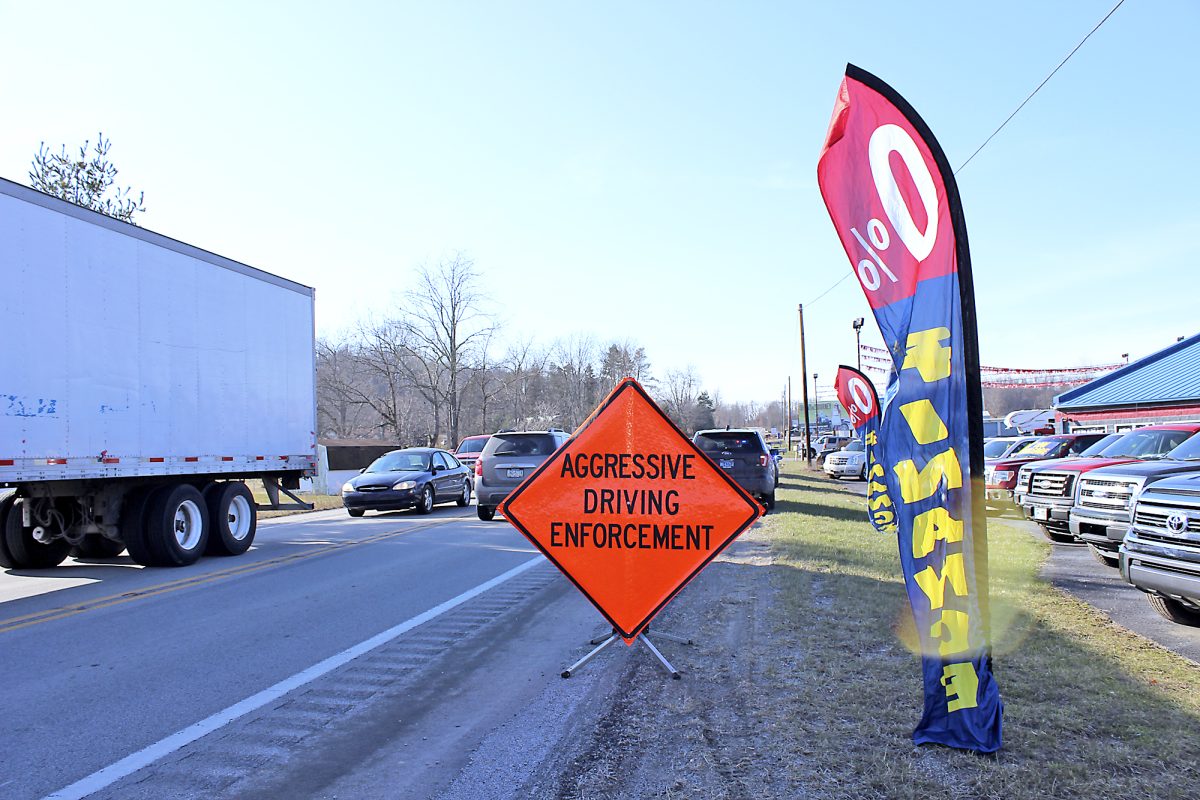
Cumberland Township police partnered with local state police to target aggressive drivers on Route 21 near Bailey’s Crossroads Monday.
{child_flags:editors_pick}Radar gun legislation still in flux
{child_byline}By Trista Thurston
Staff writer
tthurston@observer-reporter.com
{/child_byline}
CARMICHAELS – Last Monday, Cumberland Township police partnered with local state police to target aggressive drivers. One of the biggest assets state police brought to the table wasn’t manpower, but a device that looks like a hairdryer.
Municipal police departments have been barred from using radar devices since their inception in 1961. The concern was speed traps would pop up in small communities that would be used by departments to rake in cash with speeding tickets. Pennsylvania is the only state that has such a restriction. State police are the only law enforcement officers in Pennsylvania who able to use the devices.
Of course, speeding tickets can be costly, but they’re not much of a moneymaker for departments. Most of the fees in a ticket cover court costs, along with an emergency medical service fee.
Legislation to allow local departments to use radar guns has been in flux for years and previous tries to overturn the ban have not been successful. Most recently, state Rep. Greg Rothman, R-Cumberland County, told PennLive earlier this month he was working on a new bill that would allow radar guns while trying to prevent their misuse.
The bill would include provisions that only trained, full-time officers would operate the devices, enforcement would only come after a local ordinance, signs would need to mark “radar enforced” communities, departments could not generate revenue from tickets and reports would need to be submitted to state Department of Transportation annually.
Many departments, especially in Greene County, rely heavily on part-time officers who would not be permitted to use the devices. The bill also would expire after six years, serving as a pilot to see if it works.
The state Senate passed a similar resolution, SB251, in November that has since languished in the House Transportation Committee. It also would allow police to use radar guns, but does not include the other restrictions that Rothman has proposed. Rothman is a member of the House Transportation Committee and told PennLive he does not think SB251 could pass without added provisions. He believes a more restrictive, incremental introduction would be more effective.
In just a few hours Monday with the help of state police, Cumberland Township officers issued 29 citations for speeding and as well as one warning for not wearing a seat belt, one inspection warning and five other warnings.
Police officers were stationed on Route 21 near what’s commonly referred to as Bailey’s Crossroads in Cumberland Township, which is the convergence of Route 21 with West George Street.
Vogel said the intersection was selected in response to an increasing number of crashes at or near it in the past two years, mostly due to speeding. There have also been numerous complaints about the intersection, especially about the speed of large trucks that travel through the area. He added it’s a rare chance his officers get to work in conjunction with state police and that it was an opportune time to enforce laws “that we don’t always have the time to do” and “make an actual difference” in the community.
According to the National Highway Traffic Safety Administration, 27 percent of fatal crashes across the country in 2015 were a result of speeding. In Pennsylvania, 45 percent of fatal crashes were due to speeding, the second-highest percentage in the country that year, only behind New Hampshire.
Vogel said since he has taken over in late 2016, the department has not done this sort of detail, but he’s hoping for more cooperation in the future. He hopes to have the help of a state trooper once a week, but Vogel realizes that they’re strapped, too.
Without the help of state police, Cumberland Township has only limited methods to catch speeders. Mostly, township officers rely on timing drivers through two widely-separated white lines painted on roadways. But those lines quickly fade, are hard to see in the dark and are static. There’s no flexibility if police want to monitor another section of a road.
Though Vogel said there usually isn’t a lot of difference between radar and manual times, there is the human element. Speed enforcement, Vogel said, can be an expensive endeavor.
“There’s no way we could do this without the help of the grant,” Vogel said, referencing money from PennDOT, which funds the Pennsylvania Aggressive Driving Enforcement and Education Project.
If nothing else, an increased police presence gets people to slow down. It’s part enforcement, but a larger part education.
“Perception is very important,” Vogel said. “The goal is public safety.”