

Canon-McMillan appealing property assessments it considers too low
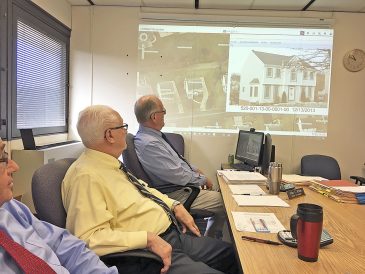
Andrew Martincic of North Strabane Township was traveling for his job when he learned of a letter, postmarked Aug. 24, advising Canon-McMillan School District was appealing his home’s assessment.
He described his reaction as “shock” as he showed up Thursday for the appeal hearing.
For the second time in the past few weeks, members of the Washington County Board of Property Assessment Appeals convened for a day of what are known as “reverse appeals.”
When owners of homes or businesses seek an assessment appeal hearing, it’s always to have an assessment lowered. School districts and municipalities can also file assessment appeals, but they seek to have the opposite effect: an increase in assessment.
Canon-McMillan School Board in July approved these types of appeals, seeking to increase the assessments on properties identified by parcel number, said attorney Susan Key, whose firm, Peacock Keller, has handled Canon-McMillan school district property appeals for years.
Key, who went to court in 2008 on behalf of the Washington and McGuffey school districts seeking Washington County’s first property assessment in nearly 35 years, prepared talking points Thursday that read, “Despite the reassessment, the district is aware that current sales of real property located within the district exceed the Washington County assessment of those same properties. Different municipalities within (the) county have properties that have appreciated in value more quickly than other municipalities within the county.
“As a result, those residents whose properties have increased in value over time in more affluent neighborhoods are underpaying taxes while owners of property that have decreased in value are overpaying.”
After exhausting their legal options, the county commissioners in 2013 hired Tyler Technologies Inc. of Moraine, Ohio, to perform a reassessment. The first round of appeals were scheduled three years later for municipal and county tax bills that went out at the beginning of 2017.
School districts, which operate on a different fiscal calendar, mailed tax bills based on property assessments to their residents in the summer of 2017 after adopting their 2017-18 budgets.
Thirty appeals – the majority for homes – were being handled Thursday by Key’s associate, Tom Steele, who also represented Canon-McMillan for a similar schedule in late August.
When Martincic talked to a lawyer, the attorney was already handling a court matter Thursday morning, so the homeowner took a day off work and represented himself.
“I don’t understand this whole process,” he told appeals board members John Rheel, Sonny Spossey and William West.
After house-hunting for a decade, he and his wife bought their home last December. The purchase price was $105,700 greater than the assessed value.
“If the market goes down, are they going to go the other way?” he asked after his hearing.
The board of assessment appeals takes five or more business days to issue its decision. The next option is to take the matter to court.
For another proceeding, Brian Bair, also of North Strabane, arrived with his real estate closing documents and was concerned he might have to pay back taxes to June 2017 on the $275,000 sale price of his house.
He was told the school district was seeking a higher value beginning with the 2019 tax year and that any increase would not be retroactive.
Conversely, when a property’s assessment is lowered, any taxes paid under the previous assessment must be refunded to the owner.
A list of frequently asked questions posted online by the Pennsylvania Association of School Business Officials claims “misunderstanding and opposition has risen over the use of assessment appeals by school districts” and asserts that taxing body assessment appeals are not “spot assessments.”
“This important right has existed since the 1930s, providing taxing authorities including school districts the same right as taxpayers to file appeals on properties that appear to be incorrectly assessed.”
It said neither a government, such as a school district, or a property owner “has the right to unilaterally determine an assessment outside of the tax appeal process. A taxing authority is expressly not an assessing authority.”
A 2017 state Supreme Court case, Valley Forge Towers Apartments v. Upper Merion School District, held that a school district’s practice of filing reverse appeals only against commercial properties would violate the Pennsylvania Constitution’s uniformity clause.
“We couldn’t just, say, go down to Southpointe and look at a large building that had recently sold and appeal it,” Key said.
Neighboring Peters Township School District is not currently appealing assessments on any residential properties, according to an email from its spokeswoman, Shelly Belcher.
Dr. Michael J. Lucas, superintendent of Trinity Area School District, which also borders Canon-McMillan, said, “We have discussed a district-initiated appeals process and plan to form a policy to present to the school board at an upcoming finance committee meeting.
“Other than during the countywide reassessment, we have not done district appeals.”