

WVU touts standing as a research institution
MORGANTOWN, W.Va. – When it comes to being among the nation’s great research universities, officials at West Virginia University are quick to promote “We R1.”
WVU has been classified as an R1, or “very high research,” university by the Carnegie Commission on Higher Education.
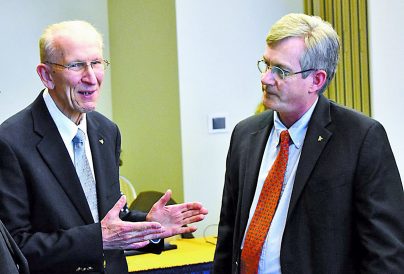
Fred King, WVU vice president of research, discussed this distinction during an Academic Media Day gathering Monday in Morgantown attended by media members from across the state.
The event took place at the WVU Erickson Alumni Center on the Evansdale campus.
The Carnegie Commission designates a research institution as either an “R1” or an “R2” institution based on a variety of factors. Among these are the number of doctorate-level educators on campus and the amount of funding spent on science, technology, engineering and math research and in other areas, King said.
As a land grant institution established in 1867, the purpose of WVU is to focus on humanities – or how human activity affects the environment, according to King.
While this definition might include anything from farming to drama, and music to writing a new novel, the definition of what education the university must provide has broadened over the last 152 years, he said.
Focus areas today include energy, water stewardship, STEM education, gravitational wave astrophysics, and addressing health needs in West Virginia and Appalachia.
Today the university offers more than 263 degree programs with an enrollment exceeding 30,000 students, King said.
More than 6,000 degrees are conferred each year, with 34 percent being either graduate or professional degrees.
Tenured track faculty number 920, and there are over 3,170 graduate students at WVU, he said. Payroll amounts to $89 million a year.
The university attracted $117 million in outside research dollars in fiscal year 2018, accounting for 87 percent of all external research dollars coming to West Virginia during the year, according to King. External research dollars pertain to funds provided by outside sources, including government research grants, money from foundations and private donations.
He said the R1 designation benefits WVU in a number of ways. At the top of the list, the classification enhances the institution’s profile – and it also helps the university to attract and retain high-quality students and faculty. In addition, WVU has access to additional private foundation opportunities and increased investment as a result.
There are seven states that don’t have an R1 university within their borders, King said. These include Alaska, Idaho, Maine, North Dakota, South Dakota, Vermont and Wyoming