

‘Father of Greene County’ remembered 223 years after county’s founding
C.R. Nelson/For the Observer-Reporter
C.R. Nelson/For the Observer-Reporter
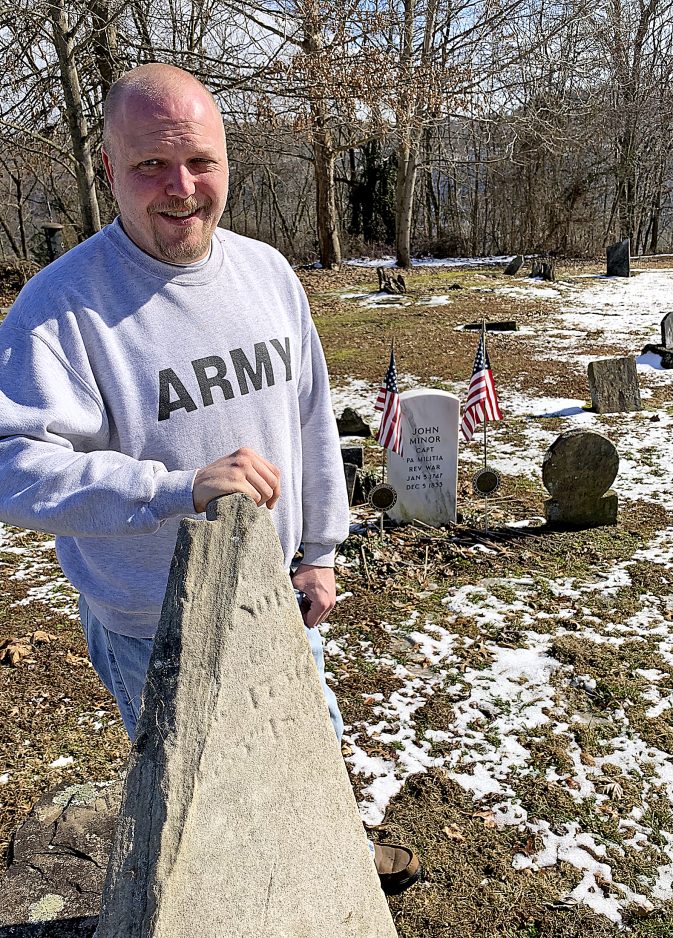
Matt Cumberledge, director of the Greene County Historical Society Museum, stands at the Old Greensboro Cemetery gravesite of John Minor, who is considered the Father of Greene County.
GREENSBORO – It’s a sunny February afternoon and the grave of Col. John Minor, tucked beside a yard on the corner of Third and County streets in Greensboro, is bright with American flags and a handsome new headstone.
Matt Cumberledge of Brave is all smiles. He helped get the stone – produced by the Department of Veterans Affairs – and is involved with the rehabilitation of this historic site while also bringing his passion for the past to his new job as director of the Greene County Historical Society Museum.
“I’m related to John Minor through his sister Sarah,” he said.
This old graveyard goes back to those days when settlers along the Monongahela River lived in log cabins and faced the threat of ambush nearly every day. When Minor was buried here in 1833, he was “86 and then some,” Cumberledge said. While his headstone states he was born in 1747, some reports indicate that Minor may have been born as early as 1744.
It takes the energy of young men to make history like this happen, history that comes alive when reading the scraps of local lore and legal documentation that tell how Minor became “the father of Greene County.” Minor was commissioned an officer in the Virginia militia when he arrived here in 1764, just three years before the Mason-Dixon Line was cut to separate the colonies of Virginia from Penn’s Woods.
He came from Loudoun County in Virginia, crossed through Redstone Fort of what is now Brownsville and made a “tomahawk improvement” on hundreds of acres of wilderness around Whiteley Creek near Mapletown. He then made a separate claim for older brother William and another for good friend Zachariah Gapen. According to historian L.K. Evans, Minor built a “snug cabin” on Whiteley Creek and in subsequent trips to Virginia and Maryland, and he eventually returned with brother William and his family along with mill equipment to build the “first flouring mill west of the Monongahela River.
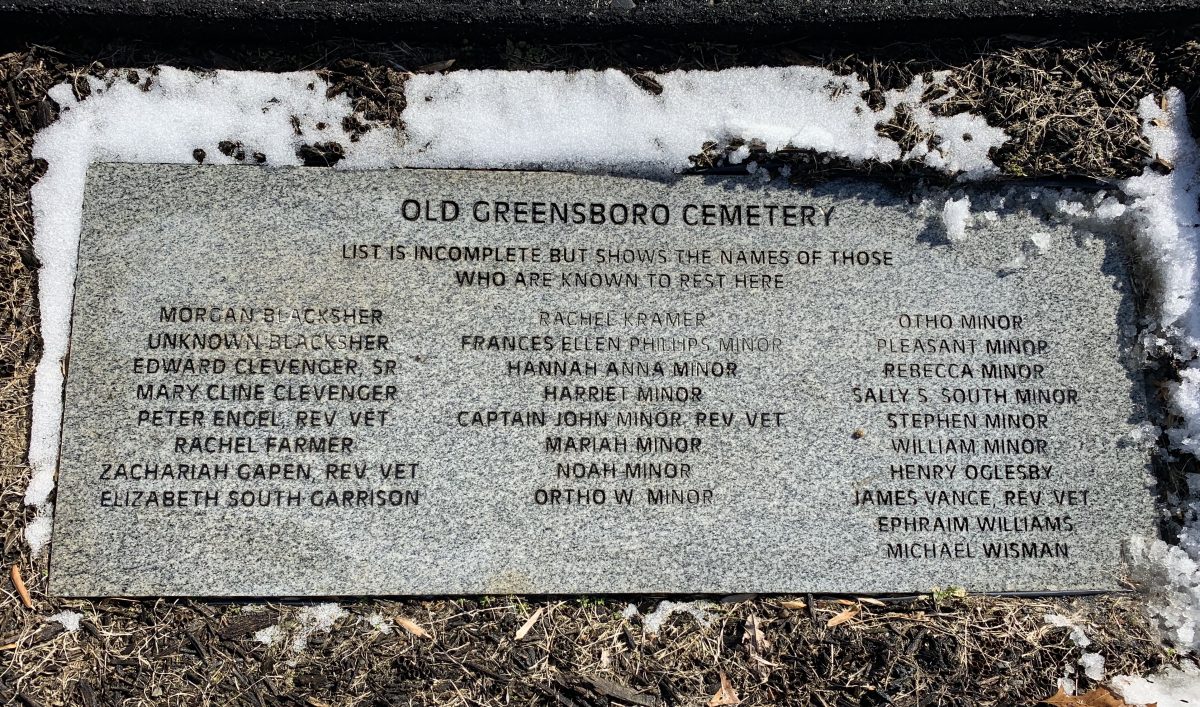
A list of the some of the people buried at the Old Greensboro Cemetery, including Col. John Minor.
He and William also built docks and a boat yard at the mouth of Dunkard Creek on the Monongahela River and began doing business. Tensions had spilled over between the French and British over land claims; displaced native tribes were recruited into this guerrilla war and Minor’s cabin became the neighborhood fortress. Evans wrote that Minor kept a conch shell to sound warnings of attacks and led militias of local frontiersmen to pursue raiding parties.
His first wife, Christina Williams, died in childbirth in 1772 while Minor was building his flour mill. He married Christina’s cousin, Cassandra, in 1776 and Evans recounted that the family, with first-born son Otho “in a sugar trough, the crude cradle of the primitive life” returned to Whiteley Creek as the War for Independence spread to the frontier in 1776.
When the first shots of the revolution were fired in the “Massachusetts Bay Colony” in April 1775, it took less than a month for the settlers in Pennsylvania and Virginia to join the resistance. Minor became a captain under Col. Zachariah Morgan in 1777 and was put in charge of Statlers Fort near Blacksville and Garards Fort on Whiteley Creek. Later he would become a colonel under Morgan – by then a newly minted general – and began enlisting men, overseeing supplies and pursuing raiding parties coming in from the Ohio Territory.
Descendent Tom Miller writes that Minor is also credited with being the boat builder for Gen. George Rogers Clark’s expedition of 1778 that took a 10-boat flotilla of 150 militia and more than a dozen settler families into “Illinois country” near present-day Lexington, Ky., to expel the British. Clark captured three outposts but the British, led by Detroit Gov. Henry Hamilton, marched south to reclaim one fort. Clark returned in December to capture Hamilton “the notorious Hair Buyer,” which was “highly significant in the final accord relinquishing that land to the United States at the end of the Revolutionary War.”
When Minor became justice of the peace in Cumberland Township in 1781, Washington County was mostly unsettled land and roads were little more than bridle paths. In 1784, David Rittenhouse and Andrew Ellicott finished the last 31 miles of the line that Mason and Dixon had taken as far as Brown’s Hill near Mt. Morris and in 1786 Ellicott returned to survey the western line to Lake Erie. Now it was official: the border of Pennsylvania was identified forever “by the places of the stars in the heavens.” But that was little comfort to John Minor and his neighbors who had to make the long hazardous trek to the county seat at Catfish Camp, also known as the town of Washington, to do business.
Historians agree that settlers on the Western Frontier got pretty wound up about the 1791 Federal excise tax of “four pence per gallon on all distilled liquors” promoted by President George Washington’s Treasury Secretary Alexander Hamilton to repay America’s Revolutionary war debts. This was America’s first tax on domestic goods, payable in cash only.
The frontier was cash poor and most business was still done by barter. Farmers were hemmed in – the Ohio Territory was held by indigenous tribes and Spain controlled the Mississippi River. The newly formed federal government provided scant infrastructure or military protection and worse, the law had a loophole that allowed larger distilleries – mostly in the more settled in the East – to pay a lower flat tax on the whiskey they produced.
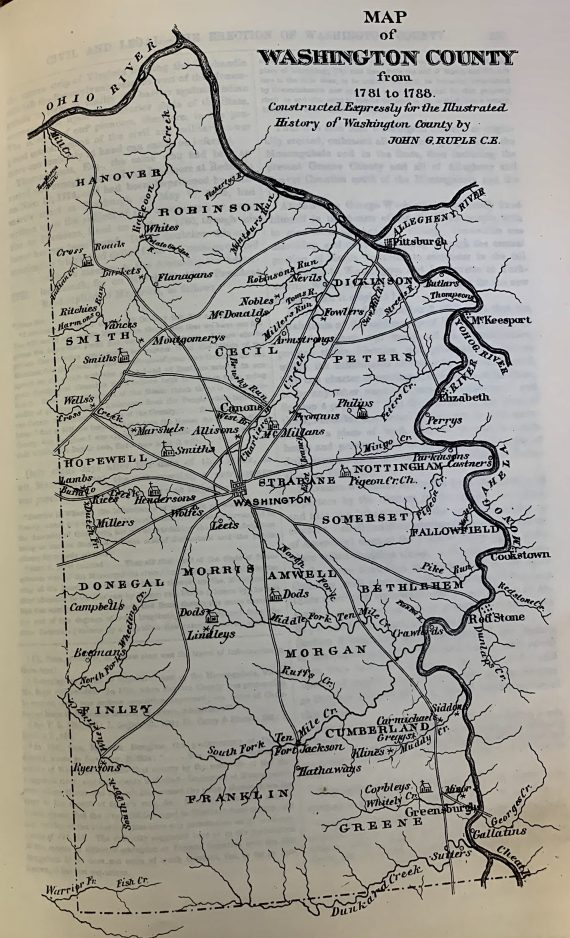
A map of Washington County in 1788.
Sensing the beginning of governance that favored the rich, farmers large and small refused to pay and the rebellion was on. Minor, now a member of the Pennsylvania Legislature representing Washington County, warned against the revolt, as did his neighbor Albert Gallatin, who would later go on to become secretary of the Treasury. A battle tested frontier businessman turned politician, Minor seemed to know there was a better cause worth fighting for. After winning his seat in 1791, he had immediately “commenced to agitate the forming of a new county” that would better serve him and his neighbors.
In the Minor files at Cornerstone Genealogy Society in Waynesburg, some written family history suggests “fake news” isn’t new at all – Minor lost his seat in 1792 thanks to a rumor that he considered “all Germans Tories.” When the rumor was recanted, he won in 1793 and “redoubled his efforts” to secede from Washington County.
The Whiskey Rebellion ended in 1794, when Washington mustered an army of 13,000 soldiers to scare the “Whiskey Boys” into obeying federal law. Rebellion leaders were suddenly hard to find so troops raided houses and 20 men, including passionate protesters like the Rev. John Corbly of Garards Fort, were marched to Philadelphia and tried in federal court. Minor, it is said, went to Philadelphia to testify for his friend Corbly.
Most were freed due to lack of evidence but two were sentenced to hang for treason. The only two men who were convicted were later pardoned by Washington, which earned him and his new government the grudging respect of local farmers. But the lines were drawn in politics that still stand to this day – an uneasy balance of power between states’ rights – including that of the people to petition and have their voices heard – and a strong central government that serves the nation as a whole.
Two politically charged years later, on Feb. 9, 1796, Minor’s petition was finally approved to create Greene County, and those hardy veterans who had helped birth a nation named their new county after Gen. Nathanael Greene. Their freshly surveyed county seat was named Waynesburg after “Mad Anthony” Wayne, who had just defeated the tribes in the Ohio Territory at the Battle of Fallen Timber.
Back at the Greene County Historical Museum near Waynesburg, Cumberledge is busy five days a week getting ready for a new season of historical exhibits, busy sorting through hundreds of years of artifacts – thousands of years if the tools and pottery of the indigenous people who once lived and hunted here are counted.
His plans include giving the Father of Greene County his own exhibit this year. Minor’s old stone that was replaced has already been taken to the museum and his written records are being put in order, the new director is happy to announce. Cumberledge is looking for any family history or artifacts that can be shared with the museum.
“My research into the life and times of John Minor is ongoing,” Cumberledge said. “There’s a lot of information recorded on him in local histories, but I think there’s more out there.”