

Where would George Washington have been without Casimir Pulaski?
Barbara S. Miller/Observer-Reporter
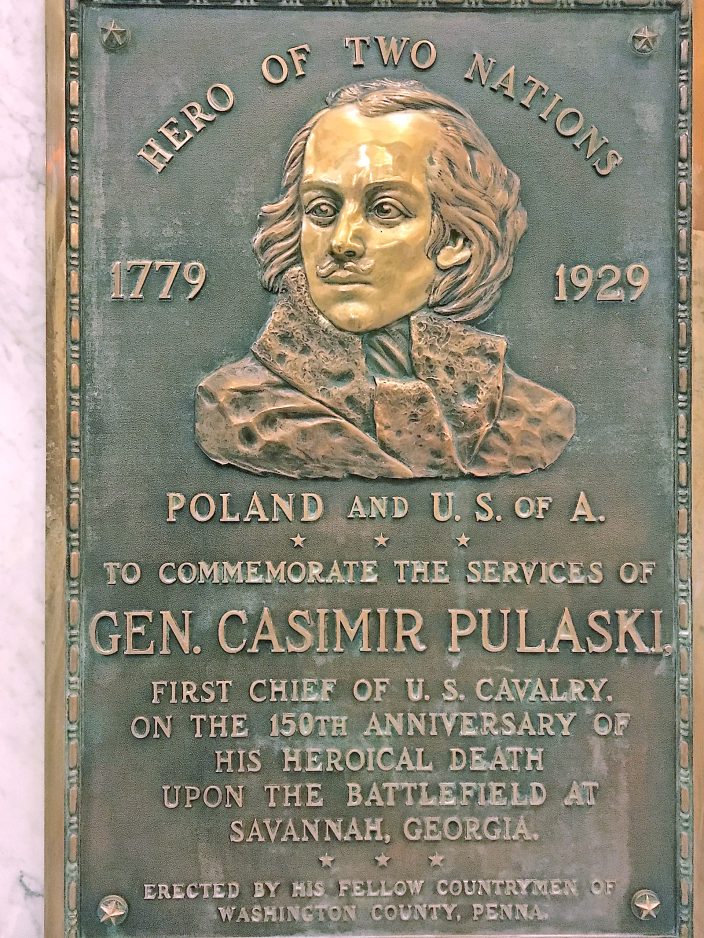
This plaque honoring Gen. Casimir Pulaski is on the wall between the offices of the prothonotary and register of wills in the Washington County Courthouse.
Celeste Van Kirk/Observer-Reporter
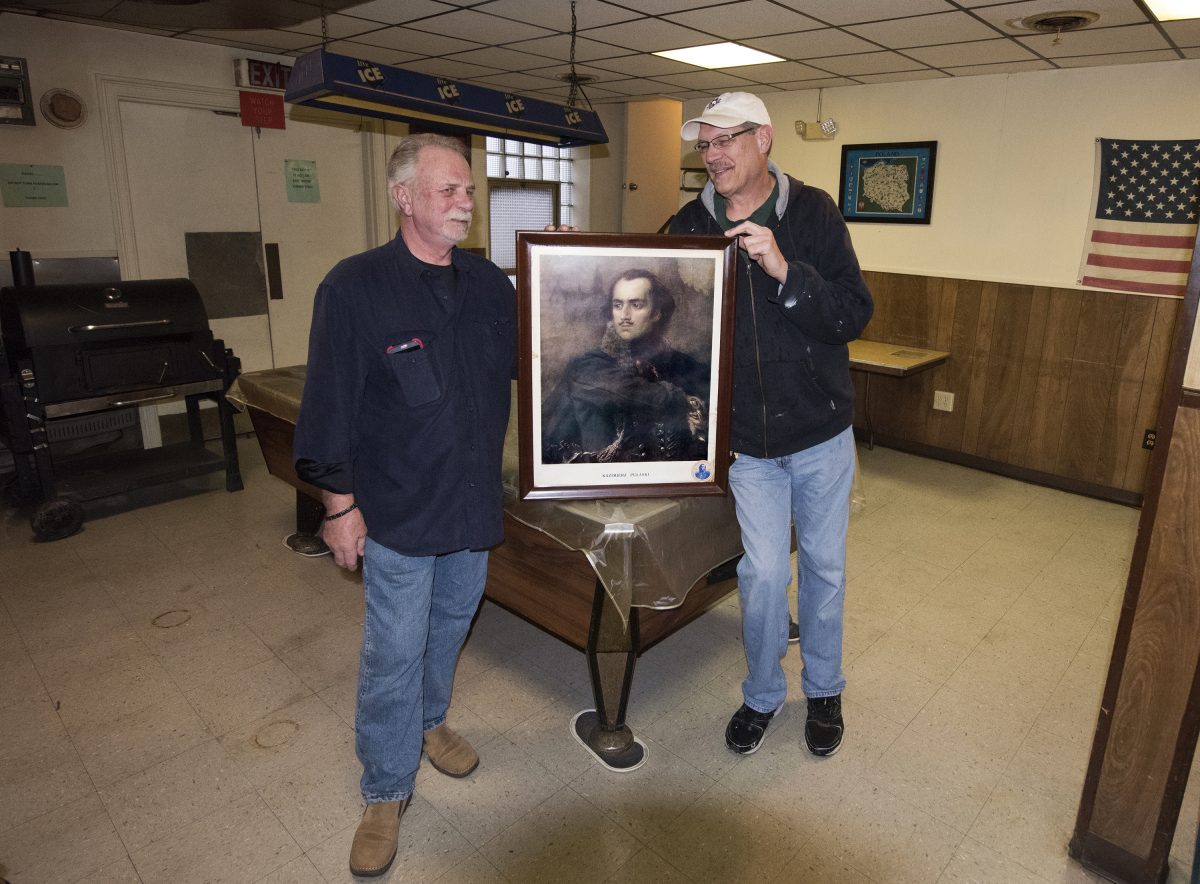
Gary Karluk, left, and Jim Koziel hold a portrait of Casimir Pulaski at the club bearing his name in Washington.
Celeste Van Kirk/Observer-Reporter
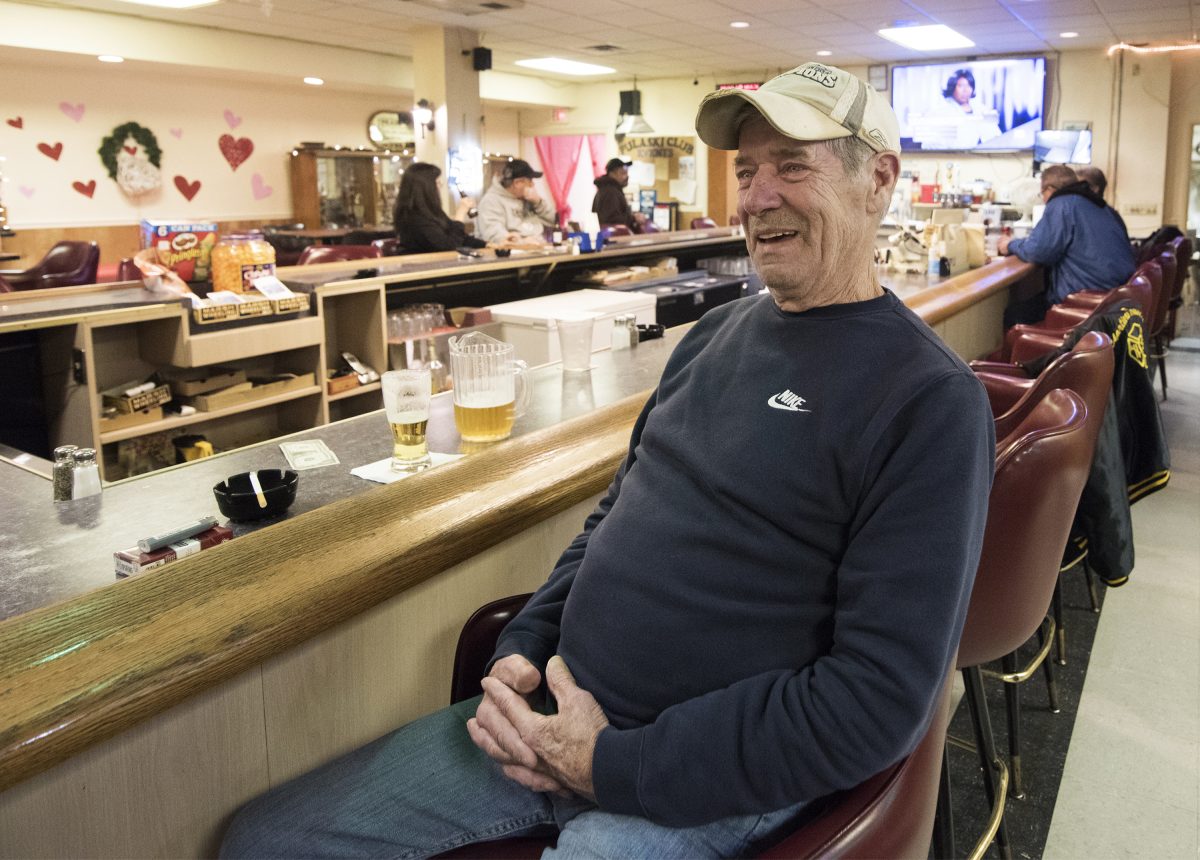
Jack Frazier of Washington is a longtime member of the Pulaski Club.
Yes, it’s Presidents Day, and no, Casimir Pulaski was never president of the United States.
But had it not been for Pulaski, George Washington may not have survived to become the father of his country.
Here’s the story of how two lives intersected, according to a joint resolution of Congress that posthumously proclaimed Pulaski to be an honorary citizen of the United States.
None other than Benjamin Franklin, on a diplomatic mission to Paris, recommended that Gen. George Washington accept Pulaski as a volunteer in the American cavalry, saying the Pole was “renowned throughout Europe for the courage and bravery he displayed in defense of his country’s freedom.”
Arriving in America, Pulaski wrote to Washington, “I came here, where freedom is being defended, to serve it, and to live or die for it.”
His words proved to be prophetic.
Congress noted in its resolution that Pulaski’s first military encounter with the British took place on Sept. 11, 1777, at the Battle of Brandywine as the Redcoats were on the march to capture Philadelphia, at that time the capital of the fledgling United States.
Public Law 94 of the 111th Congress states Pulaski “and his courageous charge in this engagement averted a disastrous defeat of the American Cavalry and saved the life of George Washington.”
Fleshing this out, a Facebook author who goes by Crazy Polish Guy in a 2016 article about Pulaski and the Battle of Brandywine, wrote that the soldier “and his cavalry played a significant role in distracting the British Army, while Washington escaped with his army.
“Had it not been for Pulaski’s cavalry charge at this crucial moment, the American army might have been utterly destroyed and Washington might have been captured or even killed.
“Therefore, it’s not an exaggeration to claim that Pulaski played a necessary role in the United States developing as it did.”
Among those wounded at Brandywine was another European, a young French general, Marie Joseph Paul Yves Roche Gilbert du Motier, more commonly known as Marquis de Lafayette.
Four days after the Battle of Brandywine – also known as the Battle of the Clouds because of heavy fog – Pulaski was named brigadier general of the American cavalry.
The British went on to capture Philadelphia, and the Continental Congress decamped to Lancaster for a single day, and then to York.
A year and a half later, the Pulaski Cavalry Legion ejected British occupiers from Charleston, S.C., and in 1779, Pulaski mounted an assault against British forces in Savannah, Ga.
On the morning of Oct. 9, 1779, Pulaski was mortally wounded and was taken aboard an American ship, USS Wasp, where he died two days later at age 34. He was buried at sea, but Congress, shortly after his death, resolved that a monument should be built in his honor. The Congressional resolution places Gen. Lafayette at the cornerstone-laying ceremony for the structure in Savannah in 1825.
In 1929, Congress recognized Oct. 11 of each year as Pulaski Day in the United States.
Philadelphia is the site of an annual Pulaski Day parade in honor of the Polish nobleman’s birthday each October.
In Chicago, Pulaski Day is observed on the first Monday of March, when schools and Cook County government close to honor the date of the freedom fighter’s birth.
To mark the 150th anniversary of Pulaski’s death, Polish-Americans of Washington County placed a plaque near the South Main Street entrance of Washington County Courthouse in 1929.
His legacy also lives on two miles away from the courthouse at the Pulaski Club in Washington’s Tylerdale neighborhood.
Founded in 1928, the club has had several locations, and since the 1950s, it has been on Summerlea Avenue.
Gary Karluk, 70, and Jim Koziel, 68, are the only current officers descended from charter members.
Karluk, who remembers visiting the premises with his grandfather, Adolph, said of the Polish-Americans and the origins of the club, “They were hard workers. They drank the hard stuff and smoked and the women were always running them out of the house.”
Those trying to discern this or other details from Pulaski Club records might need a translator.
“The minutes of the club, I can’t read ’em,” Karluk said. “They’re all in Polish.”
An English-language document from the commonwealth of Pennsylvania registered the Pulaski Literary and Athletic Association on Jan. 9, 1933.
Koziel’s roots in the club go back to Steve “Stitch” Wiencek, who served as the club’s bartender and president and held other offices. Koziel moved back to the area from Florida and got involved in the club.
“It’s been 20 years now,” he said.
Jack Frazier of Washington, who was having a beer at the club during the first week of February, said he has fished in Pulaski, N.Y., where he’s caught a lot of salmon.
The National Park Service notes, “In the United States, numerous streets, bridges, counties, and towns are named for him in honor of his aid to American forces.”
Frazier has been a member of the Pulaski Club since 1970, but asked if he was familiar with its Polish noble namesake, he replied, “Honestly, no. I know the name. I’m Scotch-Irish.”
The Pulaski Club offers “great friendship and relationship with the people down here forever,” Frazier said.
Although there is a national organization of Pulaski clubs, the one in Washington is unaffiliated.
“We are holding our own,” Karluk said. “We’re not setting the world on fire, but we’re still paying the bills.”