

TRPIL premieres mental health first aid training

Carol Jones remembers her daughter as an activist. She once organized a boycott against Styrofoam, getting her classmates to bring their own utensils and plates to and from school. And in high school, she served as vice president for Students Against Drunk Driving.
But everything changed her senior year, when Jones’s family lost four close relatives in the span of just one month.
Jones’s daughter started behaving erratically. One day, she borrowed her mother’s car and returned it with all of its windows smashed. She didn’t remember where she had been.
Shortly after graduating high school, she was diagnosed with bipolar schizophrenia. Over the years, psychiatrists tried to help Jones’s daughter. But to Jones, they just offered the refrain of advice: “Make sure she takes her meds.”
Jones said it took her two years to learn how to talk to her daughter, who passed away in July from a heart condition. She wishes she would have been given more guidance.
“Oh dear Lord, I wish. There was so much I lost with her,” said Jones, a quality assurance specialist at Transitional Paths to Independent Living, a Washington advocacy group for people with disabilities.
Now, as an instructor with TRPIL’s new Mental Health First Aid training, Jones has the chance to give people an understanding of mental illness that she wishes she would have had when her daughter was diagnosed.
With a $50,000 grant from the Staunton Farm Foundation of Pittsburgh, TRPIL started offering the training in November to equip its staff and community members with the knowledge and skills to assist people through mental health and substance abuse crises.
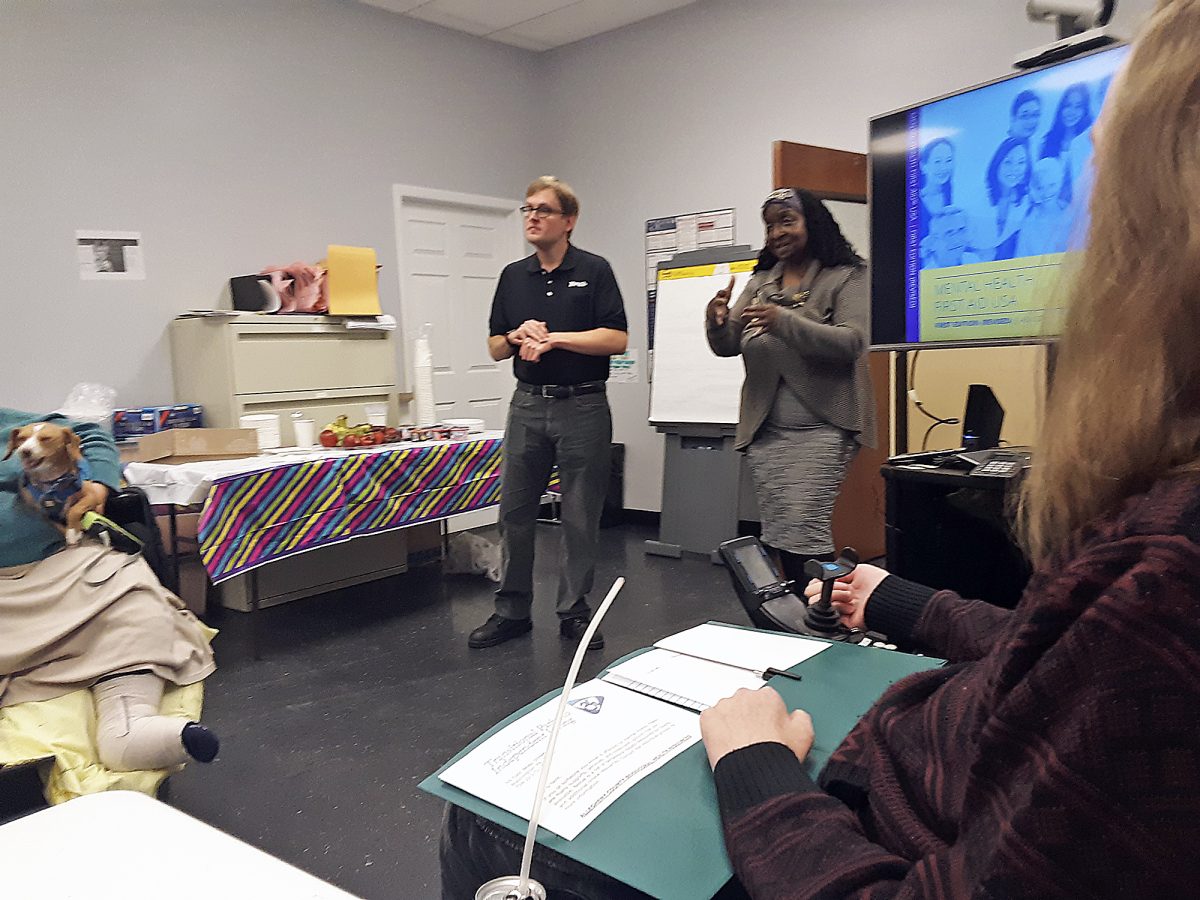
Photo courtesy of TRPIL
Photo courtesy of TRPIL
Carol Jones and TRPIL staff member Isaac Perry teach a mental health first aid session.
Since 1999, suicide rates have been rising across nearly every state and demographic group, according to the Centers for Disease Control and Prevention. Washington County isn’t exempt from this epidemic: Last year, 28 people died by suicide, according to a TRPIL press release. In addition, 54 people died by drug overdose.
Jones hopes that the training combats these grim statistics.
“If we lose one less person to suicide or drug overdose next year, it would be worth it,” she said.
So far, TRPIL has hosted four training sessions and has one more planned in January. Through informative videos and guided discussion, the instructors walk participants through various mental illness diagnoses – including bipolar disorder and schizophrenia – and types of substance abuse. Participants also act out scenarios to practice helping someone in crisis.
Janet Caldwell, who also works as a TRPIL quality assurance specialist, is one of 30 staff members who has received the training so far. She urges community members to sign up for the training, which she said taught her to recognize signs that someone might be suffering from a mental illness.
“You become more attuned with others’ behavior,” she said. “You start to pick up on and recognize symptoms immediately.”
Caldwell added that the training helped her view those with mental illness and substance use disorder with more empathy.
This is precisely what Jones hopes to do as an instructor: break down the stigma that surrounds these conditions.
“Those little walls and barriers, you chip away at them until they’re not there,” she said.
TRPIL will hold its training sessions Jan. 17 and 18. To register, email Jones at cjones@trpil.com.