

Mingo park terrain hampers 911 contact, fall victim learned firsthand
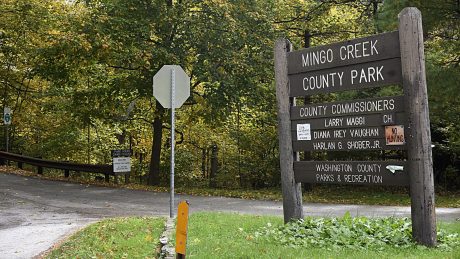
A walk in the park turned out to be anything but for Diane DiSalle, whose morning exercise with her family dogs ended abruptly when she suffered a broken leg.
Compounding the problem was difficulty in reaching 911 to summon an ambulance to Mingo Creek County Park.
As visitors to the park have undoubtedly noticed, the picturesque stream cuts through a valley at the base of wooded hillsides. What they may not realize is that this type of terrain often disrupts the signal required to communicate via a cellular phone.
The leg of DiSalle, 63, twisted the morning of Oct. 24, resulted in a stress fracture while she was walking canines Nina and Chester, both adopted from the Washington Area Humane Society.
“We came out to the main road that parallels the creek,” she said this week. “I just hit a little bit of the uneven concrete.”
DiSalle, a nurse, immediately knew her femur was broken, and, from the spot where she landed on the park’s main road, she tried to call 911.
But her phone had no signal.
She placed a second call to her husband, Washington County Judge John DiSalle, and was able to leave a message.
“He may’ve been on the bench,” she said, so she tried 911 again and then, a neighbor, but with no luck.
With her dogs sitting on the road, a motorist she recalls as Mr. Kennedy came to her aid. As the minutes ticked by, a call eventually reached 911 and an ambulance was dispatched to the park. Her husband called back and, with a sheriff’s captain, he was able to retrieve the dogs, whom Kennedy had taken to DiSalle’s truck, and the vehicle, itself, on that cool but partly sunny morning.
Diane DiSalle is continuing with physical therapy, and she acknowledged her injury was not life-threatening. But she questioned what the outcome might have been in a situation that was much more serious.
Washington County Commissioner Diana Irey Vaughan learned of DiSalle’s plight afterward and asked her if she needed any help.
DiSalle said her response was: “A cell tower out at Mingo.”
But as Washington County Public Safety Director Jeff Yates explained Friday, the solution is complex, and it comes down to a market-driven cost-benefit analysis because cell towers are built by private enterprise.
“We have no control over where any cell carrier puts their tower or coverage,” Yates said. “They make their decisions based on business.
“This is a cell carrier issue. This is not a 911 issue.
“There are dead spots with cell coverage anywhere,” Yates said, estimating that installing a tower can cost a million dollars.
Scott Fergus, Washington County director of administration, said the county requested proposals a year or two ago to improve communications at Mingo, but the response was that a tower requires the participation of service providers who are willing to install their equipment on the structure.
There’s no tower in the park, but one was constructed nearby on Lanik Road, Yates said.
Lisa Cessna, Washington County’s director of planning, whose department oversees county parks, said federal and state money was used to purchase land for parks in the 1960s through the 1980s under restrictive covenants that reserved the area for recreational purposes only.
Installation of a cell tower on park land could require the county to either add land to make up for the commercial installation or conduct a survey and appraisal to reimburse the governmental entities.
Jeff Donahue, the county’s superintendent of recreation, said phone reception often improves after leaves have fallen from trees, which retained their foliage rather late last fall.
Washington County Sheriff Samuel Romano, whose deputies patrol county parks, suggested that pedestrians walk in Mingo park with a buddy so that, in case of an emergency, one person is able to seek help, perhaps on higher ground.
“A lot of times my guys will say they have to drive up a hill to get service for the radios. When it’s hilly, it really is hard,” the sheriff said.