

Missing Mon Valley WWII airman’s remains discovered at Germany crash site
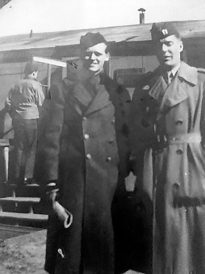
U.S. Army Air Forces Sgt. Vernon L. Hamilton of Monongahela was serving as a gunner during World War II aboard a light bomber plane when it fell out of formation and turned over above Germany.
Witnesses in the 409th Bombardment Group watched it nosedive, but they never saw it crash March 21, 1945, on a farm in Hülsten-Reken, said Jeannette Gray, a mortuary affairs officer with the Department of the Army Casualty Branch.
“It was pretty rough on the family,” Gray said Thursday when her division announced in a news release that the remains of Hamilton, 19, were found in 2016 and later positively identified.
“It created a lot of heartache,” she said.
Hamilton enlisted in the Army in 1943 and was considered missing in action until the military sent a letter in April 1945 to his mother, Dorothy, notifying her that her son was presumed to be dead, said Terry Necciai, a historian in Monongahela.
“They were worried about where he was for quite a while,” Necciai said.
“In the eyes of the family, the government had given up on him, quit looking for him,” Gray added.
Hamilton has one surviving sister in the state of California, who did not consent to having her contact information listed on the news release, Gray said.
The sister was about 7 years old when her brother died, yet her mother kept insisting that he was coming home.
She said in an interview with Gray that the family’s apartment in the 400 block of West Main Street stood above a bus stop “where soldiers were coming and going.”
The surviving sister said she often stood in the window facing the street to see if her brother would exit one of the buses.
Dorothy Hamilton, whose husband died about the same time as her son, never locked the door to her apartment at night in case Vernon came home when everyone was asleep, Gray said.
Vernon Hamilton was participating in an interdiction campaign to obstruct German troop movements in advance of the Allied crossing of the Rhine River two days later. He died almost instantly when his plane crashed after the bomber was struck by enemy anti-aircraft fire, Gray said.
After the war, the American Graves Registration Command searched extensively for the crash site without finding Hamilton’s A-26B aircraft.
The scenario that his mother believed was that he “was hurt and doesn’t know who he is,” Gray said.
A researcher who has collaborated with other such search efforts discovered the crash site in June 2016. The plane had been heavily scavenged by Germans over many years, but the data plate was discovered in the buried wreckage, making it easier to link to Hamilton.
Investigators also used DNA samples to make positive identifications of Hamilton and two of his crewmates, Gray said.
Hamilton will be given a full military funeral, both at the airport when his remains arrive in Pittsburgh and beside his gravesite in Monongahela Cemetery, possibly in April.
Gray said the plan is to bury Hamilton above his mother.