

Coroner’s office: It can be a challenge finding next-of-kin

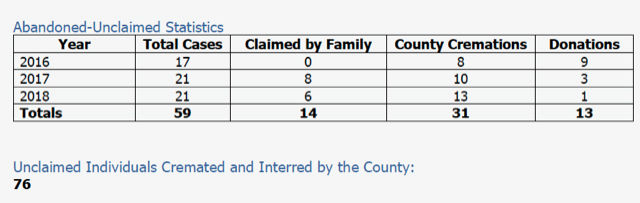
At the request of Coroner Timothy Warco, Washington County Commissioners have entered into an agreement with a database provider to help track down next-of-kin to people who have died.
Under the agreement, Trans Union Risk and Alternative Data Solutions Inc. of Boca Raton, Fla., will allow the coroner’s office to have access to its informational database at a cost of $75 per month from Dec. 1 through Nov. 30, 2021.
By law, the coroner is responsible for notifying family members of a death. The county takes responsibility if a family cannot be contacted or declines to claim the body.
“So far in 2019, we have 15 cases which were initially unclaimed. Of those, to date, nine remain unclaimed and became county cremations or inurnments,” wrote Matt Yancosek, chief deputy coroner in an email response to a request for information.
“That leaves six successfully resolved cases where family has chosen funeral homes.”
Yancosek said family members could not be located in the other nine deaths.
“There are many cases where we identify and notify family members and they still choose to do nothing either due to poor relationships or financial constraints, or a mixture of both,” Yancosek wrote.
“Additionally, there are a number of cases each month where identifying family is challenging. People don’t always die at home with friends and family. Highway accidents and deaths in hospitals or other public places top that list.”
The coroner’s office considers notification of next-of-kin “one of the most important things we do and we do our best to do it as quickly as possible, in person, unless that is absolutely impossible,” Yancosek wrote.
Husbands, wives, adult children or parents are those the coroner tries to contact whenever possible. If these relatives are unavailable, the next priority would be cousins, friends, aunts and uncles.
He also noted the number of natural gas and oil industry workers staying at hotels in the region, and hotel desk clerk don’t routinely ask for emergency contact information.
An individual’s employer, however, can typically help with those cases.
Even a death that occurs in a hospital can lack emergency contact information, particularly if no one accompanies a patient who arrives at the emergency room and the patient is unable to speak or communicate with hospital staff prior to death.
Emergency contact information in wallets, phones or vehicles can be helpful, but contacts in a phone can’t necessarily be accessed.
Hospital social services departments can be of help, or the coroner’s office will make calls to the district attorney’s office, adult probation department or county jail.
“In some cases, police departments have arrest records, but those leads don’t always pan out and often that information is several years old,” Yancosek wrote.
After exhausting these sources, the coroner’s office runs a notice in the Observer-Reporter, which is limited to those who are reading the newspaper or are specifically searching for a decedent by name.
“And of course, we have those cases where someone has simply outlived the remainder of his or her family,” Yancosek wrote.
The database, he said, “will give us a number of additional resources and insights to ensure that we do everything we can to locate the appropriate family member and make contact with them.”
The county has a total of 76 cremated remains dating back to 1979, plus the nine from this year.
The 40 from 2016-19 shows the trend. In 85 county cremations over 40 years, 40 came over the past four years.
In April 2017, Warco also came to the commissioners for help in solving a similar problem when it had become more common in Washington County that no one was stepping forward to bury a friend or relative. Two years ago, he sought a time limit of not more than 15 days to cremate a body.
Coroner’s Solicitor Stephen Toprani said at the time Warco told him in his first year or two as coroner in the 1980s, there may have been one unclaimed body, but the number has been increasing.
Statutes actually use the term “interment,” not cremation, in dealing with unclaimed bodies. In the case of an unclaimed body because of homicide, burial rather than cremation would be part of the protocol because of a possible exhumation.
The county code allows $300 per cremation.