

Local PennDOT district saw continued increases in overall and serious crashes in 2018
Being safe on the road last year was tougher than usual across Fayette, Greene, Washington and Westmoreland counties.
In 2018, the highest number of crashes occurred across those areas since at least 2009, according to recently released Pennsylvania Department of Transportation data.
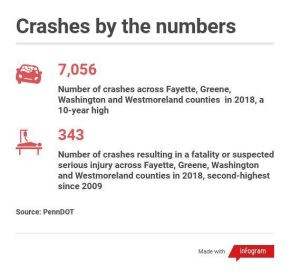
PennDOT District 12, which is comprised of those four counties, was the site of 7,056 crashes in 2018, a 4% increase from 2017. Fayette County was the site of 1,247 of those crashes and was the only one of District 12’s four counties in which crashes dropped from 2017 to 2018, albeit by only two.
Statewide, crashes rose by just 0.01% to 128,442, the second-highest number over the last 10 years, behind only its 2016 total.
The most serious crashes across the four-county area increased last year as well.
Crashes resulting in a fatality or suspected serious injury rose 1.5% to 343 for the district’s second-highest total in that category since at least 2009. Fayette County was again the only one of the district’s four counties where such crashes decreased (from 66 to 64).
Jay Ofsanik, safety press officer, said that motorists exercise more caution in adverse winter conditions than they do under sunny skies, meaning that mild winters can yield a greater number of crashes because drivers aren’t being as cautious.
“I don’t think people fear rain like they do snow,” Ofsanik said.
There was a lot of rain to drive through in 2018, the area’s wettest year on record, according to the National Weather Service.
There were 56 crashes resulting in a fatality or suspected serious injury in 2018 that took place on wet road surfaces, a 12% uptick from the previous year and the highest total within the 10-year stretch for which data is provided by PennDOT’s online custom query tool.
Last year also marked a 10-year high in heavy truck-related crashes across the counties. There were 521 such crashes throughout Fayette, Greene, Washington and Westmoreland counties in 2018, a 12.3% increase from 2017.
Ofsanik acknowledged that because there are more heavy trucks on local roads, there’s likely to be more crashes involving them.
But the crashes causing a fatality or suspected serious injury that involved a heavy truck dropped 34% last year, from 41 to 27.
Speeding-related crashes, in which at least one driver was speeding, driving too fast for conditions or was involved in a police chase, jumped 15.5% in the area from 2017 to 2018, although not eclipsing any of the district’s totals from 2008 through 2013, signifying a long-term decrease in such incidents.
Trending the other way are drug-related crashes, which despite dropping from 273 in 2017 across District 12 to 246 in 2018 still remained way above totals from earlier in the decade, as such crashes never exceeded 177 in the district before 2015.
District 12’s climb in drug-related crashes has come amid an opioid crisis striking both locally and nationwide. Drug-related crashes statewide declined 15.2% from 2017 to 2018 but remained well above totals from earlier in the decade. PennDOT defines drug-related crashes as indicating a driver, pedestrian or bicyclist had a drug use condition or was suspected of drug use by police, including both prescription and illegal drugs.
“If there’s a drug crisis, along with it there’s going to be an impaired driving crisis,” Ofsanik said, noting that impairment comes from not just bar drinks but use of other substances.
Continuing without any clear trends up or down over the past decade in the area have been crashes resulting in a fatality or suspected serious injury in which any person in a vehicle was not wearing a seat belt. There were 129 such crashes in District 12 in 2018, down two from the previous year.
Overall crashes in which any person in a vehicle was not wearing a seat belt have declined over time, though, hitting their second-lowest total of the last decade in 2018 at 860, with the biggest decrease coming in Fayette County.
Ofsanik noted that otherwise safe motorists who don’t wear a seat belt need to protect themselves against negligence of other drivers that could impact them at any moment.
“If you change your behavior a little bit, it makes a big difference,” Ofsanik said.