

Scary twist in former trooper’s day ends with heartfelt thank you
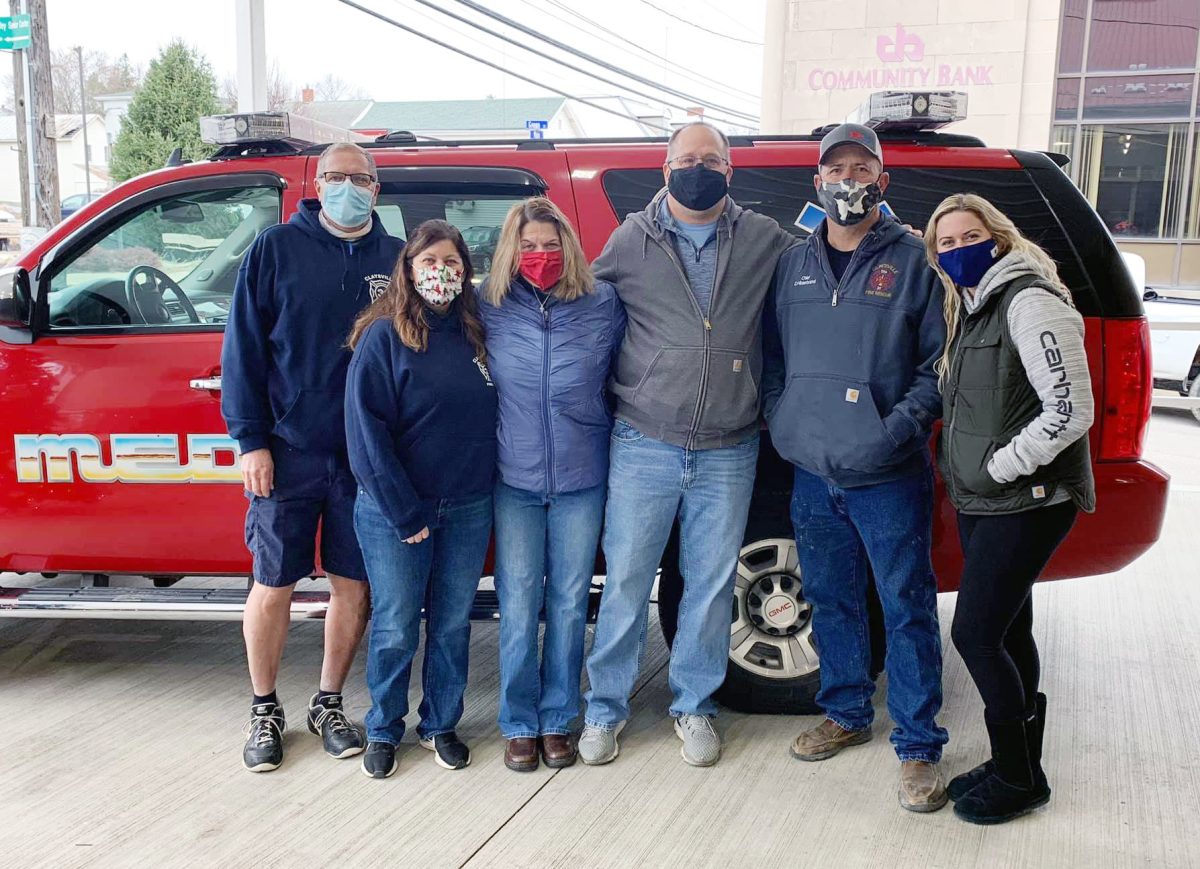
Photo courtesy of Claysville Volunteer Fire Department
From left, Randy DeGarmo, Carol Hilderbrand, Amy Demi, Jon Demi, Dave Hilderbrand and Courtney Hilderbrand pose for a photo Sunday in front of the Claysville Fire Department’s medical truck. The fire department responded to Demi’s home last week, when Jon Demi suffered a severe heart condition.
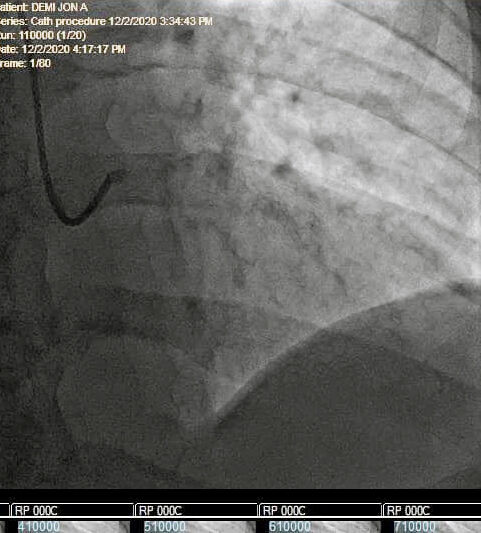
Photo courtesy of Jon Demi
A medical image shows the “before” picture of Jon Demi’s twisted artery that caused a heart attack last week.
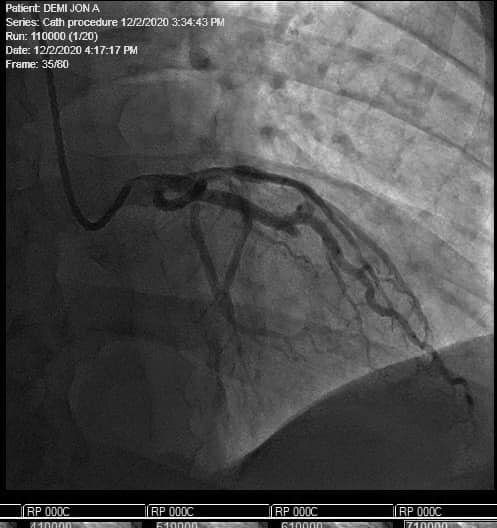
Photo courtesy of Jon Demi
This medical “after” image shows what Jon Demi’s artery looked like after a Washington Hospital cardiologist untwisted it last week.
Last week, while jogging on a treadmill, Jon Demi of Claysville started to feel chest pain.
He suspected it was a heart attack, and he would know. Not only does his family have a lengthy history of heart problems, but he was a state trooper for 20 years and familiar with the signs.
It was 6:30 a.m. Dec. 2 when he woke his wife, Amy, and told her to call 911.
“I said, ‘I think I’m having a heart attack. You better call 911,'” Demi said in a recent interview. “She’s always been concerned because there’s a real bad heart history on my mom’s side. My mom was the same age as I am when she had a quadruple bypass.”
Demi, who retired eight years ago, will celebrate his 52nd birthday this month, thanks, in part, to the folks who responded to his home that day and the doctors at Washington Hospital.
“The planets just lined up for me that day,” he said.
When Claysville volunteer firefighters were dispatched to Demi’s address, they knew exactly whose home it was.
“We’ve known Jon and his wife for a long time,” fire Chief Dave Hilderbrand said. “Me and Jon have been on a lot of calls together. When you’re in a small community like ours and do what we do, 75 to 80% of the time, we know the people whose house we’re going to. Sometimes it’s more difficult if you know the person, but you just go and do what you were trained to do.”
When Dave, his wife, Lt. Carol Hilderbrand, and their daughter, Capt. Courtney Hilderbrand, responded to Demi’s home, he knew he was in good hands.
“I knew that if my wife called 911, I was very confident that if anything needed to be done, they could do it,” Demi said. “I was pretty scared. I knew something was wrong, and I knew it was my heart.”
Demi was conscious, but the pain continued to worsen, he said. Courtney, an EMT who also works as a technician at Washington Hospital, said that when she arrived, Demi was leaning over the side of his bed in pain, sweating and vomiting.
“When they saw how bad I was, they told the ambulance to expedite,” Demi said.
The first responders – including Ambulance & Chair employees, advanced EMT Sam Bashioum and EMT Chris Pohill – administered typical heart attack medications, like baby aspirin and nitroglycerin. But Demi’s heart attack was not typical. Doctors eventually determined it wasn’t a typical blockage due to plaque buildup, but rather, his artery had been twisted – kinked like a hose.
“They told me that somewhere between 90 and 95% of heart attacks happen because of a blockage,” Demi said. “This happened because of my artery being twisted.”
That’s why the medications weren’t alleviating his symptoms, and why his enzymes weren’t elevated, and why his electrocardiogram (EKG) and computed tomography (CAT) scan were normal. Demi said he was worried the hospital would release him because everything was showing up normal. The only thing unusual was his pain.
“I wasn’t showing any secondary signs of having a heart attack,” he said. “I’m sure with the spike of COVID cases, they’re being very judicious in who they keep and who they send away.”
Carol Hilderbrand, also an EMT, said that Demi was fortunate that his pain was severe enough that he couldn’t “shrug it off.”
Courtney called the hospital to let them know Demi was on his way in the ambulance and to give doctors some information on his condition.
Demi said Dr. Jose Venero, a Washington Health Systems cardiologist, performed an initial cardiac catheterization to try to determine the cause of Demi’s pain, but the location of the twist in the artery made it undetectable. After the procedure, Demi was still in pain, even with morphine, he said.
Demi said Venero went over the sonogram again and saw an area of his heart where “there wasn’t as much activity as normal.” Venero, Demi said, decided to “go back in” and check it out.
“In what I can only describe as him being guided by the hand of God, he was able to probe the area where he thought the blockage might be, open the artery and put a stent in to keep it from twisting again without puncturing or perforating my artery,” Demi wrote in a Facebook post two days after the procedure.
While at work Dec. 3, Courtney went to check on Demi. She knew a friendly face would be welcomed, as patients aren’t allowed visitors right now due to COVID-19.
“I told him he looked like a new guy,” she said.
On Sunday, Demi visited the Claysville fire station to thank the Hilderbrands, along with firefighters Randy DeGarmo and Grayson Stewart, who also responded to his house that day.
“The whole system of first responders, and relaying that initial assessment of information, was terrific and it saved my life,” Demi said. “They’re dedicated. They’re angels in the community.”