

Bipartisan coalition promotes safe voting in Nov. 3 contest
Barbara S. Miller/Observer-Reporter
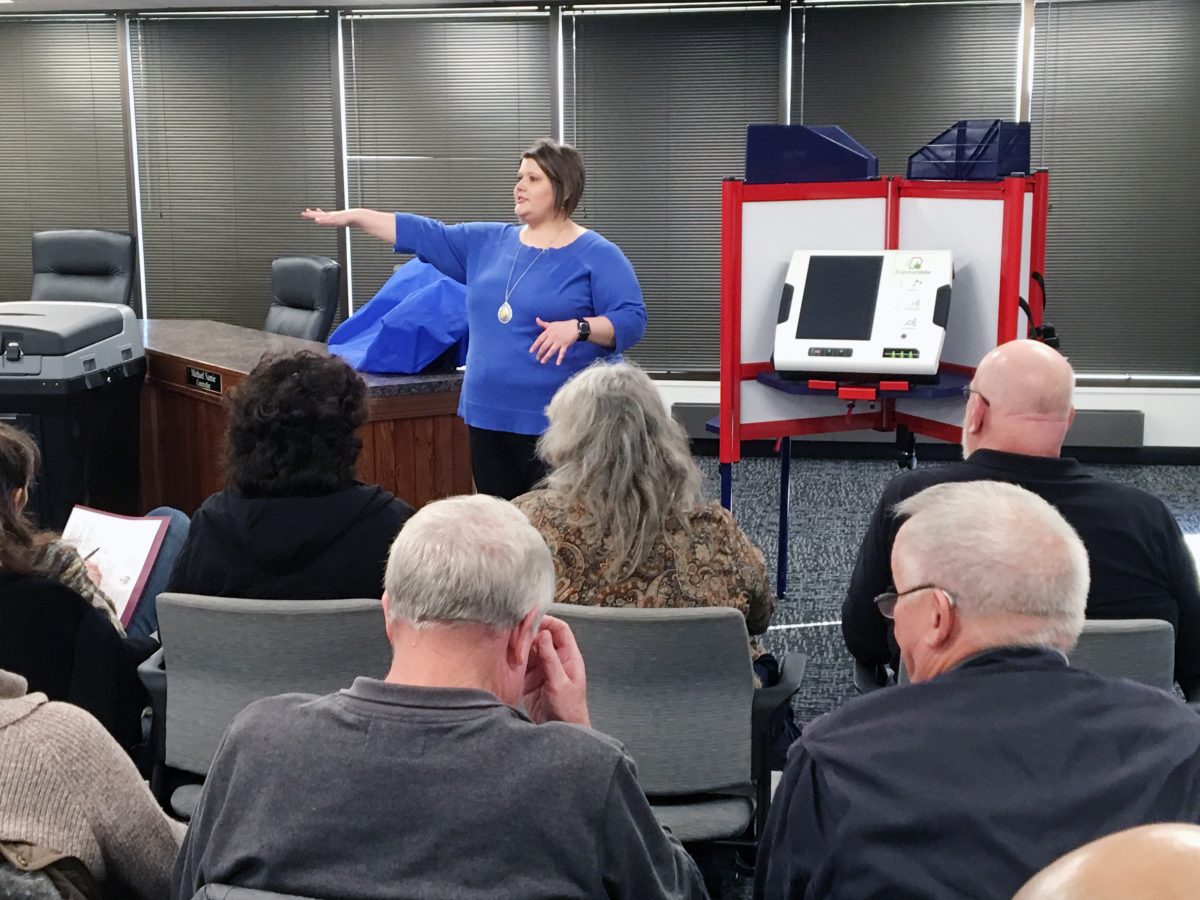
In February, before the arrival of the novel coronavirus, Washington County Elections Director Melanie Ostrander explains components of new voting machines at a training session for poll workers. Washington County voters submitted 22,000 mail-in ballots, projected to escalate to 70,000 because of heavy turnout in a presidential election.
Katie Anderson/Observer-Reporter
Katie Anderson/Observer-Reporter
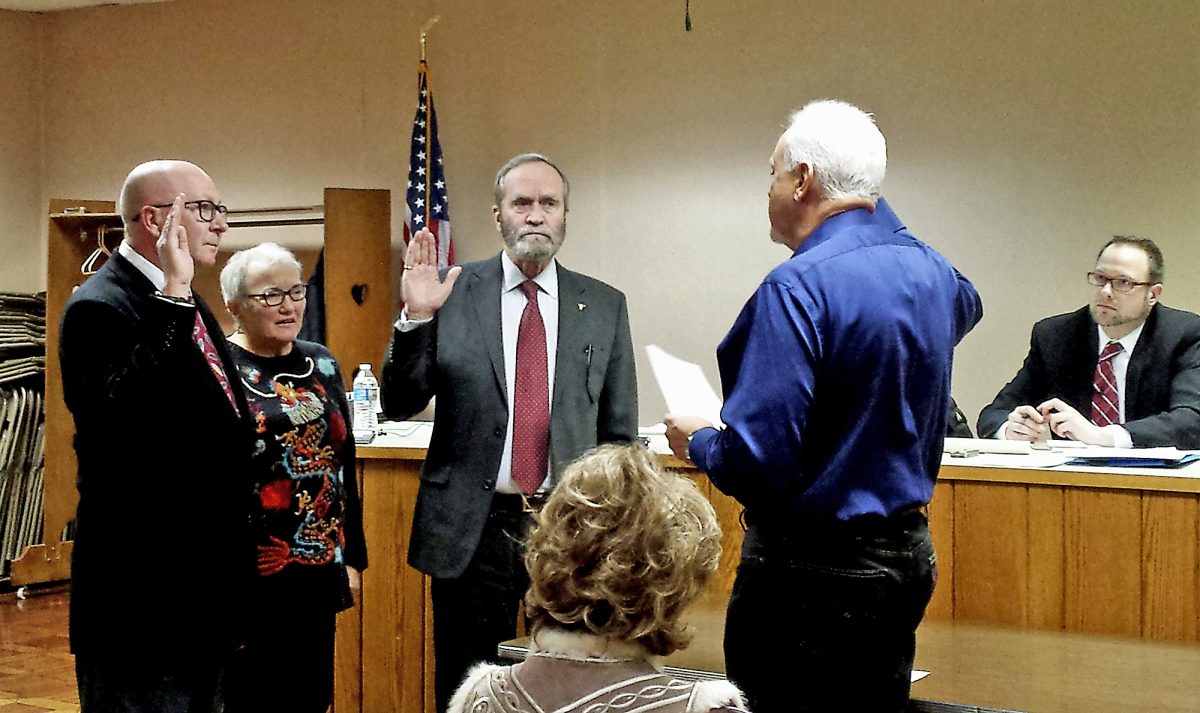
Richard Luketich, left, and Bracken Burns are sworn in as South Strabane supervisors and Sherry Blackburn as township auditor by District Judge Jay Weller during Tuesday’s reorganization meeting.
As a 21-year-old U.S. Army veteran, Bracken Burns was attending college at Indiana University of Pennsylvania’s Kittanning campus when the first election rolled around in which he was eligible to vote.
He recalled it was the primary of 1966, a few years before 18-year-olds won the right to vote in every state.
Burns boarded one bus bound for Pittsburgh, caught another to Bellevue along the Ohio River, stopped by his home to say hello to his mom, then went to the polls. He repeated the route via public transportation to return to the campus.
“I probably didn’t even know there was such a thing as an absentee ballot at the time,” Burns said Tuesday.
The South Strabane Township supervisor and former Washington County commissioner doesn’t want anyone to be in the dark when it comes to voting options this fall, especially if the United States is still in the midst of the coronavirus pandemic.
Burns, five former governors, and others belong to a group called VoteSafe Pennsylvania which launched a statewide campaign to promote mail-in ballots and safe, in-person polling places.
Not only has the voting age been lowered since Burns first voted in 1966, but last year legislation was enacted allowing what’s known as “no-excuse” mail-in voting, which augmented the absentee ballot process already in place.
Burns was among those who took advantage of it.
“I am a believer,” he said, “and I actually voted by mail the last time to check it out, and it worked just fine.”
During his 16 years as a commissioner, Burns served as a member of Washington County Election Board 26 times. The commissioners don’t comprise the board in years when they’re on the ballot, but in Burns’ final year of 2011, when he chose not to run, he was able to be a member of the election board.
“In all those years, I, in all honesty, am trying to be forthcoming with you, would be hard-pressed to name cases of voter fraud,” he said.
“You don’t just wander in there as some immigrant from Ecuador and vote two or three times.”
Burns said he’s confident of the safeguards in the system to weed out the nefarious.
The Heritage Foundation tracks those who have been convicted of voter fraud, employing a website that can be found at whitehouse.gov, which lists 21 Pennsylvanians dating back to 1998.
The most notorious case in the area was that of former U.S. Rep. Austin Murphy, who was convicted of one count of absentee ballot fraud in 1999.
“Murphy forged ballots for senior citizens living in a nursing home, claiming merely to be assisting them in exercising their voting rights. He was sentenced to six months of probation and ordered to perform 50 hours of community service,” the website says of the Fayette County case.
Mailing in illegal ballots or assuming a false ID would mean “you have crossed a line that most people never have and never will. The average American is not a crook,” Burns said.
“They may be passionate about politics, but that doesn’t make them a criminal,” he said. “We can sit here and talk philosophically about how easy it would be to go into this precinct and pretend you’re that person over there. If we’re assuming everybody wants to cheat at the polls, that’s all paranoia, and that’s not based in reality.”
He called the percentage of proven fraud “some infinitesimally small number.”
“I do recommend voting by mail,” he said. “It could not be easier, not that I don’t enjoy going down to the township building and chatting with the troops.”
Burns joins Democratic former state representative Peter J. Daley, former Pittsburgh mayor Tom Murphy and former Republican governors Tom Corbett, Mark Schweiker, Tom Ridge and Dick Thornburgh and former governor Ed Rendell, a Democrat, and a slew of other politicos in promoting the VoteSafe Pennsylvania principals.
A citizen must be registered to vote in Pennsylvania on or before Oct. 19 to participate in the Nov. 3 presidential election.
Those who want to vote by way of a no-excuse mail-in ballot can apply online at www.votespa.com. Those without internet access can call 1-877-VOTES PA for a paper ballot, or contact a county elections office.
Applications are being taken now for mail-in ballots, but elections offices cannot start processing them until 50 days before an election, which would be approximately mid-September provided there are no circumstances that would require the ballot to be altered by court order.
Just because someone requested a mail-in ballot for the June 2 primary doesn’t mean he or she will receive one for the November contest.
Those who plan to apply for an absentee or mail-in ballot must do so for each election, unless they qualify for and request permanent status to vote by mail.
Melanie Ostrander, Washington County elections director, said there has been a change in Pennsylvania election law that was not in effect for the primary, but affects Nov. 3.
In June, if a person had requested a mail-in ballot and received it but chose to vote in person, he or she could go to the polls on the day of the primary and receive a provisional ballot.
On Nov. 3, a person who applied for and received an absentee ballot but chooses to vote in person should take it to the polling place and relinquish it to the judge of elections, who is to mark the ballot and envelopes “void.” The voter would then be directed to a machine to cast a vote.
President Donald Trump has sued elections directors and boards of elections from all 67 Pennsylvania counties in federal court.
He wants counties to reject mailed ballots that voters have not placed in secrecy envelopes; limit delivery of voted ballots to county elections offices; and allow poll watchers to observe any polling place in the state, not just those in their county of residence.
A federal judge has scheduled the case for Sept. 23 in Pittsburgh.
The Democratic Party of Pennsylvania is also pursuing an election-related case in Commonwealth Court in an attempt to block the aims of the Trump suit.