

Congressional Gold Medal being awarded to local men
Courtesy of Carole Ortenzo
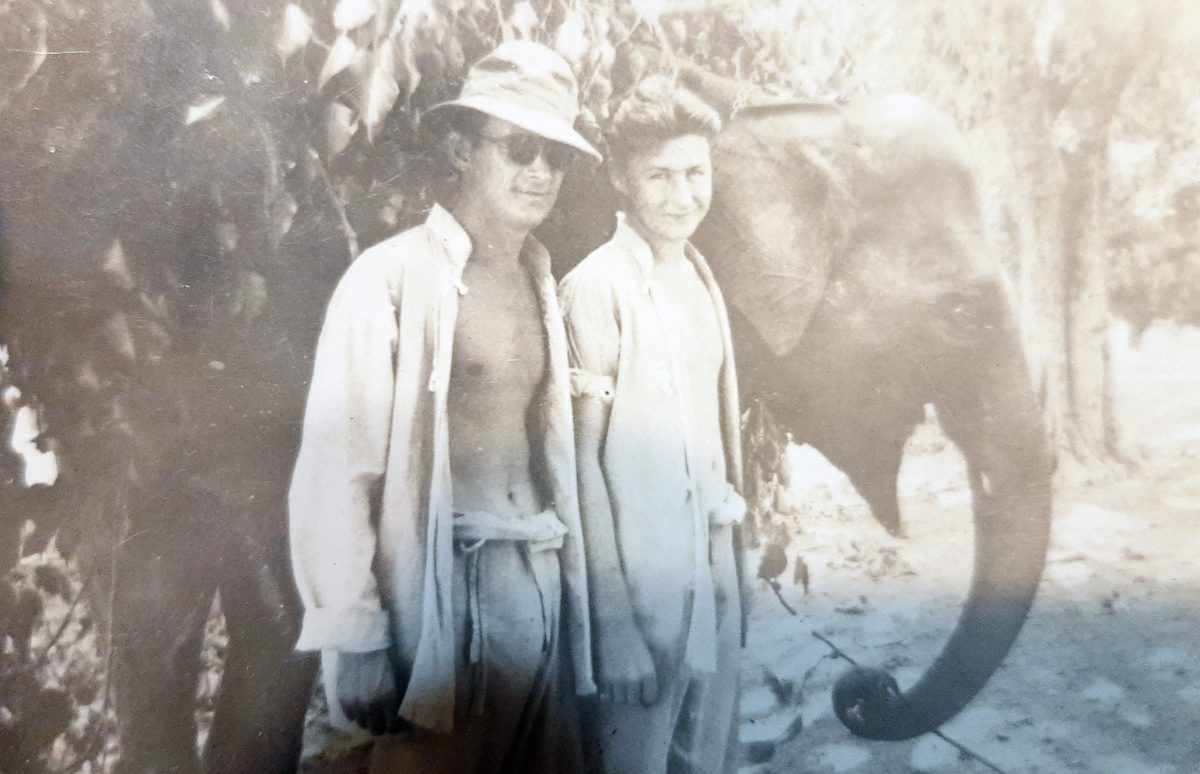
Russell “Huck” Hamler, right, is shown in northern India in spring 1944, where he was recovering after being shot in the hip in Burma, where he served with Merrill’s Marauders, a U.S. Army unit that embarked on a secret mission to seize a strategic airstrip. He was 19. Beside him is a fellow Marauder.
Courtesy of Carole Ortenzo
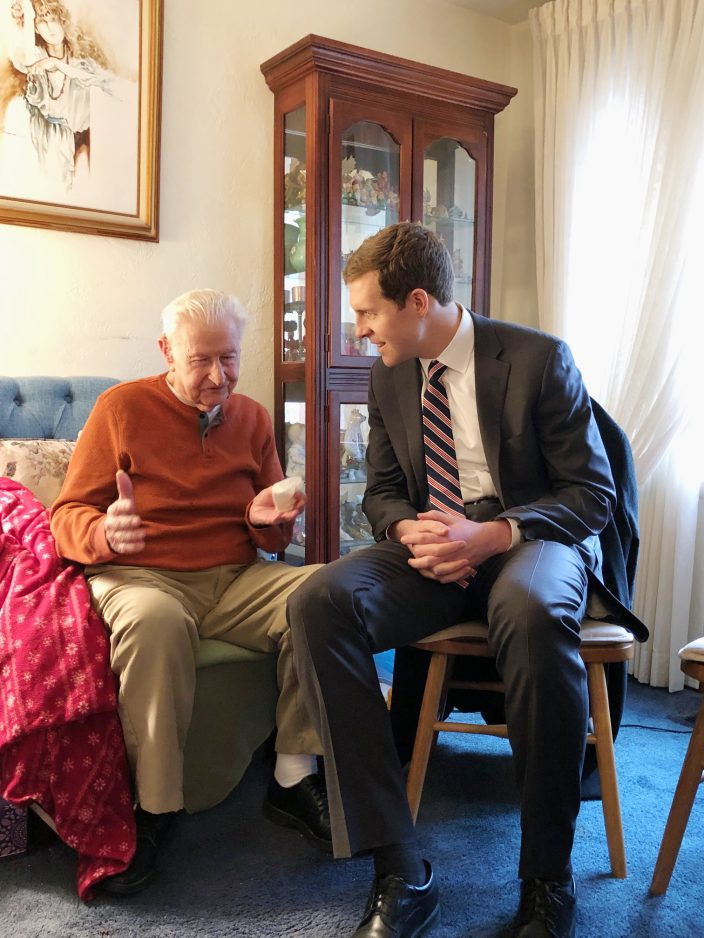
Merrill’s Marauder Russell “Huck” Hamler, a World War II veteran, is shown with U.S. Rep. Conor Lamb. The Marauders will receive the Congressional Gold Medal for bravery for their extraordinary efforts in Burma during a brutal five-month campaign.
Courtesy of Carole Ortenzo
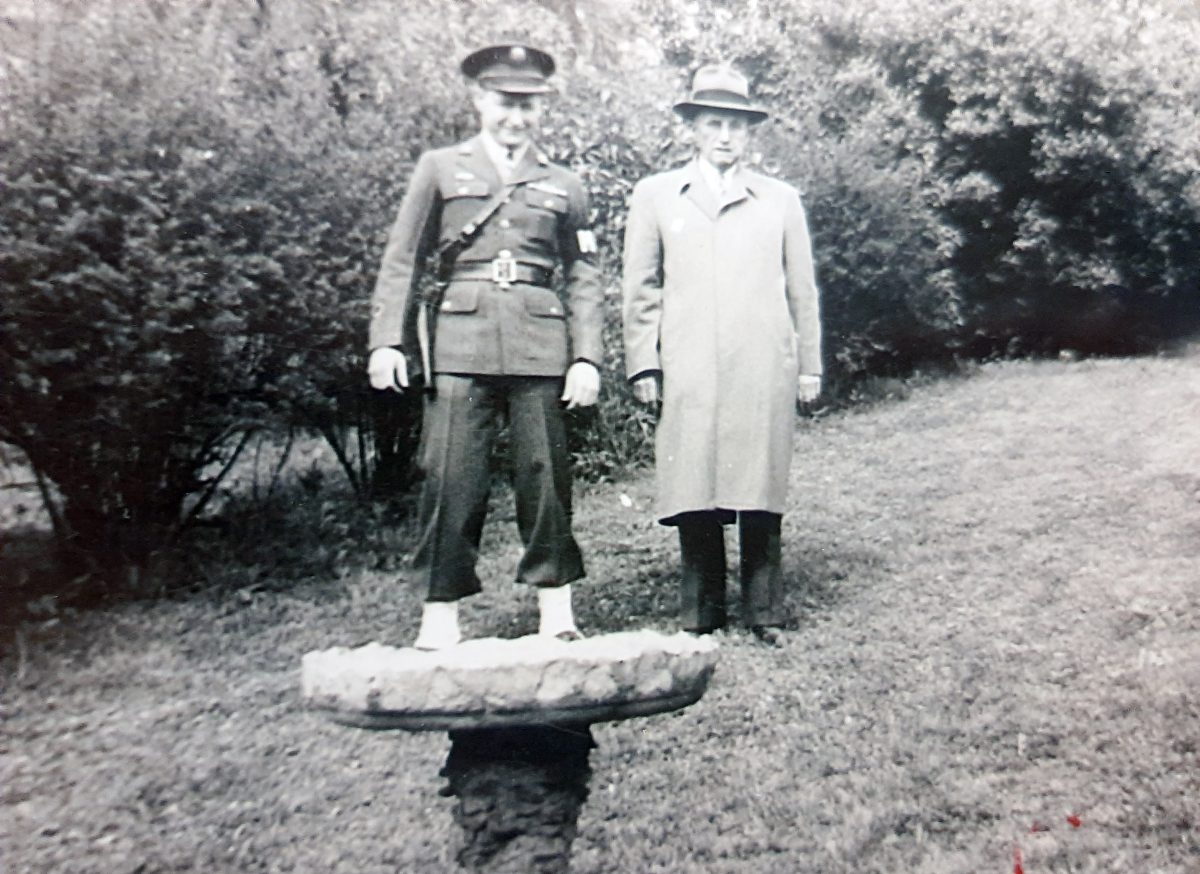
Russell Hamler, left, is shown with his father, in 1945. Hamler was stationed in Pittsburgh where he worked as an MP after he returned from Burma.
Courtesy of the Ammon family
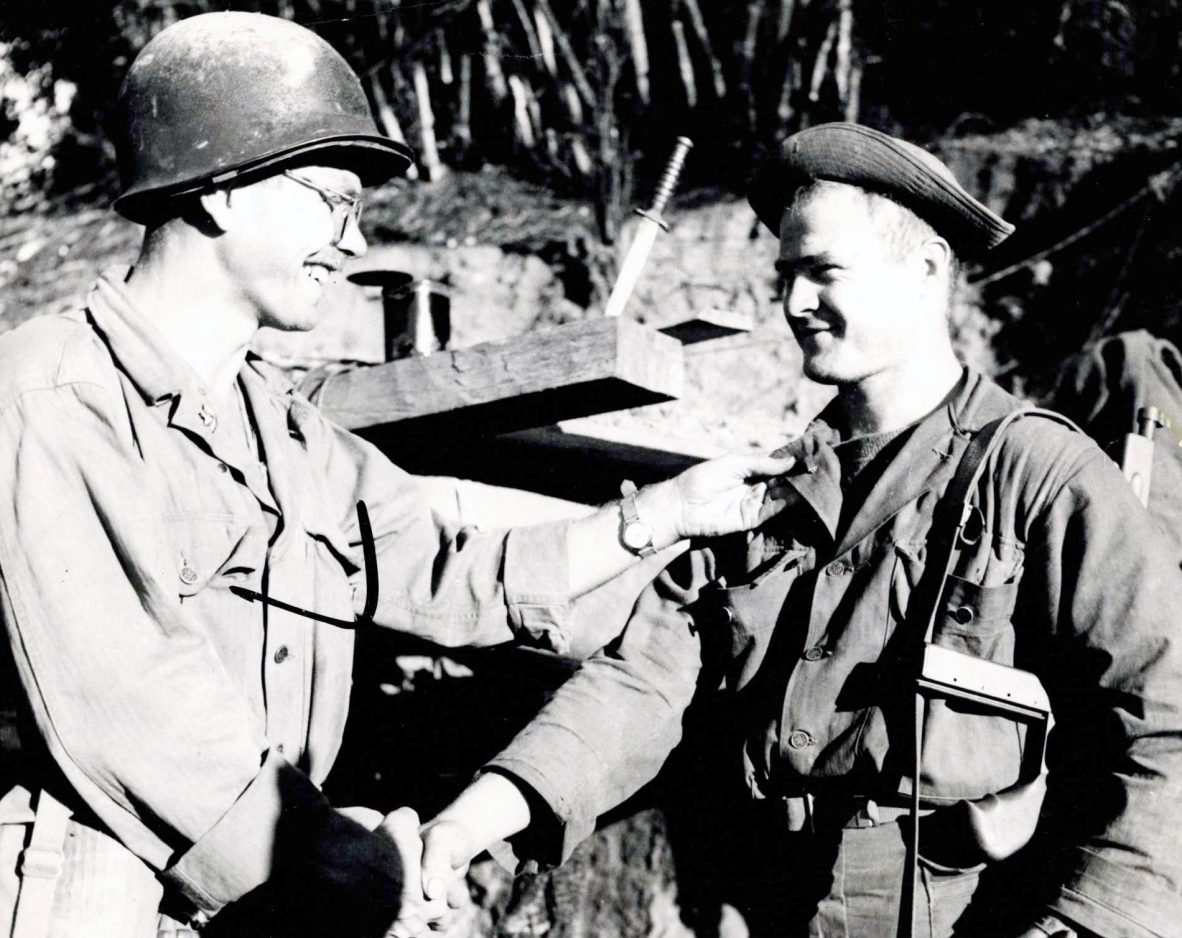
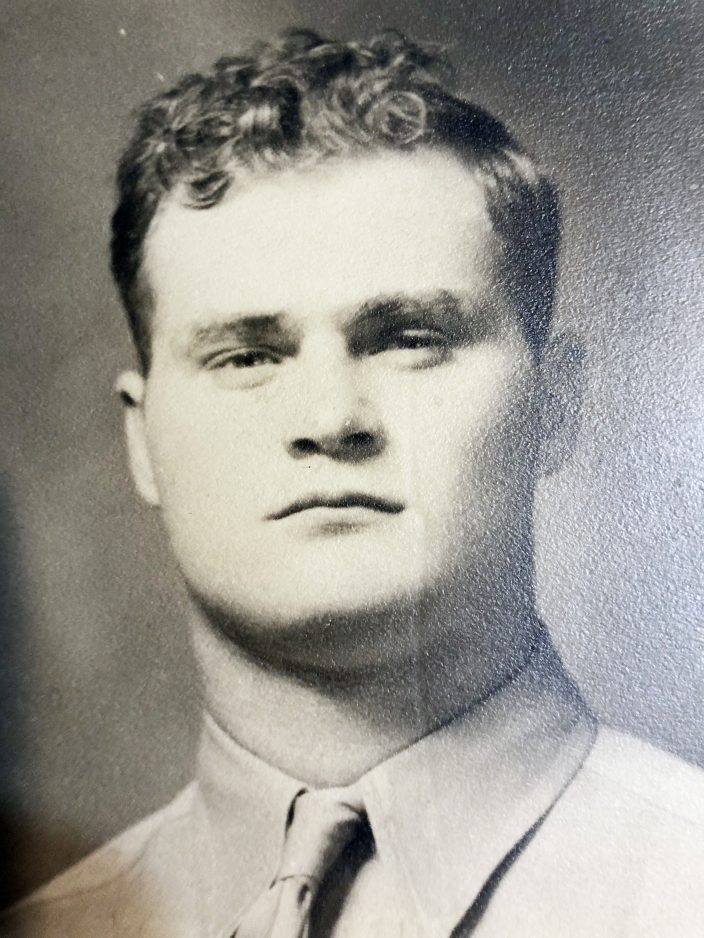
The late Ed “Bud” Ammon, one of the Merrill’s Marauders who served in Burma during World War II, received a Silver Star for gallantry in action for his heroic efforts to rescue an injured soldier during a battle.
Courtesy of the Ammon family
The late Ed Ammon will posthumously receive the Congressional Gold Medal. His unit, known as Merrill’s Marauders, embarked on a “suicide mission” in Burma in 1944 and played a pivotal role during World War II
Editor’s note: This story has been updated.
In February 1944, 3,000 American soldiers set out on a dangerous and secret mission in Burma.
Their assignment: to capture a Japanese-held airfield and open an Allied supply route between India and China.
The nearly 1,000-mile journey – on foot, through dense jungle and the steep terrain of the Himalayas – was grueling, and when the soldiers weren’t battling Japanese forces, they were fighting starvation, malaria, dysentery and monsoons.
When the all-volunteer unit, nicknamed Merrill’s Marauders, completed their mission five months later, fewer than 200 men were left. The rest of the soldiers had either been wounded, were sick, or had been killed in action.
Now, more than 76 years later, the Marauders, designated by the Army as the 5307th Composite Unit (Provisional), will be awarded its highest honor, the Congressional Gold Medal.
Legislation, named the Merrill’s Marauders Congressional Gold Medal Act, was passed in September, and approved by the White House in October. The congressional medals will recognize the “bravery and outstanding service” of the 3,000 men who fought.
Among those who fought in the campaign are the late Ed “Bud” Ammon, who was born in Washington and will receive the medal posthumously, and Russell “Huck” Hamler, who is one of nine surviving members, who grew up in Mt. Lebanon but now lives in Baldwin Township with his son.
For Ammon’s son, Ed Ammon II, the recognition of the courage and determination his father and the Marauders showed is well-deserved.
“What he did, to me, is amazing. And I’m talking about that whole generation. They were just ready to give it all, and they did,” said Ammon. “My dad was a part of it, and I’m extremely proud of it, even though he never made a big deal about it.”
Ammon said his father was eager to volunteer for the mission – the unit wasn’t told the objective or the location – when President Franklin D. Roosevelt and Prime Minister Winston Churchill agreed to form a ground unit to go behind enemy lines to cut off communications and supply lines, and to capture northern Burma’s only strategic, all-weather airfield. It was considered a suicide mission, with an expected casualty rate of 85%.
Ammon was commander of an Intelligence and Reconnaissance platoon, tasked with finding Japanese troops and reporting their location.
The Marauders survived 35 battles, including five major engagements, as the badly outnumbered Marauders defeated the Japanese military’s much larger 18th Division.
The members of Merrill’s Marauders, named for the unit’s commander, Gen. Frank Merrill, were awarded a Bronze Star, and the unit received the Presidential Unit Citation. Ammon also received a Silver Star for gallantry in action.
On March 28, 1944, he returned to an area that was under intense artillery, mortar and machine gun fire, to help a soldier who had been wounded. According to the commendation, Ammon “spent the night under terrible shelling and left his foxhole under fire to improvise a litter to be used in evacuating the wounded man as soon as daylight came.”
Hamler, who grew up in Mt. Lebanon and now lives in Pittsburgh with his son, was awarded a Purple Heart after he was shot in the hip in April 1944 when his unit was surrounded by the Japanese. Hamler was trapped in his foxhole for 10 days until another battalion rescued his unit, on Easter Sunday.
Ammon’s grandson, Edward James Ammon, said his grandfather didn’t talk about his experiences in Burma until later in his life, after the younger Ammon joined the Marine Corps.
“We all knew my pap was in the Army, but he didn’t say anything about what he did during the war,” said Ammon, whose brother and father also served in the military. “After my brother and I joined the service, he began to tell us more about it. We didn’t realize how much of a hero he was.”
Ammon was familiar with hardship. He was born in 1919, the oldest of five children. When Ammon was 9 years old, his father, who worked at the Washington Ice Plant, died of pneumonia at the age of 29. Ammon quit school in the eighth grade and took a job at an auto body shop to help support the family. A Golden Gloves boxer, he worked as an auto body repairman until 1940, when he joined the Army. He was serving in Panama when he volunteered for Merrill’s Mar
Ammon’s son said his father described how the Marauders marched hundreds of miles, with no artillery support, inadequate rations, and supplied only with what they could carry on their backs, pack on mules, or pick up from occasional air drops.
“They were hungry all the time. They never had enough food. When a mule would get killed, or would break a leg and die, they would cut it up and cook it,” Ammon recounted.
Carole Ortenzo, a Washington & Jefferson College graduate and a retired colonel in the U.S. Army, is a member of Hamler’s extended family. She became involved in the effort of families of Marauders to secure the medal for the unit.
She recalls Hamler describing how the soldiers, desperate for food, would throw grenades into the river, scoop up the dead fish that rose to the surface, and cook them in their helmets.
At night, the men – who wore the same clothes for nearly the duration of the campaign – slept on the ground and stayed quiet. The soldiers tied a string to each other, Hamler said, and pulled it in the morning to wake the others.
Ammon also expressed grief over the number of lives lost, and described crossing a river during a monsoon by clinging to a rope, then turning to help a comrade make to shore.
“My dad reached out to help him, but he lost his grip, and the guy went into the water. They never found him,” Ammon’s son said.
Ammon contracted malaria while he was in Burma, and he suffered from bouts of the disease for years, Ed Ammon Jr. said.
After the Marauders was disbanded, the unit was re-formed as the 475th infantry, and Ammon stayed in Burma and continued fighting until the Japanese were driven out.
When Ammon returned to Washington County, he moved to Canonsburg, married, raised six children, and eventually owned Annex Body Shop in Washington.
After Hamler returned to the U.S. following his injury, he was stationed in Pittsburgh, where served as an MP. Following the war, Hamler began working for Trans World Airlines, where he retired as a mechanic.
For Hamler – who met annually with survivors through the Merrill’s Marauders Association for more than 40 years – receiving the Congressional Gold Medal will be “a great honor.
“It means they recognize what we did,” Hamler told Ortenzo in a recent conversation. “We were all volunteers. In essence, they didn’t think any of us would pull through … What we did made it easier to get the Japanese out of Burma.”
The legacy of the Marauders, who fought in what has been called the “forgotten theater,” lives on. The Army’s elite 75th Ranger Regiment descended from Merrill’s Marauders, and its crest is based on the Marauders patch.
Of the original 3,000 Marauders volunteers, more Marauders came from Pennsylvania than any other state.
Although only nine Marauders – who are now between the ages of 96 and 99 – are alive to receive the Congressional Gold Medal, it is an honor for the families of all of the men who fought in Burma and played a pivotal role in World War II.
Ed Ammon II said his father would have been pleased to received the Gold Medal.
“He was a great man,” said Ammon, who called his grandfather a hero and an inspiration. “He deserves the Congressional Gold Medal, and so do all of the men who served with him.”