

Washington’s new code enforcement officer targets blight

Katie Anderson/Observer-Reporter
Employees of ServiceMaster Restore board up broken windows at a vacant commercial building on West Chestnut Street in Washington Thursday.
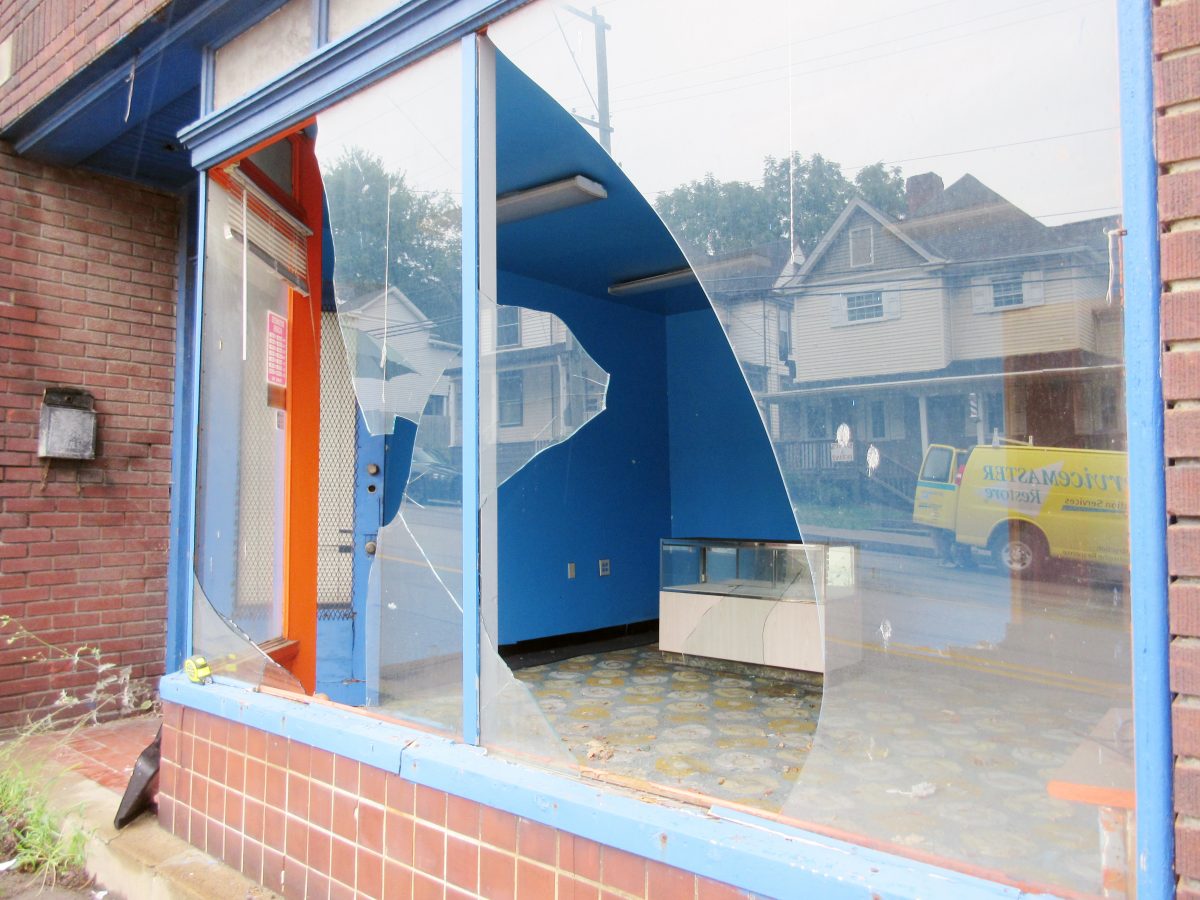
This commercial storefront on West Chestnut Street in Washington has had broken-out windows for months. The city's new code enforcement officer, Jeffrey Donatelli, had a company clean up the glass and board up the windows Thursday morning.
Washington’s new code enforcement officer has been busy the last few weeks.
Since taking over the job July 20, Jeffery Donatelli has managed an 80% compliance rate for complaints he’s received.
“That’s a really high rate,” he said in a recent interview. “When I was in the city of Pittsburgh, we were lucky to get around 60%.”
Donatelli, who worked in code enforcement in Pittsburgh about 15 years, said that compliance rate likely won’t stay that high, but it’s a number he aims to keep high.
“I’d rather people do what they’re asked to do rather than be cited,” he said.
Donatelli said he took the job here because he was “ready to move” out of Pittsburgh. As soon as Washington residents knew the position had been filled, they started calling him.
“I’ve been getting a ton of calls and complaints,” he said.
So far, Donatelli said, the job has kept him busy, but it’s “going really well.” There’s been a lot of paperwork to catch up on, as the position had been vacant since January, when former code enforcement officer Ron McIntyre died unexpectedly at age 40. McIntyre had served the city nearly two decades, first as a police officer, then as a code enforcement officer.
Mayor Scott Putnam said that because of McIntyre’s death, followed by the COVID-19 pandemic, the city “had a hard time interviewing” for the position.
“We’re really happy to have Jeff,” Putnam said. “He’s done a great job in the time he’s been here. He brings a wealth of knowledge with him from his previous job.”
Donatelli said that while the city doesn’t necessarily have designated problem areas, it does have a similar issue that many residential areas in cities have – vacant properties.
“When I interviewed, I was told there was a bit of a blight problem that we want to get out in front of,” he said.
He said one difficult issue to solve occurs when a homeowner dies and no relatives want to take or care for the property.
“Those are the houses that end up looking like the eyesores,” he said. “Vacant properties are always the biggest problem for many cities. There’s a pretty good amount of them in Washington.”
Donatelli said he has yet to find a previous demolition list on which McIntyre may have been working, so he started from scratch.
“I went out and spent several days looking for some of the worst properties in the city,” he said.
He’s up to 12 properties, all of which have large amounts of taxes due on them, and for which the mailed notices have “bounced back” and no contact was able to be made with the owners.
“We do our due diligence to ensure they’re all dead-end properties,” he said.
Donatelli’s list was approved by council Thursday to begin the demolition process. According to Putnam, that list will go to the city solicitor for title searches. Then the city will hold demolition hearings to give the property owners notice before council approves them for demolition. Once they’re approved, the city will turn over the properties to the Redevelopment Authority.
He hasn’t had much of a chance to turn his focus to commercial properties yet, Donatelli said.
“People are more concerned with the house next door to them than they are the building four blocks away,” he said.
Still, the very first notice he sent was for a vacant West Chestnut Street storefront, where the front windows have been broken for months and glass littered the sidewalk.
“It was like that the day I started,” he said.
Thursday morning, Donatelli had a company clean up the glass and board up the windows, “to get rid of the safety risk over there.”