

Greene commissioners receive dire budget warning
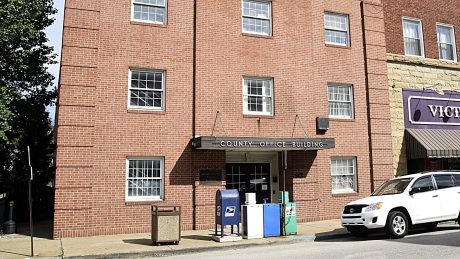
Greene County commissioners received a dire warning regarding county finances at Thursday’s board meeting.
Scott Kelley, the county’s chief financial officer, presented the financial report with a prediction that if major changes aren’t made to sufficiently balance the budget, the county could be “out of money” by 2023.
He noted that in 2021, county revenue is expected to decrease while Act 13 spending is expected to increase. The county used $5 million of an allotted $6 million in Act 13 money to balance the 2020 budget, while the current board of commissioners was able to reduce $1 million in expenditures and $430,000 in Act 13 spending.
The county received $4.6 million in Act 13 money that can be used toward the 2021 budget, and Kelley said between next year’s normal annual increases – such as salaries and benefits, utilities and rent – expected to jump nearly $1 million and an estimated coal depletion of $750,000 – with coal being 32% of the county’s taxable value – balancing the budget could be problematic.
The anticipated closing of Murray Energy, the previous closing of CONSOL and reports that Contura intends to sell its Greene County operations will also be severely detrimental to the budget over the next few years, according to the report.
“Moving forward, the annual budget needs balanced, and we need to stop using Act 13 money to do that,” he said. “If we don’t, the short version is that we may run out of money by 2023, assuming that the county’s taxable value does not drop.”
The report indicates a continuous decrease of county fund balance and increase of Act 13 spending from 2014 through 2019. In 2014, the county’s fund balance was over $4.7 million, and in 2019 that balance dropped to $1.3 million.
Conversely, the county used $682,000 in Act 13 money for the general fund in 2015, but that number increased to nearly $4.3 million in 2019.
The report lists several options on how the budget could be balanced, including:
- Raise taxes. The report states that 5 mills – 66% – would need to be added to the current 7.535 mills;
- Increase county taxable value from $1.5 billion to $2.7 billion – an increase of 43% – with no tax abatement by 2022;
- Cut expenditures by 26%, as $5 million would be needed from the total $19 million budget;
- Raise other revenue, a total of $5 million;
- Combine the previous four suggestions, along with the county receiving a declining annual amount of Act 13 money, allowing lower amounts/percentages in each category.
Kelley said most of the budget expenditures are mandated by the state, adding that “there’s not a whole lot to cut,” noting that the county’s single biggest expense is payroll while the biggest department is the county jail.
Kelley said the time line for the budget to be approved starts Sept. 21 to 28, when officials meet with department heads to discuss their respective budgets. Oct. 8 marks the deadline for any changes to be made to the draft, and on Oct. 9 officials will meet to review. Nov. 18 will see the release of the preliminary budget, with a notice of final action for Dec. 17 to be advertised, when tax rates will also be adopted.
Kelley also reported that the county’s sinking fund, which is used to ensure that the debt millage is sufficient to cover debt obligations, is “sufficiently funded.”
Following the report, Commissioner Mike Belding said, “Certainly, these are trying times. There is a spectrum of issues, between the COVID-19 pandemic and the reduction of gas production. All options are on the table, and we need to look at a combination of increasing revenue through others sources, decreasing our reliance on Act 13 … these are things we’re going to have to look at. We need to approach this in a sustainable manner.”
Belding added that the pandemic severely and negatively impacted the county.
“Nobody predicted the pandemic and what the financial impact would be,” he said. “But we need to do the best that we can going forward.”