

Questions raised about Pfizer’s COVID-19 vaccine booster request
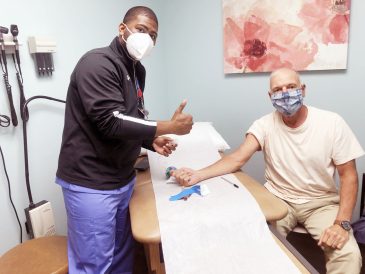
The announcement Thursday that Pfizer is asking federal regulators to authorize a booster for its COVID-19 vaccine came as a surprise to Larry Maggi, who has never received a third shot while participating in the company’s clinical trial over the past year.
Maggi, a longtime Washington County commissioner, volunteered last year for Pfizer’s clinical trial for the vaccine and received his first dose in late July and his second shot in mid-August.
He has traveled frequently to Columbus, Ohio, to give blood samples that were tested for antibodies, and he agreed in December to continue undergoing regular evaluations for another 18 months and take an additional shot if warranted. But those overseeing his progress have never administered a booster or indicated that he’s lost any immunity against the coronavirus after receiving those two original doses last summer.
Maggi said he was at the tail end of the clinical trial, so he wonders if others who were admitted into the program before him may have already received boosters, although he has no evidence that is the case.
“I was a little bit (surprised),” Maggi said of Thursday’s news. “There were different, varying people in the trials. We didn’t all start at the same time.”
Pfizer is asking the U.S. Food and Drug Administration for emergency use authorization for a booster as the more contagious Delta variant spreads within the unvaccinated population. Both the FDA and Centers for Disease Control and Prevention responded Thursday that they do not think a booster is needed right now for Pfizer’s two-shot regimen.
“Americans who have been fully vaccinated do not need a booster shot at this time,” the FDA and CDC said in a joint statement. “We continue to review any new data as it becomes available and will keep the public informed. We are prepared for booster doses if and when the science demonstrates that they are needed.”
That’s the approach Dr. Amesh Adalja, an infectious disease expert in Pittsburgh and senior scholar at the Johns Hopkins Center for Health Security, is taking after hearing Pfizer’s request.
“The need for the boosters is when you see vaccinated individuals with breakthrough infections needing to be hospitalized. That’s just not happening,” Adalja said during a phone interview Friday. “The Pfizer vaccine is holding up.”
He thinks it’s premature to say whether fully vaccinated people will eventually need a booster for Pfizer, but all the evidence he’s seen shows it’s not needed in the short-term. That could change as Pfizer’s clinical study continues and more data is available from the vaccinated population.
“Immunity is working. It’s important to study boosters and have an easy (approval) pathway if needed,” Adalja said. “We have to let time elapse, we have to follow people, not just for the antibodies, but are you actually running into problems with the vaccine?”
He noted that in its announcement, Pfizer cited an Israeli study raising concerns about the vaccine’s effectiveness against the Delta variant, but he thinks federal regulators are correct in studying hospitalization data and the statistics of who is still dying from COVID-19.
“When we look at who is getting hospitalized, it’s the unvaccinated individuals. Who’s dying of COVID-19? It’s the unvaccinated,” he said. “This (decision) has to be clinically driven.”
Maggi has had no problems since getting his two doses last summer and kept a journal of his experience through the entire process. He has another appointment in Columbus on July 28, and expects the topic of a third shot might come up when he asks the medical staff whether he still has enough antibodies to ward off the virus.
“I don’t know if I’m going to get the shot or not,” Maggi said of whether they’ll administer it to him during his next appointment. “I kind of go in there, there’s protocol we go through, and they draw blood.”
But he knows he’ll gladly accept a booster if it’s required.
“I’ve already agreed to it,” he said.