

Paternity leave is a benefit some dads are able to take advantage of

Courtesy of Matt Lazzaro
Matt Lazzaro was able to get paternity leave to bond with his daughter, Isabella, after she was born in March, and help out his wife, Nicole.
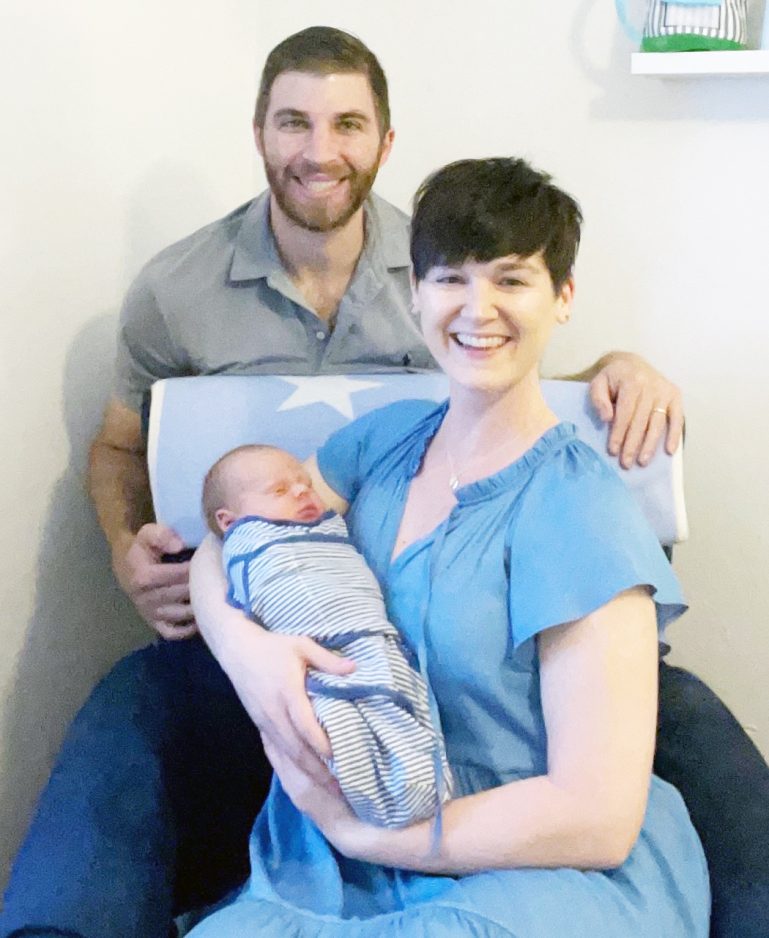
Courtesy of Catie Samples
Nick Samples is taking 16 weeks off from his job at BNY Mellon to help his wife, Catie, care for their newborn son, Nicholas.
When Matt Lazzaro became a dad for the first time in March, he decided he didn’t want to head right back to his job as a manager of investor relations at First National Bank in Pittsburgh.
So the 2006 graduate of Peters Township High School and current resident of South Fayette Township took advantage of an opportunity that’s becoming available to a relatively small number of new fathers in the United States – he took paid paternity leave.
“It was the right decision,” Lazzaro explained. “It was pretty invaluable to go through these life experiences with my wife.”
In the United States, it’s long been the case that after moms go through the labor of having a child, dads have promptly returned to their labor at the factory, office, or wherever they punch the clock, unless they have vacation time they can use. But some freshly minted American dads are able to take advantage of paid paternity leave at the companies where they work. It can stretch from a few weeks to a few months, with employees able to continue to draw paychecks while they are changing diapers and getting to know their bundle of joy.
Even as paid paternity leave becomes more available, however, it’s a privilege still enjoyed by a relatively tiny slice of the workforce. As of 2019, fewer than 10% of new fathers had paid paternity leave as a benefit, and most new fathers had their noses back to the grindstone within a week after their wife gave birth. And in the private sector, paternity leave tends to extended to highly educated, well-remunerated employees whose skills are in high demand.
Many employees eligible for paid paternity leave also work for companies that have an international presence, and the United States remains an outlier among developed nations in not guaranteeing leave to new parents. In Iceland, both moms and dads get three months of parental leave, while in Canada, parents have 40 weeks of leave, with dads able to get five weeks away from their jobs following the birth of a child. They are paid 55% of their average earnings during the leave. New fathers in France can take 28 days leave, and are mandated to take seven, while their counterparts in Japan can take a full year, and get their full paycheck for two-thirds of that time.
Marcey Zweibel, director of corporate public relations for PNC Financial Services Group, said the Pittsburgh-based company offers six work-weeks of paid time off at 100% of salary, a benefit that is separate from PNC’s other benefits, including its maternity leave and adoption assistance policies.
“Research shows that employers are more likely to attract and retain strong talent when they offer benefits like this,” Zweibel said. “For PNC, this makes good business sense, but more so, is the right thing to do.”
Under the 28-year-old Family and Medical Leave Act, employees in the United States can get up to 12 weeks of unpaid leave to care for a child, sick family member or recover from an illness as long as they work for a company that has more than 50 people on its payroll. California, New York, Washington, Rhode Island and New Jersey are the only states that require employers to offer parental leave. Last year, federal employees became eligible for 12 weeks of paid time off for births, foster placements or adoptions. President Biden has proposed making paid parental leave available to all new parents. Under the plan, parents would be paid two-thirds of their weekly wages, with the lowest-wage workers getting 80% of their wages. The amount recipients get would be capped at $4,000 per month.
When polled, Americans generally approve of the idea of paid parental leave and paternity leave. According to a 2017 Pew Research Center poll, 69% of Americans support paid paternity leave, with support rising to 82% for paid maternity leave. With Americans divided on so many issues, the level of support for paid parental leave is “astounding,” according to Chris Knoester, an associate professor of sociology at Ohio State University, and Richard J. Petts, a professor of sociology at Ball State University in Indiana. Writing for the website The Conversation in April, they said, “Years of research underscores the benefits of paid maternity leave for women and their families. Our research has demonstrated that when fathers take paternity leave, they tend to develop better relationships with their kids and partners, become more actively involved in parenting and get divorced less frequently.”
The lack of paid paternity leave in the U.S. is a holdover from the days when it was assumed that caring for young children was women’s work, according to Dawn Huckelbridge, director of Paid Leave for All, a campaign to offer the benefit to all workers in the country. She also said the lack of paid paternity leave here is part of a larger “caregiving crisis.”
“It’s reached a breaking point,” she said.
Nick Samples, a Masontown native and graduate of California University of Pennsylvania, is taking 16 weeks off from his job as a trust analyst for the banking company BNY Mellon in Pittsburgh following the birth of his son, Nicholas, at the end of May. The Brookline resident is receiving full pay, and his leave is so comprehensive that he is not even able to log into his work account while he is away.
“I think it’s important to spend time with him,” Samples said, and help his wife, Catie, a native of Washington who is a registered dietitian at Jefferson Hospital, with all the chores that come with having a newborn in their lives.
“There are things that need to be taken care of around the house,” he added.