

East Washington to purchase Tesla police car
Tesla Sales
Associated Press
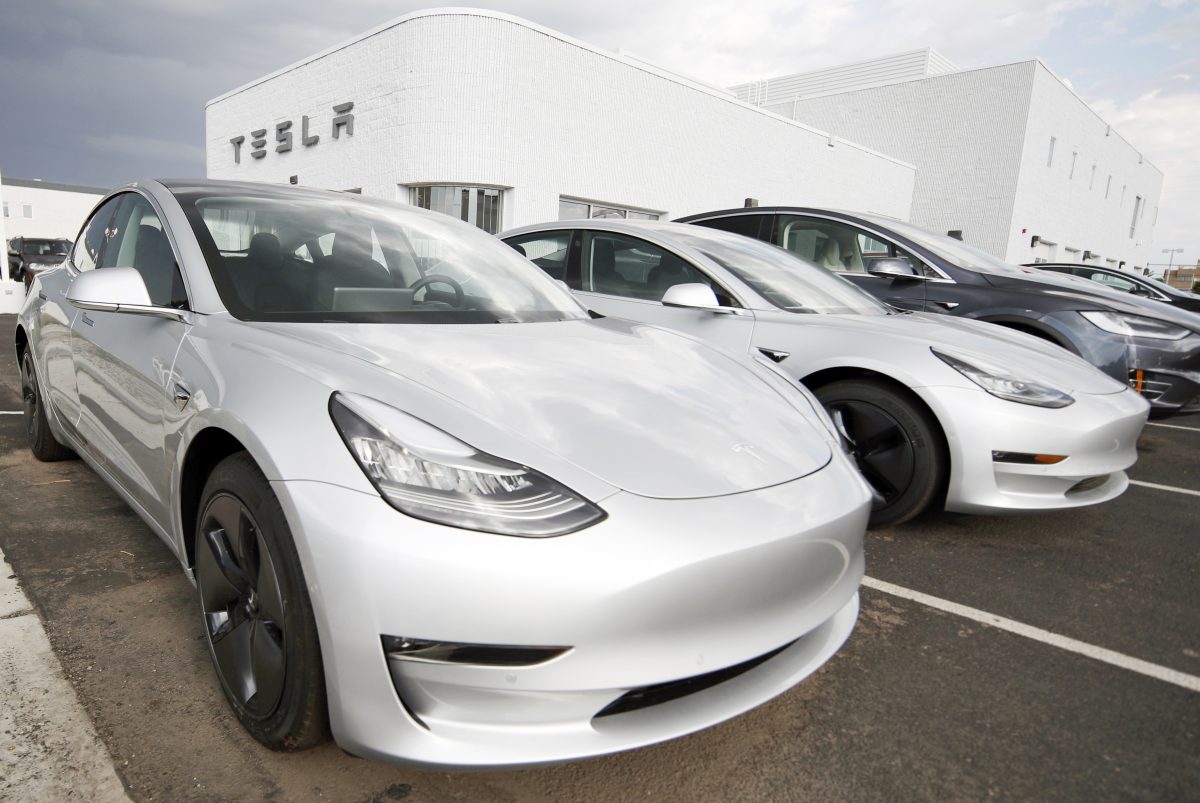
Model 3 sedans sit on display in July 2018 outside a Tesla showroom in Littleton, Colo.
Observer-Reporter
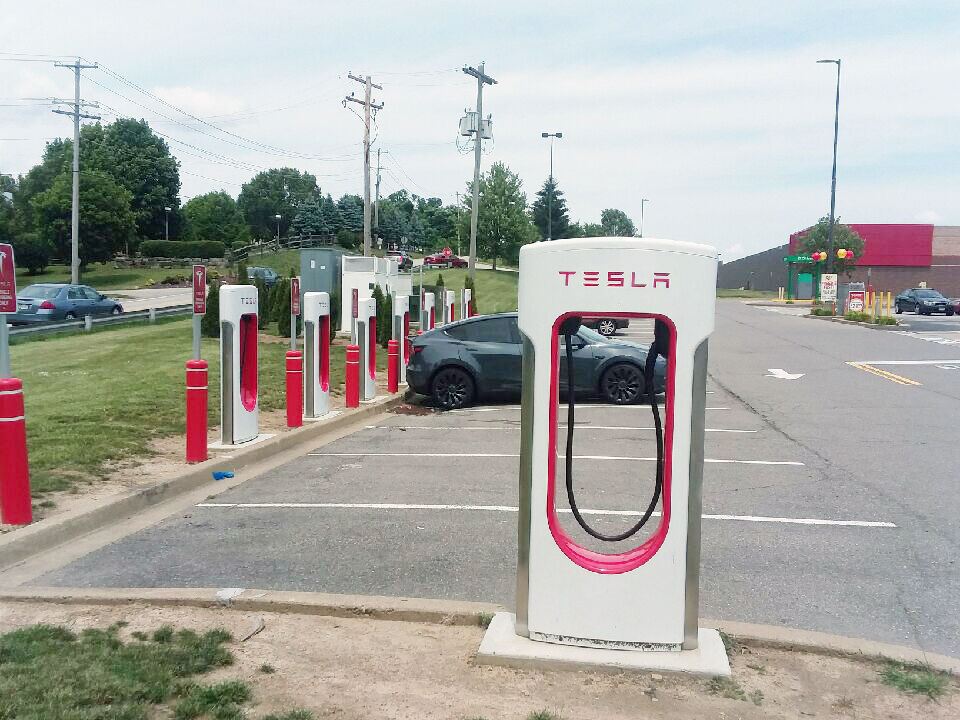
The Tesla super-charging station in the Giant Eagle parking lot in South Strabane Township can charge a Model 3 battery at a rate of 300 miles per hour. The charging station is among those that East Washington will be able to use to charge the vehicle it recently approved for purchase.
East Washington Borough plans to purchase a Tesla Model 3, making it one of the first in the state to use an electric police vehicle.
In a 5-2 vote last week, council voted to purchase the vehicle for the department, which is down to one Ford sedan and in need of another car.
“Someone has to be first,” said Councilman Joseph Fulton. “There’s a few reasons why I voted for it. We’re going to be able to save money on gasoline. Teslas also hold their value better than the Ford.”
Fulton also argued that Teslas don’t typically require as much maintenance as gas-powered vehicles, so they potentially could save the borough money.
Police Chief David Bradley said the department had to sell two older vehicles last month and has just one Ford sedan. He said he doesn’t necessarily have a vehicle preference, as long as it’s ordered soon and is all-wheel drive.
“I was surprised just because I never thought of an electric vehicle in that role,” Bradley said. “With any type of change, there are probably doubts. We’re not the first department to talk about it.”
Within the last two years, the Allegheny County Sheriff’s Department considered adding electric vehicles to its fleet, and departments in other states, like Indiana and California, have started using electric vehicles in their departments.
East Washington Councilman Kent James, who has experience driving electric cars, was the first to bring it up as an option for the borough. He was on the committee, which narrowed the decision to two options: the Tesla 3 at a total cost of $56,485, or a Ford Interceptor Explorer SUV at $42,200. The Ford is designed to be a police vehicle, while the Tesla is not, though the borough plans to outfit the vehicle to fit the department’s needs.
“This was not designed as a police vehicle, but we think it’s worth trying,” James said. “We’re taking a chance, but I think it’s a good chance. If it doesn’t work out, if our officers decide they don’t like it for whatever reason, Teslas have a really good resale value.”
Bradley, a 21-year veteran of the department, said the full-time force consists of 15 part-timers, including himself. He said officers put 70 miles on a vehicle in one day, and that their gas budget for the year is $5,000.
“I had pros and cons for both vehicles,” he said. “Our gas budget for the year would be cut in half.”
Bradley said that police vehicles tend to sit in idle for a good portion of the day, which can cause maintenance issues and drain the gas tank.
“With an electric vehicle, it doesn’t idle,” he said. “It goes to a rest mode like your computer.”
The Tesla wouldn’t have a barrier or “cage” in the back, separating officers from prisoners or people they transport. Bradley said that wouldn’t be an issue, since they don’t typically transport anyone being charged with a crime. Since they don’t have a holding facility at their station, they typically call the city of Washington or South Strabane Township police to transport prisoners.
Despite the pros, Bradley understands the public perception of a small department spending extra up-front money on a vehicle like a Tesla.
“In that respect, it’s no different than if you purchase a BMW, a Mercedes or a Cadillac,” Bradley said.
The borough plans to use the Tesla super-charging station in the Giant Eagle parking lot in South Strabane, as Tesla charge plugs are free for Tesla drivers, according to James. He said those stations with high voltage can charge a car battery at a rate of 300 miles per hour.
“We don’t drive a lot of miles on the police cars, so we won’t have to charge very often,” he said.
Borough leaders also mentioned possibly using plugs in the parking lot of Washington & Jefferson College. James said the borough could also install a plug at the police station, which wouldn’t cost very much.
“It’s basically a dryer outlet, with about 220 volts, so it’s not like you need a lot of infrastructure,” he said.
That outlet would charge significantly slower, at around 13 miles per hour.
James said he suspects the borough will save money on maintenance costs too, as there are fewer parts on an electric car.
“There’s no exhaust system. It doesn’t need regular oil changes,” he said.
Even though the borough – with a population under 2,000 – plans to spend $15,000 over budget on the car, James suspects they’ll make up the difference by keeping the car longer and saving on fuel and maintenance.
“It does cost more than a regular police vehicle, but we think it will save money in the long run,” he said. “We want to be as fiscally responsible as possible.”
Borough solicitor Dennis Makel said the Tesla is available to purchase through the cooperative purchasing program COSTARS, meaning the borough won’t have to seek bids.
“That allows us to get the best price for the vehicle and get it sooner rather than later,” Fulton said.
Fulton and James both said electric cars are the future, and that reducing an environmental footprint was part of their decision.
“We’re very proud to be moving in this direction,” Fulton said. “We feel this is a good thing, not only for the environment but it may save us money in the long run.”
Not everyone on council is proud of the decision, as the two dissenting votes came from council members Doug Corwin and Dan Bird. One of Bird’s concerns is that should the Tesla need maintenance, the closest Tesla service location is in Cranberry.
“For me, it’s a no brainer – the car costs too much, you can’t get it serviced locally and it’s not designed to be a patrol car,” Bird said. “If the car is not designed to do police work, then we should not be purchasing it for police work.”
Bird said he doesn’t want to spend taxpayer money on something the borough “doesn’t need.”
“East Washington doesn’t have to be a prototype to use this car,” he said. “They’re all for reducing the carbon footprint, but at what cost? The borough radius is less than a half-mile, and I just think we can use that money better elsewhere. For what we are, I just think this is a waste of time to even discuss it.”
Corwin said he voted against the purchase more for the public perception of spending a lot of money on a newer vehicle, when there are less expensive options.
“If we got an expensive electric vehicle, that reinforces the perception that we’re the rich kids, the snobs next door,” he said. “We’ve been using the Fords forever. Why change?”