

Cal U. students have work published
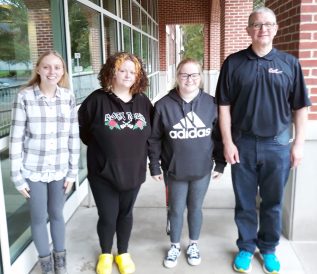
Some California University of Pennsylvania students have had work they’ve done for a class project published on a geographical organization’s website.
The project was done in the environmental applications of geographic information systems course taught by geography professor Dr. Tom Mueller in conjunction with Cyclomedia, a company that specializes in the large-scale and systematic visualization of environments based on 360-degree panoramic photographs (cycloramas).
“I wanted to know if there was any way we could get access to their demo version of Cyclomedia so that our students could interact,” Mueller explained. “Our students (were given) access to Cyclomedia and their training material and this was integrated into an upper-level course.”
Students created exercises highlighting Cyclomedia projects. But first they had to train for a month to be ready by watching a series of videos that explained how to use the tools provided by Cyclomedia and how to apply them.
“This was a class project,” Mueller said. “Those projects were sent to Cyclomedia and Cyclomedia evaluated each of them. So the students got my grades, but they also got an evaluation from Cyclomedia.”
Two of the five projects submitted by Cal U. students were chosen to be published on the PennsylvaniaView website.
Mueller is the Pennsylvania director of an organization called AmericaView, of which PennsylvaniaView is a member. The organization advances Earth observation through remote sensing, applied research, workforce development, technology transfer and community outreach.
Junior Jasmine Davis, senior Cortney King, senior Hailey Stall and recent graduate Rebecca Randall produced one of the published projects.
The task they chose was taking on the lead role of the organization that undergoes setting up historical parades in Washington, D.C. Their job was to analyze the parade route used in the annual National Cherry Blossom Parade to inform parade attendees and participants about potential regulations and hazards.
“It involved event planning for a parade route,” said Davis, a geology major from Canonsburg. “There are a lot of stipulations and regulations that you have to have. We picked a street in Washington, D.C., on the Cyclomedia page.”
“We wanted to show how that website and those tools can be used in real life situations,” added King, a geology major from Hiller. “I compare it a lot to Google Maps. You have that 3-D view. You can measure everything. You can see the roads and measure the roads. It was very good for handling real life conflicts.”
Measurements were taken to determine the maximum width allowed for a parade float on that street, and streetlights were measured to make sure any parade float would not be so tall that it would damage the lights. Potential hazards, such as the possibility of ponding in the event of rain, were explored.
“They used the tools from social media to bring this scenario to life,” Mueller explained. “What I thought was amazing is that it wasn’t about just punching the button, but it’s interpreting a problem and finding a solution.”
The other published lesson was created by Emilee Leydig, Elizabeth Buchanan and Andrew Orsini. Their lesson dealt with creating a fire safety plan in case of a fire emergency inside a building.
Work on the projects was affected by COVID-19, as the students couldn’t always meet in person.
“I think that, in itself, also makes it such a great project,” Mueller said. “They had to not just deal with the assignment itself, the stress involved since it was going to someone besides the professor, but also having to deal with all of the COVID issues.”
Also, group members really didn’t know each other before working together on this project.
“It’s always weird to get thrown together with random people,” said Stall, a senior geographic information systems major from Greensburg. “I don’t think it caused that many issues. You work together every day with people on the job that you don’t know. I think it was a good learning experience.”
Students received a letter informing them they were selected to be published. Obviously, they were pleased.
“I was excited. I didn’t expect that. It was good to know that we did a good job,” Stall said, adding that having this work published helped her land a job with an engineering consulting firm.
“That was extremely exciting, because it is something that we can put on our resume,” King added. “Just getting that publication inspired me more to work harder. I want more publications. I want more recognition for what I did. If there’s more opportunities for students to work on those things and they get rewarded like that, that can really inspire them.”
“Just seeing it on the website was really rewarding,” Davis said. “It felt great that we put in the work that they thought was the best. “
Mueller hopes there will be continued work with Cyclomedia.
“We hope to increase our partnership so students would be eligible completing internships with organizations using Cyclomedia,” Mueller said.