

W&J distinguished fellow releases his eighth book
By Paul Paterra
Staff writer
ppaterra@observer-reporter.com
Jonathan Gottschall considers stories the very best thing in the world, and also the worst.
Stories and their impact on people have been the subject of many of Gottschall’s books. That is the case for his latest publication, “The Story Paradox – How Our Love of Storytelling Builds Societies and Tears Them Down,” which was released Nov. 23.
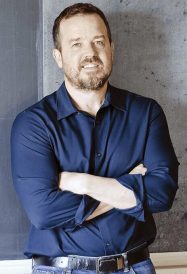
Gottschall, of Washington, is a distinguished fellow at Washington & Jefferson College.
“Stories are behind so much of the good things in life,” Gottschall said. “They’re also the roots of many evils.”
“The Story Paradox” explores the dark side of storytelling, including how misinformation and disinformation provoke divisive, us-them thinking.
“I tell some stories,” Gottschall said of the book. “I spend a lot of time in the book discussing this special power stories have as tools of communication. They out compete other forms of messaging and they out compete them by a lot, but there’s a catch. None of those advantages actually kick in unless the story is good.”
The book is like Gottschall’s other works in that it is based on his own observations and extensive research.
Gottschall thinks storytelling has played a big role in the divisive and polarizing political climate that exists in today’s world. He also believes storytelling has emerged into a dangerous force as digital technology has given everyone the ability to broadcast limitless narrative in real time.
“I hope people are all very aware of the other side of the political divide. Whatever our other side is, is lost in narratives, going around this lavishly fictionalized version of reality,” he said. “I hope people will learn to turn that scrutiny around on themselves and ponder the possible fabrications and exaggerations in their own narratives.”
That doesn’t mean Gottschall thinks people should stop telling stories. Quite the contrary.
“Stories aren’t just at the heart of the problem, but they’re also at the heart of the only solution, because stories are a way we can really get through to each other, but only if we can tell them in a way that works,” he said. “There’s a tendency to draw people on the opposite side as cartoonish villains, as the bad guy. That’s just never going to work.”
“The Story Paradox” can be considered the flip side of Gottschall’s 2012 book, “The Storytelling Animal: How Stories make Us Human,” which focuses on how stories can positively spread information and bring people together.
“The Storytelling Animal” was a New York Times Editor’s Choice and was selected as a finalist for the LA Times Book Prize. After it was published, it led him to think about the dark sides of storytelling.
“After I write ‘The Storytelling Animal,’ I started to feel somewhat guilty,” Gottschall said. “I helped give people permission to approach stories in an unwary, rather than skeptical, way.”
Most of Gottschall’s books have dealt with storytelling with the exception of a book about cage fighting, called “The Professor in the Cage: Why Men Fight and Why We Like to watch,” which was released in 2016.
“The Story Paradox” has been received favorably.
“Jonathan Gottschall is not only the deepest thinker about the powerful role of stories in our lives, but a lively and witty writer. The Story Paradox offers much insight and many pleasures, said Steven Pinker, Johnstone professor of psychology, Harvard University, and author of How the Mind Works and Rationality.
“The Story Paradox” is available online from retailers, such as Amazon and Barnes & Noble. True to Gottschall’s style, it’s a shorter book of 240 pages.
Gottschall said there are probably some more books in his future, but he’s going to take a break for now.
“These big idea books sort of push me to my cognitive limit,” he said. “I need a little bit of a break before I jump back into it.”