

Greene commissioners raise concerns about county’s new SWAT team

Photo courtesy of Will DeForte
Greene County District Attorney David Russo speaks with Zack Sams, who is a county detective and team leader of Greene County’s new SWAT unit, during a demonstration in early October at the firing range near Garards Fort.
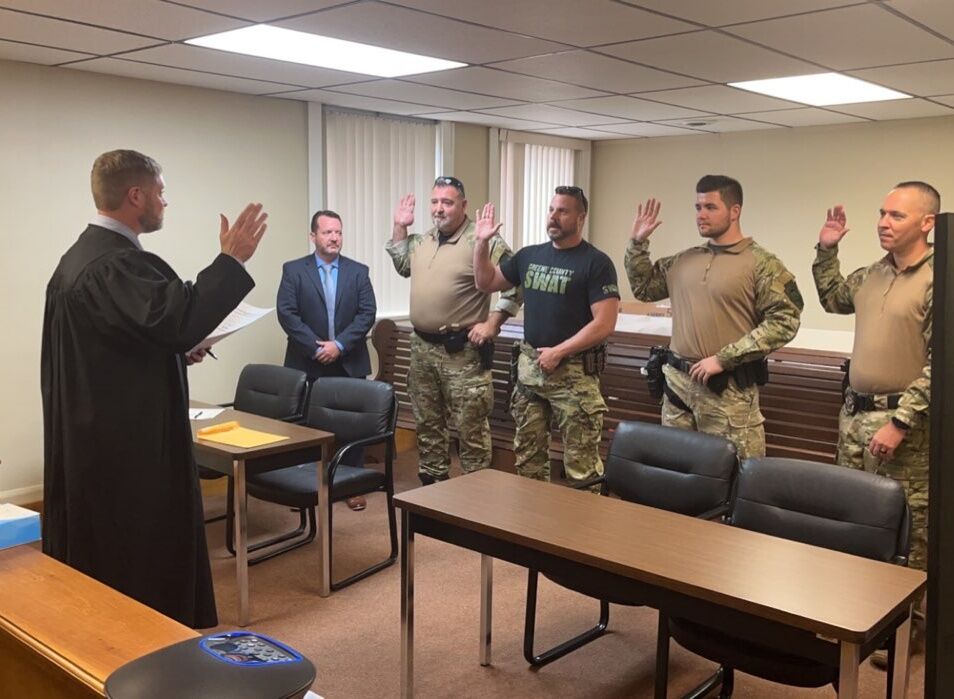
Photo courtesy of Will DeForte
Members of the Greene County SWAT team are sworn-in by District Judge David Balint while county District Attorney David Russo looks on.
The Greene County commissioners are raising “numerous concerns” about the district attorney’s decision to create a SWAT team, as the simmering feud between county officials appears to have reached a boiling point.
In a letter sent Monday to District Attorney David Russo, commissioners Mike Belding, Betsy Rohanna McClure and Blair Zimmerman said the county cannot provide insurance coverage for the team and will not indemnify its members from potential lawsuits, while they also accused Russo of going beyond the scope of his row office in supervising the squad’s responses.
The letter also states that the unit’s presence at a crime scene could “create chaos and a lack of communication among existing well-trained SWAT teams” and other first responders in the event of a major emergency. Currently, the state police’s specialized response team based in Western Pennsylvania would typically oversee situations that go beyond normal police matters.
“While Greene County is open to discuss this issue with you, we have numerous concerns, including the safety of the citizens and other first responders, the financial liability this team poses to Greene County, the lack of specialized training of the team, the funding of the team, and your authority and competency to form and be the ‘command control’ of this unit,” the commissioners wrote in their Nov. 21 letter to Russo.
Russo unveiled the new SWAT team Oct. 3 and said it would respond specifically to school shootings while preparing for expanded duties as the team completed more training in the coming months. Russo said last month the time that he hoped the team would allow for quicker response times to emergencies since no such specialized units are based in Greene County.
“The absence of a response team is much more dangerous to the public then having (a) team, which is what the commissioners are suggesting,” Russo said Friday in an emailed response to the Observer-Reporter. “We are fulfilling a need for the safety of our citizens and children, which they are not recognizing.”
The commissioners apparently were unaware Russo had officially created the team until media reports were published in early October when he announced its formation. Belding said the commissioners sent an initial letter to Russo on Sept. 2 asking him to address rumors that he was planning to create a specialized police unit, but he never responded. The letter requested information on standard operating procedures, training standards and capabilities, memorandums of understanding with other police departments, funding sources, insurance policies and information regarding internal investigations.
In the most-recent letter sent this week, the commissioners claim that the team does not adhere to “National Tactical Officers Association” standards that require minimum training hours and number of officers available to respond. There is also no memorandum of understanding, or intergovernmental agreements between Russo’s team and state police on how to coordinate in the event of an emergency, the commissioners said. Russo said last month that state police have offered equipment and technical support to the team, but he also noted Friday that state police do not oversee similar SWAT teams in other counties since those aren’t staffed by troopers.
Russo said the current team he assembled using seven police officers from local departments is just at the beginning stages, and that more advanced training in the future will allow it to respond to more scenarios beyond an active shooter.
“Some of our officers are already certified and training has already begun,” Russo said. “I made it very clear in my press release that our Critical Incident Response Team can operate with less members and training required for SWAT, but I was very specific that we have 18 months to have individuals fully trained.”
But the larger issue seems to center around Greene County’s unwillingness or inability to insure the unit due to the “significant financial exposure that may be caused” by the team. While Russo said that the team’s members are individually insured through their own police departments, the commissioners are still worried about what would happen if a lawsuit was filed against the county.
“We will not seek or pay for insurance for this SWAT team unless and until you have demonstrated that the team and its commander and members meet the (National Tactical Officers Association) standards and is operated by an appropriate law enforcement agency,” the commissioners said in their letter. “Having no insurance that covers a ‘Greene County SWAT team,’ particularly one that is not appropriately trained, will expose Greene County to substantial financial liability, leaving the financial burden on Greene County’s taxpayers.”
Greene County Regional police Chief Will DeForte said he has officers within his ranks participating on SWAT teams in both Washington and Greene counties, and the insurance is paid through his department. His members are already SWAT certified and they volunteer for training, which is often organized and funded by his department.
Meanwhile, the commissioners are also concerned that Russo’s role commanding the team would create a “serious conflict of interest” if there was an incident in which he needed to investigate or prosecute members of the squad should something go wrong. Russo noted that while he is considered the “command leader” of the unit, his office’s chief detective, Zack Sams, is the unit commander in charge of the team.
The letter is not a cease and desist demanding that Russo shut down the SWAT team, so it’s unclear what county officials will do if changes are not made. Belding said the commissioners are still open to discussions with Russo about such a team, although there are numerous conditions that first must be met to get the county’s approval.
Whether the two sides can find common ground in unknown, but there appears to be an escalating rift between Russo and the commissioners over a variety of issues that mostly revolve around personnel matters. This most recent situation appears to be the tipping point in which neither side is ready to back down.
“You are commissioners and have no authority to direct law enforcement agencies what to do or how to function, and should stay out of the daily operations of law enforcement,” Russo said.