

Region under code red advisory for air quality
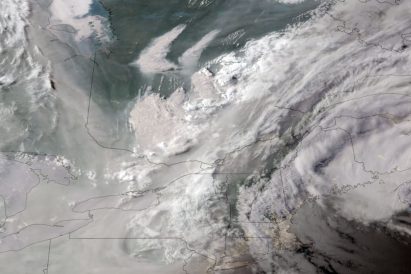
A code red air quality alert has been issued for the entirety of Pennsylvania by the Pennsylvania Department of Environmental Protection, as smoke from the wildfires burning in eastern Canada blanket counties throughout the state.
The code red alert means that due to concentrations of fine particulate matter, air quality is in the unhealthy range for the general population and outdoor activity should be avoided.
Meteorologist Shannon Hefferan of the National Weather Service Pittsburgh said the wind trajectory that is causing the hazy conditions in Southwestern Pennsylvania will continue for the next couple of days, with Friday potentially being the worst.
“The hazy skies will likely last through the end of the week, a result of atmospheric winds bringing wildfire smoke from the north. Right now, the red alert is for the smoke haze that’s kind of billowing over Pennsylvania. We’re seeing visibility drops and people are smelling it in the air,” said Hefferan.
Hefferan said the smoke – generated by several large wildfires burning in the Canadian province of Quebec – is the worst in the northeastern United States since July 2022, when a similar pattern and fires were ongoing in Quebec.
The smoke is making for dangerous air quality levels, especially for people with respiratory issues.
AccuWeather meteorologists said in a press release that, unlike other wildfire smoke episodes in the northeast, where the smoke was primarily present above the ground – resulting in hazy skies and more vivid sunrises and sunsets – the smoke in recent days has been at ground level, too, resulting in poor air quality, low visibility, and serious health risks to people, especially those outdoors.
Canada is experiencing the worst start to its fire season on record. In total, more than 4.2 million acres have burned in 2,355 fires in Canada so far this year, according to the Canadian Interagency Forest Fire Center. As o Wednesday night, 439 wildfires were burning, with 248 of those fires burning out of control.
The DEP cautions that poor air quality – a result of concentration of fine particulate matter – can cause asthma attacks, eye and sinus irritation, fatigue, difficulty breathing, chest pains, irritated throat, and increased coughing.
The agency recommends limiting time outdoors and avoiding strenuous activity, and keeping an eye on people with breathing issues.
Those heading outdoors for a significant amount of time can wear an N95 mask to reduce exposure to pollutants, and it’s recommended to run air conditioning an a recirculation setting.
Hefferan said a shift in the wind pattern on Thursday could cause the smoke enveloping Southwestern Pennsylvania, including Washington, Fayette and Greene Counties, to worsen Thursday afternoon – possibly peaking after 3 p.m. – and further impacting air quality.
How long will the smoke stick around?
“Relief from the smoke/haze may occur on Saturday, once a stationary low over Maine and Nova Scotia finally moves,” the NWS Pittsburgh said.
Hefferan said areas east of State College are experiencing visibility of one mile or less, while spots including the Laurel Highlands, Latrobe, and Morgantown, W.Va., are reporting visibility of six miles or less, and flights have been impacted from the smoke.
“We haven’t seen anything like this. You can’t take your eyes away from it. If you look east of State College, in the Poconos and other places, it does not look good at all,” said Hefferan.
Monitoring posted on AirNow.gov, a partnership of the U.S. Environmental Protection and other groups, including the Centers for Disease Control and tribal, state and local air quality agencies, showed air quality in Washington County was unhealthy on Wednesday.