

All abuzz: California students raising honeybees on campus
Notice: Undefined variable: article_ad_placement3 in /usr/web/cs-washington.ogdennews.com/wp-content/themes/News_Core_2023_WashCluster/single.php on line 128
California Area Elementary School fourth-grader Aubree Zitz used to be afraid of bees.
But her aversion to bees has changed over the past year.
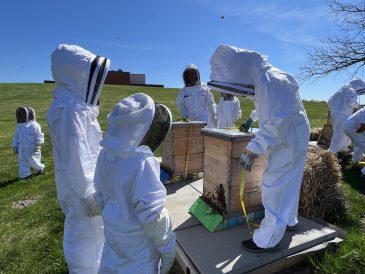
Aubree is a member of one of the coolest clubs on campus, the California Area Student Bee Club, whose aim is to “keep the buzz going” about the importance of honeybees – the insects responsible for pollinating more than 130 crops, from apples and almonds to plums and zucchini.
About 40 elementary, middle and high school students are members of the club, which was started by California Area School District Superintendent Dr. Laura Jacob about a year ago.
“One of the reasons I joined was to overcome my fear of bees, and I’m doing that. Bees are important, they’re interesting. I’ve learned a lot about them,” said Aubree.
The club also operates the California Area Student Bee Club Market, a student-run online Etsy shop, where students sell beeswax-based products they make from the four on-campus hives.
Students spent the winter making lip balm, lotion, candles, and soap, and then in April they packaged and labeled them for sale.
This spring, the club earned about $450, which the members will use to cover the costs of making the products and purchasing supplies, including the ventilated beekeeper suits, and to pay for educational trips and learning opportunities.
Next year, the club will sell honey collected from the hives.
Bees play a vital role in pollinating 80% of the food supply worldwide, but the honeybee population has been declining for several years, a result of factors such as mites, disease, habitat destruction, pesticides, and climate change.
The goal of the apiary is to educate students about honeybees and to help play a role in the bees’ preservation.
Jacob hopes students gain a genuine concern for the environment, and the realization that any human-caused disturbances can greatly affect the pollinators, which, in turn, impacts our food supply.
“I want kids to understand how important bees are to our ecosystem. I want them to realize how critical bees are to our food production, and we have an obligation to contribute to their survival,” said Jacob. “By them (being in the club), I think they see that essential part.”
California Area School District’s sustainability efforts have been acknowledged on a national level.
The school district recently was one of 11 districts recognized by the U.S. Department of Education for efforts to reduce environmental impact and utility costs, improve health and wellness and teach sustainability.
Jacob said the apiary is the project she is most proud of implementing.
The school district has integrated the beehives into the school curriculum, and is sharing its honeybee knowledge with other school districts through a traveling observation hive.
“The kids really enjoy it,” said elementary schoolteacher Brett Klima. “(The beehives) bring so much more excitement to the kids. It’s cool, for example, to study bee larvae and then have them see it in a hive.”
The beehives (which contain as many as 40,000 bees each) are home to the western honeybee. Jacob said each of the hives create between 20 to 40 pounds of honey.
The club meets weekly. As part of the bees’ care, students provide sugar water and pollen packs for the hives. They learn about the life cycle of bees, and gain experience making the products and running the online store.
Even if people don’t have beehives on their property, there are things they can do to help sustain the bee population.
“I want (students) to know they shouldn’t use herbicides and pesticides,” said Jacob, noting bees travel to gather their food, and it’s important to make sure food sources are safe for bees.
She also doesn’t want children to be afraid of bees.
“I want the kids, by being around the hives, to not be scared around bees. I think the more they’re around them, they realize bees don’t want to sting them and that they’ll sting only if they’re in harm or in danger,” said Jacob.
Jacob said interest in the bee program, and the importance of honeybees, has grown since the bee club launched.
“That’s what I love about my job. I see so much good that is in the world, and we have the opportunity to help kids create a better place. Look at how much (bee club) has evolved,” said Jacob. “I have seen them go above and beyond. There’s such good in the world, and these kids are rising up to help make the world a better place.”
[gallery_header ids=”400584,400591,400596,400604,400612,400618,400626,400633″]