

Fayette veteran receives honorary high school diploma 73 years later
The Battle of Inchon during the Korean War occurred in 1950, the same year Arthur Hostetler’s high school class was set to graduate from the former Fairchance-Georges High School in Fayette County.
However, Hostetler was preparing to go to the battlefield instead of getting his diploma.
“It wasn’t a hard decision,” he said of the choice to drop out of high school to join the military. “I’d do it again if I had to.”
And, truth be told, Hostetler said, he never thought much leaving high school to serve until he went to Albert Gallatin Area High School, which now encompasses the area of his former high school. During this year’s Memorial Day Parade, Hostetler got the attention of Alexander Lashendock and Joseph Walsh, both with the Albert Gallatin JROTC, when he asked the men about getting a new formal dress uniform.
He came to the high school to get fitted for the uniform, and they found his photograph wasn’t included on the district’s Wall of Honor with other veterans who had served in the military. After a little more digging, Lashendock and Walsh learned the photographs were of veterans who graduated from the district. Because he was off serving his country, Hostetler didn’t actually graduate.
The men decided that was a wrong that needed to be righted.
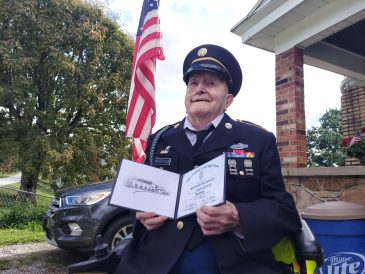
Earlier this month at a Military Appreciation Night before an AG football game, the 91-year-old came out onto the field in his wheelchair, where he was recognized for his service and received his honorary high school diploma.
“I didn’t know what it was. I didn’t believe it at first until I read it,” he said. “And then they said to me, ‘Now you have to go get a job.'”
“He was emotional,” said his daughter, Kellie Foster. “I want to have a graduation party for him.”
Walsh said when he presented the idea to the Albert Gallatin School Board, the only debate was who would present Hostetler the diploma.
“He thought he was there to flip the coin for the football game,” Walsh said, adding when high school Principal Eric Witt presented Hostetler with the diploma, he looked shocked.
Hostetler wasn’t unfamiliar to the football field; he played in high school, before he opted to drop out at 17 to enlist in the U.S. Army National Guard at the start of the Korean War. He said he was whisked off to boot camp, went through mortar training in Indiana, and was dropped at the Pusan perimeter.
“I was asking when we’re going to be on the battle line when we landed in Pusan, and they said, ‘You are on the battle line now,'” Hostetler recalled.
The U.S. defense of the perimeter stopped North Korea from capturing the entire Korean peninsula.
Following that, Hostetler was part of the Inchon invasion where about 75,000 troops recaptured the South Korean capital of Seoul from the North Korean army, and was considered a turning point in the war.
“I was so damned scared,” Hostetler said of his 15 months in Korea with a mortar platoon, loading and firing mortars at the enemy, and detonating unexploded mortars. “A lot of guys said they weren’t afraid, and I said, ‘You weren’t there.'”
During the invasion, Hostetler sustained a shrapnel injury to his left leg and nearly lost a part of his ankle. He also sustained a bullet wound to his left leg, where the bullet remains lodged.
“I’ve had guys fall alongside me,” he said. “Luckily, the good Lord was with me, and I’m still here.”
His remaining two years in the service were spent at Governors Island in New York, training soldiers to be on mortar platoons. He said he often found the training to be nearly as dangerous as the war. He recalled during a target practice, a young, untrained recruit was using a hammer and a screwdriver to open a canister on a mortar, which caused it to ignite and explode, killing 15 men. Hostetler was further down the line when the explosion happened.
Hostetler, a sergeant first class at the end of his service, toyed with the idea of reenlisting until his master sergeant took him to the place he’d be stationed.
“I was in Vietnam for a week, and I said (to the master sergeant), ‘I’m going back to New York,'” Hostetler said. “I did one tour. I’m not dumb enough to do another one.”
In 1953, civilian life brought him to the state of Delaware, where he worked during the day as a bricklayer and at night on the assembly line at Chrysler and General Motors. In 1970, he, his wife, Doris, and their five children returned to Fayette County and purchased a house and two acres of land in Smithfield.
He started his own company, Hostetler Masonry, which he ran until he retired in the early 1990s.
Around that time, Doris passed away, and he later married his second wife, Elaine.
Hostetler said he appreciates Elaine and Foster, who both care for him, and Walsh, Lashendock and everyone with the Albert Gallatin JROTC and the district administration who helped him graduate – even if came 73 years late.
“There are nice people in the world,” he said. “I truly appreciated everything they’ve done for me.”