

LETTER: Does Southern Beltway deliver?
Does the Southern Beltway deliver?
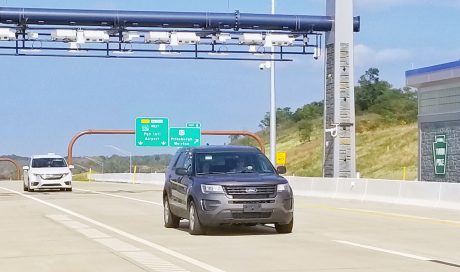
After decades of debate and years of construction, the much-touted leg of the Southern Beltway from Interstate 70 at Southpointe to the Pittsburgh Airport is open to traffic. We have heard repeatedly that the toll road will be a great time saver for commuters heading to the airport, and will allow the motorist to avoid traffic on the Parkway West with its occasional log jams of accidents and heavy usage.
On a bright Sunday afternoon, we decided to test out the validity of the Southern Beltway as the better route to the airport, versus the traditional I-79 and Parkway West journey. It is factual that the new roadway is a marvelous piece of construction and engineering. The posted speed limit is 70 mph, and that is the normal speed limit for all of the Turnpike’s highways. The route is scenic and the surface is remarkably smooth, as should be expected. But is the much-ballyhooed new toll road the big time saver it has been promised to be? Well, here are the bare facts, as we found them. From our home adjacent to the Canonsburg Hospital, to the airport’s departure gates, by using the beltway, the distance is 27.2 miles, and with the time to arrive at 28 minutes. By returning home via the Parkway West and I-79, the distance is 29 miles, with a time to arrive back home of 32 minutes. So, what are the true savings in time and distance? We found a time savings of 4 minutes, and a mileage differential of 1.8 miles. We made every effort to keep to the posted speed limits in both directions. Traffic was very light on the Parkway West as expected on a Sunday afternoon. In all fairness, it should be possible to shave off maybe 1 to 2 minutes on the return trip via the Parkway West & I-79 South because we had to reduce our speed through the construction zone on I-79 for the I-576 interchange work. That would bring down the time differential to maybe 1 to 2 minutes, as long as the weekday traffic on the Parkway West was not heavy and slow as often it is.
Now, we have to take in the toll charges for using the new highway. If the driver has an EZ Pass, each way costs $3.90, with a round trip of $7.80. Supposing that a flying traveler will need to be taken to the airport then picked up on the return home; two round trips will set the driver back $15.60. By having the Turnpike Commission bill the driver without an E-Z Pass, a round trip costs $15.60, and the favor of two round trips for the departure and the return home will be billed at $31.20. It is quite clear that if commuters who use the new toll road, an EZ Pass is a great savings. If the driver doesn’t have one, a hefty bill will arrive in the mail for the two round trips.
The decision to use the Southern Beltway for passenger car trips to and the airport is not as clear-cut as expected it would be. The time savings may be big or small depending on the parkway’s traffic conditions. The mileage savings is hardly worth any serious discussion. But as I have seen, the Turnpike’s fairly new toll roads in our region appear to be underutilized, and drivers seem to opt for the longer routes on toll-free highways to their destinations. If the tolls can be written off as business expenses, I’d expect those travelers will quickly adopt the Southern Beltway without any forethought. But the vacation airline passenger may not be so willing to start and end the vacation with a bill for toll road usage. However, commercial use of the toll road by the trucking industry may prove to be a genuine savings for those operators.
Ronald J. Yamka
Canonsburg