

Hits and Misses

Markus Schreiber/Associated Press
A doctor administers a COVID-19 vaccine in this file photo.
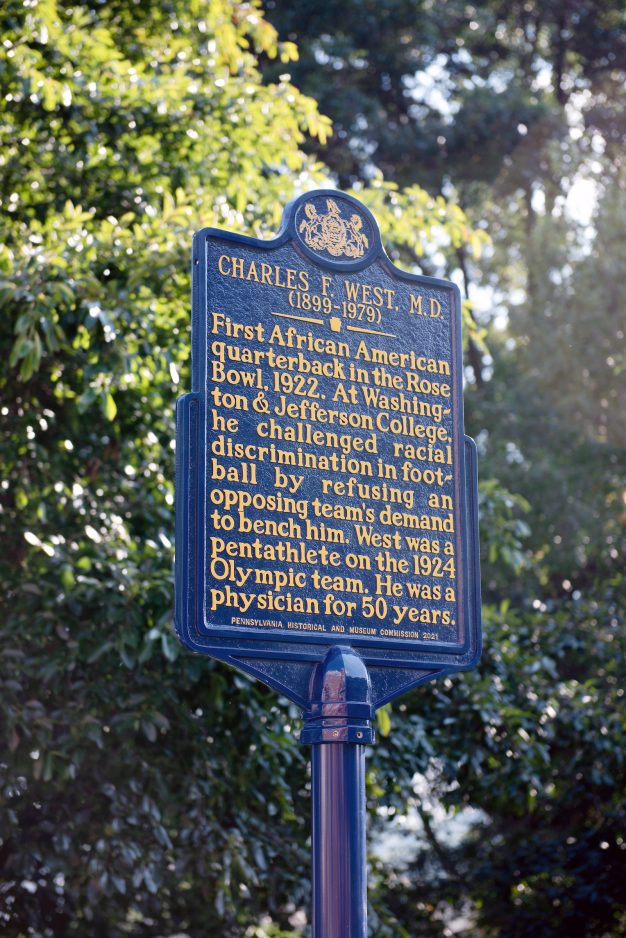
Courtesy of Washington & Jefferson College
The Pennsylvania State Marker honoring Dr. Charles F. West was erected last year on the campus of Washington & Jefferson College. A marker honoring Andrew Gardner Happer will be placed at 130 E. Wheeling St., outside of the Admission House on W&J’s campus.
Greene County officials are able to continue expanding broadband capabilities to underserved areas thanks to a $1 million donation from CNX Foundation. In partnership with Kinetic by Windstream, the money will be used to install 31 miles of fiber cable, providing high-speed internet to 103 customers in Gray, Morris and Richhill townships. It marks the third project undertaken by the county to help its rural residents have reliable internet service. The first $3 million project used CARES Act funding to upgrade online speeds for 8,300 homes and businesses in Waynesburg, Carmichaels and Mount Morris. And a $2.5 million grant from the Appalachian Regional Commission, supplemented by a $2.7 million match from Kinetic will bring high-speed connections to 767 customers on the county’s southern border. Having the ability to reliably join in an online world is something most people take for granted. The continued expansion of availability in Greene is important to keep the county residents and businesses competitive.
Need an example of the ingenuity of American science? Well, there were actually two excellent examples that emerged this week. First, a study from the Commonwealth Fund found that the COVID-19 vaccines created with lightning speed by Moderna, Pfizer and Johnson & Johnson saved 3 million American lives over a two-year span. The vaccines also prevented 18.5 million hospitalizations, saved the economy $1 trillion and stopped another 120 million coronavirus infections from happening. Then, there was the news that American scientists have made a breakthrough in nuclear fusion energy at California’s Lawrence Livermore Laboratory. If it is refined, it could create abundant and inexpensive energy for the world without generating greenhouse gases, pollution or the radioactive waste that is produced by nuclear power plants. The United States is polarized right now, but the resourcefulness of American science should be a point of pride no matter where you stand on the political spectrum.
Every year, the Pennsylvania Historical & Museum Commission – PHMC, for short – announces a new batch of historical markers that will be going up around the commonwealth. This year, a diverse batch of nominees were honored, including renowned Pittsburgh photographer Charles “Teenie” Harris and onetime Pennsylvania Gov. Richard Thornburgh. Another was Andrew Gardner Happer, a Civil War veteran and important figure in the Washington community in the late 1800s and early 1900s. Among other things, he contributed funds that helped build Washington Hospital. He also accompanied the funeral train of Abraham Lincoln as it moved through Pennsylvania shortly after the president’s assassination in April 1865. The blue sign with the gold lettering will be placed outside the Admission House for Washington & Jefferson College at 130 E. Wheeling St., which was Happer’s one-time home. One of the benefits of the PHMC’s marker program is how it illuminates relatively obscure corners of our history, and connects people to their community’s past.
In recent days, it seems as if the Pittsburgh region has seen deadly house fires on an almost daily basis. On Tuesday, for instance, two children were killed in a fire at a residence in Sewickley. That was just a little more than 24 hours after one resident of a high-rise apartment building in downtown Pittsburgh perished in a fire. As the temperature outside tumbles, the number of house fires increases. More than half of all house fires occur in December, January and February. Though the recent house fires are all, of course, being investigated, house fires at this time of year are frequently caused by space heaters, cooking mishaps or chimneys that have not been properly cleaned. Staying warm or enjoying a hearty meal are all important at this time of year, but caution, as always, should be exercised.