

Countries should aid, not reject, fleeing Russians
ASTANA, Kazakhstan – Tens of thousands of Russian soldiers have died in the war with Ukraine and hundreds of thousands of men are fleeing Russia to avoid the same fate. But many countries have closed their borders to them.
In 2014, Crimea got annexed by the Russian Federation. That event steered the relationship between the two former allies in the abominable direction no one had ever foreseen. Almost eight years later, on Feb. 24, 2022, Vladimir Putin announces his immediate plans to conduct a “special operation” on the territory of Ukraine.
In September of this year – without having officially declared war on its western neighbor – Putin publicly called for the start of a “partial mobilization,” meaning that most Russian men were going to become soldiers and would be sent on a tour to the eastern part of Ukraine. Following the news, the local military branches located all over Russia, whose chief purpose is to keep track of and enlist conscripts, started sending out povestkas – cut-short paper slips with some text and an official government stamp that informed their recipients about the obligation to show up at their local branch – to almost every man regardless of their age, health or marital status. Even though several people are known to have been sent to Russia’s western front immediately as soon as they showed up at the branch, a povestka, per se, does not imply that its intended recipient is 100% going to war. However, for most male Russian citizens things are crystal clear now: at any moment they can be taken away from their jobs, homes and families in order to take part in the “liquidation of the anti-Russian enclave.”
Realizing this, a lot of them have decided to escape Putin’s regime as soon as possible. But how have the countries and their populations that border Russia and Ukraine reacted to the sudden and massive inflow of those Russians who are not willing to go to war and risk their lives?
Where are all those Russians, most of them men aged 20 to 40 with stable jobs and some savings, moving? Given that the airline ticket prices to such destinations like Astana, Almaty, Tbilisi, and Baku grew tenfold or even higher within a matter of several hours following the announcement of the partial mobilization, most have managed to find a vehicle, endure enormous traffic, and cross the borders with Kazakhstan, Georgia, and even Mongolia. As of today, the Republic of Kazakhstan, sharing the longest border in the world with Russia, remains the top destination with roughly 200,000 newly arrived Federation citizens already within its boundaries. Others have taken advantage of the visa-free agreements for Russian passports and have flown to Mexico, Turkey, and the United Arab Emirates; the plan for the majority of them is to settle on foreign land temporarily and wait out the turbulence, or at least until things in their homeland improve.
But not all Russia’s neighbors have been so hospitable. As of now, surprisingly, the three Baltic states, Finland, and Poland – the countries you would normally expect most help from – have closed their borders even for those Russians who hold valid Schengen visas (visas that allow foreigners to travel to most European states.) For instance, Gabrielius Landsbergis, the minister of Foreign Affairs of Lithuania, recently in one of his “tweets” claimed that the measure is to “make Russians stay and fight. Against Putin.” Another, more direct, example of such talk by the official can be seen in this reply to the tweet dated Sept. 24, in which those Russians who are against the mobilization and are forced to flee Russia are called “dodgers with responsibility.”
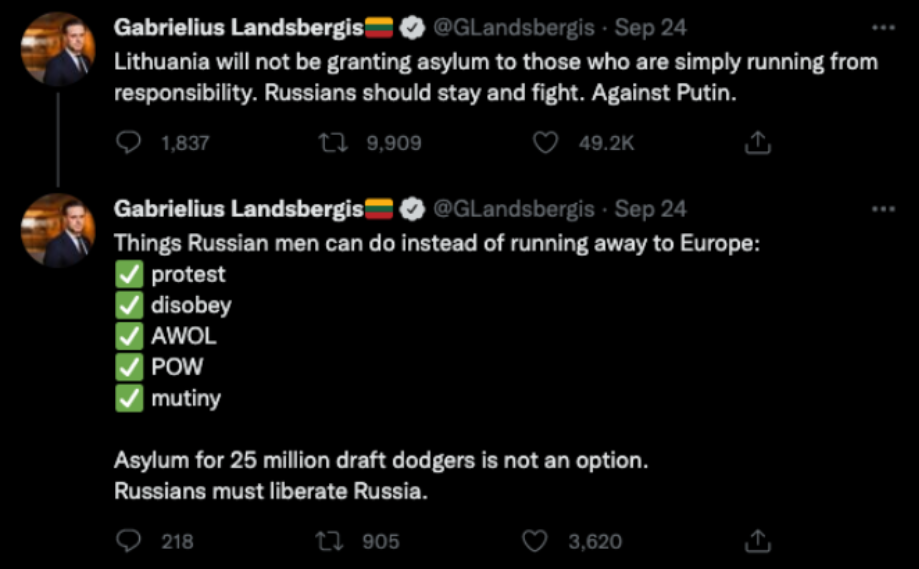
The Lithuanian minister also suggests Russian men engage in “protest” and “mutiny.” As one popular internet saying goes, “sounds good, doesn’t work.”
Given the current state of matters, a legitimate question arises: Why is it that while some of the post-Soviet authoritarian regimes – a.k.a. “second-,” or even “third-world,” countries, the so-called “developing” states, welcome fleeing Russians without limits and even offer them help in the form of expedited processing of certain documents, several eastern European states – the so-called “progressive, tolerant, democratic, and developed” countries – deny people entry simply based on the fact that one is a Russian citizen (even when they possess a valid visa)? Isn’t it hard not to notice the apparent and unexpected discrepancy in the attitude and behavior toward those in need between a presumably democratic state and an autocracy?
Vladimir Putin’s birthday was on Oct. 7. The next day, one section of the Crimea bridge – the most significant and expensive construction project under Putin’s rule that symbolizes the unity of Russia and connects the peninsula with the “Big Land” – was destroyed by a truck full of explosive material, rendering the only road connection with Crimea virtually unusable. It is clear the blast was terrorist in nature and was meant to undermine Putin’s actions. While such idiotic policy continues to assault Russian citizens’ freedom and safety, people will choose to flee the country. Their potential European destinations, by refusing them entry, are losing out, especially considering their own demographic problems such as fast-aging and unemployed parts of the population.
It is crucial to understand that those who have left and are leaving Russia can (and are able to) do so in the first place, in addition to being young, willing to work, and bringing their money that goes into the economy. Kazakhstan, unlike several European states, has chosen to help, not to reject. This is what makes the world a better place.
Artyom Sergazinov currently lives in Kazakhstan. He is self-employed, an avid traveler, and likes writing about current events in the world. He can be reached by email atartyom.sergazinov@gmail.com