

Bulger, where the buffalo roam
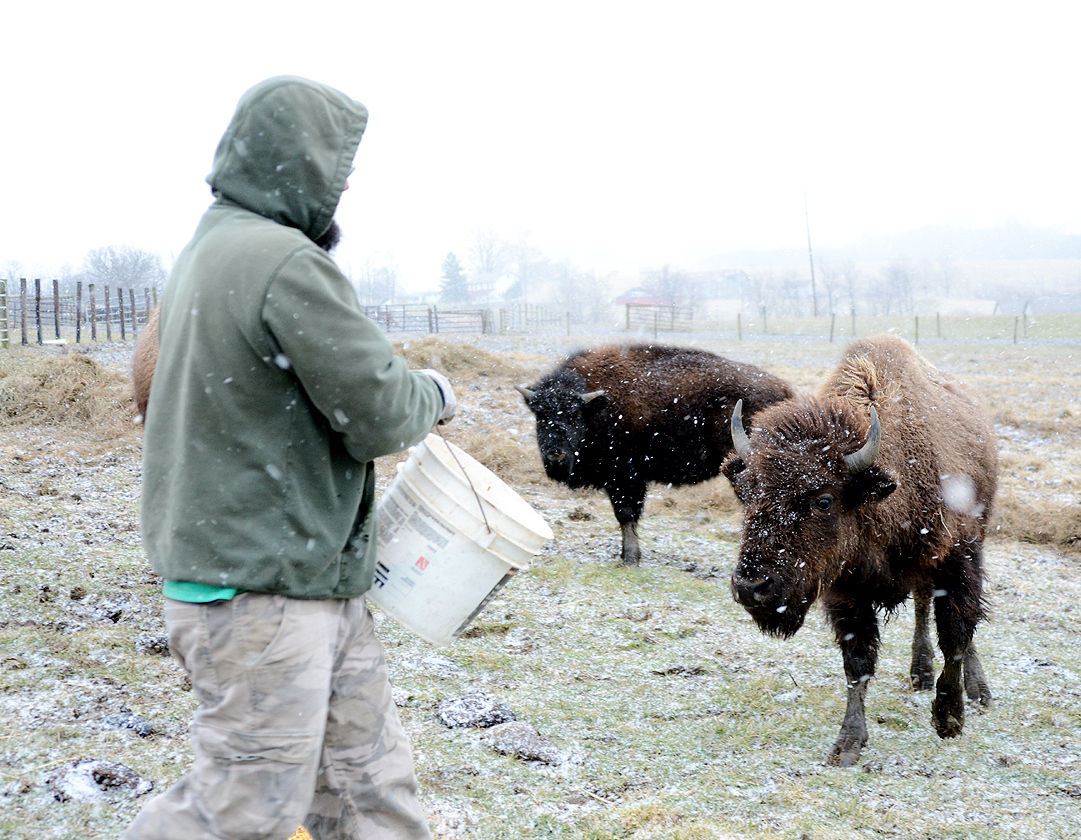
Joel Duran feeds a yearling heifer bison on his father’s farm in Bulger. He said taking care of the buffalo was a labor of love.
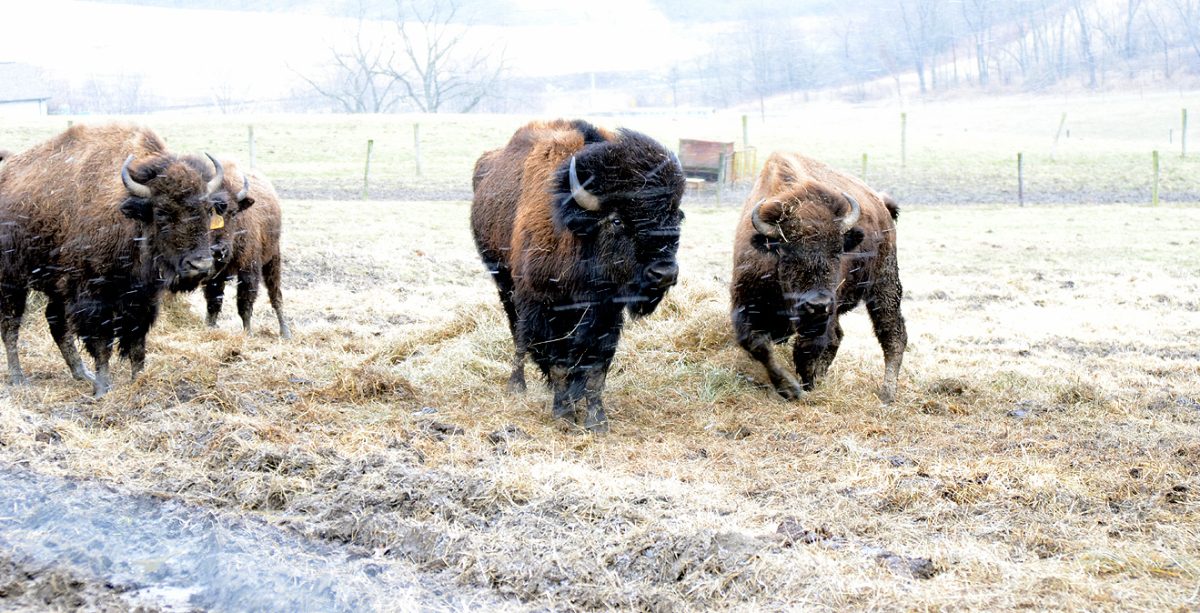
This buffalo steer, center, and his female companions didn’t seem bothered by the blustery winds and snow on this cold February day in Bulger. Wild American buffalo were originally found all over North America, and their thick hides and wooly coats protected them from the cold.
BULGER – In the gentle rolling fields of northwestern Washington County lives a small herd of noble creatures that are a reminder of the region’s past. Grazing the pasture of the Duran farm in Bulger, eight American buffalo coexist with the family’s goats, sheep and Angus cattle.
“They’re very laid back unless they feel threatened,” said Joel Duran, the keeper of the small group of bison. “If you leave them alone, they leave you alone.”
In the time before European settlement, the American buffalo ranged all over North America. Although the buffalo were hunted to near-extinction in the 19th century, between 20,000 and 30,000 wild animals still survive, mostly confined to the American Northwest and Canada.
The same features that allowed them to thrive in the wild make them a handful in captivity. They’re able to leap as high as six feet, are incredibly strong and are very fast runners.
“They got loose once,” Duran, 31, said. “I was chasing them on the Gator (utility vehicle), and they clocked out at 35 to 40 (mph). If you can’t run that fast, don’t get in the pen.”
Butchers won’t take live buffalo because of their wild nature, and herding, corralling and penning the animals can be a tricky endeavor.
“Don’t underestimate them,” Duran said. “You’ll die if you do. They will flip out, and they break a lot of stuff. They can take a metal gate and put it to splinters.”
According to a paper published in the Academy of Natural Sciences in 1895, the last wild buffalo in Pennsylvania was shot by Col. John Kelly “about 1790 or 1800” on the McClister farm in Lewisburg. The tale of how this small group of animals made their way to the small village in Smith Township is the legacy of one man’s determination.
Duran, 31, said his late father, Michael, one day decided he wanted buffalo on his family’s farm.
“My dad got an idea in his head, and he went for it,” Joel Duran said. “Anything he wanted, he’d get.”
One day, Michael piled his family in the truck, telling them there were going for a drive. They drove to a farm in Ohio and came back with three young bison. Now, the herd has grown to include eight animals.
Even for hardworking farmers, handling bison can be tough. What makes the group at the Duran farm remarkable is the fact that they are taken care of with no hope of financial benefit, although the family does occasionally slaughter an animal for meat.
Hard work is a trait that lives on in Duran’s children. Each of his four children was a member of the Future Farmers of America organization and earned the coveted Keystone Farmer Award. After his father died, Joel, along with nephew Clayton, took the reins by taking care of the small herd of buffalo in order to bring Michael Duran’s vision to fruition.
Like his father, Joel doesn’t let a full-time job stop him from taking care of the family’s animals. After finishing his shift at Union Electric Steel in Carnegie, he travels to the farm to put in some more hours feeding livestock.
“It’s difficult for him, I know, to do stuff without his dad,” said JoAnn Duran, Michael’s widow. “But he’s dedicated. He’s trying to carry on his dad’s dream.”
Before his death in August 2011, Michael Duran endured dialysis treatments for 12 years. Even as his health began to fail, the retired heavy machine operator continued to care for the animals he loved.
“He would come home from dialysis and lay down for a little bit,” JoAnn Duran said. “Then he would go out and cut hay, rake it, then get on the hog tractor and begin cutting grass. He loved to take care of them.”