

Lucky 13: Wild Things hope season brings good fortune
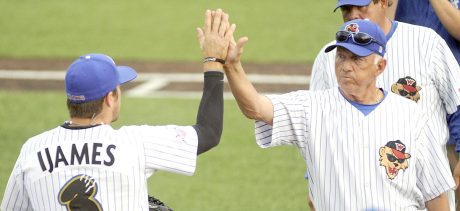
For their first six years of existence, the Wild Things were the model franchise in the Frontier League. Though a league championship proved elusive, the Wild Things won five division titles. They made the playoffs every year. They kept the turnstiles spinning by playing before sellout crowds at almost every home game. They seemingly could do no wrong.
The last six seasons, however, have been the complete opposite of the first half dozen. There have been no playoff appearances and attendance figures have dwindled to half of what they used to be. Things seem to be stuck in reverse.
So what does Season 13 hold for the Wild Things? Will it be lucky? Could it start another six-year run of success?
“I’ll take a one-year run,” said second-year manager Bart Zeller, who knows what it takes to win the Frontier League, having guided the Joliet Slammers to the championship in 2011.
Zeller was a booster shot of credibility to the franchise in his first season in Washington, though the won-lost record might not have shown as much. During a season in which the league’s level of play was at its highest in 12 years, Zeller managed to stop the constant roster changes that had plagued the team and put together a solid corps of players who return after posting a 41-55 record.
When Season 13 begins tonight at the Florence Freedom, the Wild Things will have 10 returning players on the active roster, plus several key additions who are expected to play more than casual roles. One of those newcomers is tonight’s starting pitcher, Scott Dunn, who was acquired in an offseason trade with the Traverse City Beach Bums. Dunn had 15-1 record last season and was named the Frontier League’s Pitcher of the Year.
Washington also acquired two other right-handed starting pitchers, Chris Phelan and Alex Kaminsky. Phelan had a 7-2 record as a rookie with league champion Schaumburg, and Kaminsky won 17 games over the last two years with Lake Erie and Gateway.
Washington’s lineup is led by returnees C.J. Beatty, Stewart Ijames and Jim Vahalik. Ijames, a former University of Louisville standout, was one of the top rookies in the league last year, when he hit a league-leading 29 doubles. Vahalik is a solid defensive catcher and Beatty led the Wild Things in home runs (18) and RBI (66). Beatty shifts from second base to left field, a position he played when he was in the St. Louis Cardinals’ farm system.
The infield is entirely new. William Beckwith, who hit 15 home runs two years ago in the Atlanta Braves’ farm system, will be the first baseman and is being counted on to provide a power bat in the middle of the lineup. Nick Ratajczak, a teammate of Ijames’ at Louisville, is a slick-fielding second baseman and statistically was the toughest player to strike out in college baseball last year. Ryan Kresky, another offseason trade acquisition, started at shortstop for Evansville last year.
Carter Bell is a third baseman who has four years of experience in the Arizona Diamondbacks’ system, and Garrett Rau, who can play multiple infield positions, has two productive years of independent ball experience.
Speedy center fielder Danny Poma, who also has experience in the Diamondbacks’ system and once hit. 430 in college at Hofstra, should be another impact newcomer.
“We know we’re better defensively at second base. We know we’re better in center field,” Zeller said. “Some pitchers are nice additions, Ryan Kresky should offset losing (A.J.) Nunziato at shortstop, and William Beckwith should outperform what we had at first base.”
Washington played five exhibition games against the Lake Erie Crushers and produced a 2-2-1 record. As is the case with most spring training games, the pitching was ahead of the hitting. What Zeller likes most about his team is the chemistry. While all independent baseball players would rather be in affiliated ball, the Wild Things seem to be buying into Zeller’s team-goals-first approach.
“Having good team chemistry is vital,” Zeller said. “You must have a happy clubhouse and guys who bond. Cliques don’t work in baseball.”
Even with an experienced team, Zeller is not about to make any predictions for the season. His goals go no further than the first 10 games.
“We’ve talked a lot about goals as a ballclub. We’re still taking the approach of breaking down the season into 10-game stretches,” Zeller said. “If we can win six out of every 10, then we’ll be where we want to be at the end of the season.”
Coming off six consecutive seasons that have failed to produce a playoff appearance, or even a winning record, not many people outside of Washington are expecting the Wild Things to make a playoff push out of the East Division.
That doesn’t bother Beatty, who says Season 13 could be one of surprises.
“Last year, the fans let it be known that this used to be a winning ballclub,” Beatty said. “One reason I came back is the way the fans support the team and want us to win. The expectation of winning is still here.
“I like being the underdog. I like it when the other teams are saying ‘We don’t have to worry about Washington.’ That’s OK with me. This year, we’re expecting to come out and win.”
To get down to the limit of 24 active players, the Wild Things placed pitcher Julio Perez and outfielder Marinio Guzman on the suspended list, Kaminsky on the 7-day disabled list and pitcher Zach LeBarron on the 14-day disabled list. With off days Sunday and Monday, Kaminsky’s spot in the starting rotation will not be needed until a home series May 23-25 against Rockford. … One change will bring back memories of the Wild Things’ first six seasons. Washington has switched back to its original red & black color uniform colors.