

U.S. men struggle to get by Serbia
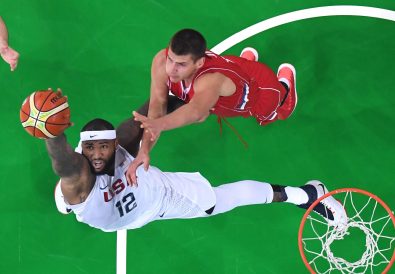
RIO DE JANEIRO – Written in Portuguese on one wall above center court at Carioca Arena is the phrase “Um mundo novo.” Translation: A new world.
It didn’t seem that way in men’s basketball to start the Rio Games, but it’s getting closer.
Threatened by Australia in its previous game, the U.S. men’s team started fast but had to survive a heart-racing final seconds to beat Serbia 94-91 Friday, the 48th consecutive international tournament win for the Americans.
This one, though, took everything the United States had.
They couldn’t put away the Serbs, who had a chance to tie it in the final seconds but guard Bogdan Bogdanovic’s 3-pointer from the left wing was a little long and Kevin Durant secured the rebound to keep the relieved Americans’ streak intact.
Kyrie Irving scored 15 points and Durant and Carmelo Anthony had 12 apiece for the Americans, who arrived in Brazil being lauded as another American super squad and gold-medal lock. However, after a close call against Australia earlier this week and now another against Serbia, the rest of the field might be starting to believe the Americans can be taken.
“We got in our own heads,” Durant said. “We had a great start, great start. We were up almost 20 points. We should have held the lead and we just got sidetracked by stupid stuff, from the calls to the physicality, the extra plays. We got to stay with it. That’s the way it’s going to be out here.”
Nikola Jokic scored 25, Milos Teodosic 18 and Miloslav Raduljica 18 before fouling out for the Serbs, who fell to 1-3 but left Carioca Arena feeling confident after taking the Americans down to the final ticks.
The United States, which will wrap up preliminary-round play against France on Sunday, led 94-87 with 2:11 left on a basket by Anthony. But the Serbs got a basket by Jokic and two free throws Teodosic to get within three.
Swimming: Katie Ledecky has delivered another dominating performance at the Rio Games, handily breaking the world record in the 800 freestyle.
Ledecky joined Debbie Meyer as the only women to sweep the three longer freestyle events at the same Olympics. Meyer took the 200, 400 and 800 at the 1968 Mexico Games, and Ledecky matched that performance with a couple of world records as well.
Ledecky was merely racing the clock as she powered away from the field to touch in 8 minutes, 4.79 seconds, eclipsing the mark 8:06.68 that she set at a grand prix meet in Texas back in January.
Then she waited for the rest of the field finish.
Jazz Karlin finally touched in 8:16.17 to claim the silver, just ahead of Hungary’s Boglarka Kapas grabbing the bronze in 8:16.37.
Some 23 seconds after Ledecky touched the wall, the last of the eight finalists finally got to the end of the grueling race.
• Maya DiRado of the United States has denied Katinka Hosszu’s bid to become a four-time gold medalist at the Rio Olympics.
Hosszu got off to a blistering start and led almost the entire race. But DiRado rallied furiously on the final lap and got Hosszu at the touch to win in 2 minutes, 5.99 seconds.
Hosszu settles for silver in 2:06.05, while Canada’s Hilary Caldwell took the bronze in 2:07.54.
DiRado couldn’t believe what she had done in her one and only Olympics. She put her hands on her cap in disbelief when she saw he name on top of the scoreboard.
• In a stunner, Michael Phelps was beaten. Joseph Schooling of Singapore built a big lead on the opening lap and easily held off the hard-charging Phelps to win gold in the 100-meter butterfly. So, unless Phelps decides to come out of retirement again, his final individual race at the Olympics will go down as a silver. He still has a chance to win his 23rd gold medal in his final race of the Olympics, the 4×100 medley relay.
Phelps was sixth at the turn and Schooling almost exactly a decade younger than the 31-year-old American wouldn’t let him pull off one of his patented comebacks on the return lap. The winning time was 50.39 seconds.
Phelps shared the silver with two other longtime rivals, Chad le Clos of South Africa and Laszlo Cseh of Hungary. They all touched in 51.14.
• Sixteen years after winning his first individual gold medal at the Olympics, Anthony Ervin picked up his second with a furious dash from one end of the pool to the other.
Completing a remarkable journey in the blink of an eye, the oldest member of the U.S. swimming team touched first in the 50-meter freestyle, edging the defending Olympic champion, Florent Manaudou of France, by a mere hundredth of a second.
Another American, Nathan Adrian, took the bronze.
The 35-year-old Ervin won his first gold at the 2000 Sydney Olympics, tying teammate Gary Hall Jr. for the top spot. Then, Ervin walked away from swimming, skipping the next two Olympics while he embarked on a journey to find his purpose in life.
Men’s golf: Marcus Fraser of Australia got off to a quick start, stretched his lead to four shots at one point and wound up with a 2-under 69 for the 36-hole lead in the Olympic golf competition. At 10-under 132, he had a one-shot lead over Thomas Pieters of Belgium, a former NCAA champion at Illinois who closed with three straight birdies for a 66.
Still, it was the sight of Open champion Henrik Stenson on the leaderboard that was so hard to ignore.
Only a month ago, the 40-year-old Swede won his first major and got his name on the claret jug at Royal Troon with the lowest score in major championship history. Friday, he had a 68 to go into the weekend at Olympic Golf Course two shots behind and in the final group.
The Americans continued to be unimpressive. Matt Kuchar had a 70 and was seven shots behind, following by Bubba Watson (67) at 2-under 140, Patrick Reed (69) nine shots back, and Rickie Fowler (71) 14 shots out of the lead.
Bronze boxer: Nico Hernandez’s chance for a gold medal ended Friday when he lost to Uzbekistan’s Hasanboy Dusmatov. With a gnarly gash over his left eye, Hernandez had blurred vision and needed stitches. His consolation: his bronze medal in the light flyweight division ends a medal drought for the American boxers that stretched to 2008.