

Forget who’s on first, what’s the (pitch) count?
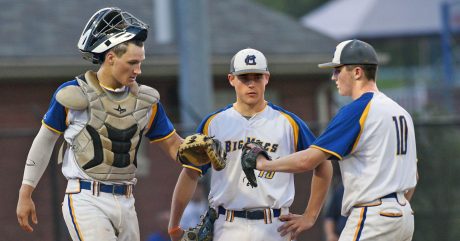
A new rule that will limit the amount of pitches a player can throw in varsity and junior varsity high school games has been met with the approval of local coaches.
But there remain questions, concerns and some doubts as to how the new system will be operated, how the information will be recorded, who will record it and how it will be verified and certified.
Last month, the National Federation of State High School Associations said its member state associations must base their pitch limitation policies on a pitch count.
The new rule, one of six approved by the NFHS Baseball Rules Committee at its June meeting and later approved by the NFHS Board of Directors, requires a policy change for member state associations – like the Pennsylvania Interscholastic Athletic Association (PIAA) – which has limited pitching based on an innings count.
“There are a lot of variables with this,” said Bob Bozzuto, athletic director at North Allegheny High School and chairman of the WPIAL baseball steering committee. “The move is necessary throughout the game. They are out for the overall safety of the player.
“I have a couple ideas I want to express to protect the player. Unfortunately in sports, you try to manage things that some people will abuse.”
High school pitchers in Pennsylvania have been allowed a maximum of nine innings in a calendar day and 14 in a week – Sunday through Saturday.
Required rest days have been based on the number of innings thrown, with a maximum rest period of three calendar days required for players who pitch six or more innings in a day.
According to PIAA policies and procedures, the PIAA baseball steering committee – one of 15 sport-specific steering committees – might make rules recommendations to the PIAA Board of Directors, which then votes on the recommendations.
Bozzuto has coached baseball at all levels, including a stint as manager of the Washington Wild Things of the Frontier League.
“There are a lot of issues with mechanics to take into account as well. One of my suggestions is that if a coach goes out for a third trip, the pitcher is done for the game. Out of the game. Protect the player.”
Many area coaches don’t mind the rule. Most of them keep pitching counts and chart the pitches. But they are wary of how the rule will be implemented and who will have access to the information.
“We have always kept track of pitches thrown so we have an accurate account of what is going on,” said long-time Peters Township Coach Joe Maize. “It is an important responsibility. At the end of the game, how is this to be reported? The intent of the rule is good. But we need to educate everyone, including parents.”
Some coaches suggested the umpires keep track of pitches.
However, a handful of umpires said there is no way for them to ensure accuracy of pitch counts because of al the other responsibilities they have during a game.
Rocky Plassio, head coach at Washington, wants to know how the pitch counts will be policed and who will be privy to the information,
“Who is going to be responsible?” he asked. “We keep our own? The honor system? There will be flaws in that.
“It’s impossible to find a box score of all high school games, Is this going to be a progressive system? We have a lot to talk about and think about. I agree to trying to do what is best for our kids is right. But there could be a lot of loopholes. This might change a team’s strategy. Do you take more pitches to work up a pitch count? They have a lot to work out.”
Currently, there is a wide-ranging difference in how states deal with limiting stress on high school-aged pitchers’ arms. For example:
• In Tennesee, pitchers cannot throw more than 10 innings over a two-day span.
• Pitchers in Indiana are permitted to throw 10 innings every three days.
• Michigan’s rules limit pitchers to 30 outs. The number resets after two days of rest.
• Illinois limits pitchers to seven innings a day.
• Alabama previously adopted a pitch count for 2017.
The rule in Alabama set the maximum at 120 pitches a day, with three days rest required after throwing 76-120 pitches in one day. It also includes a 100-pitch limit for junior varsity hurlers, and 85 for middle schoolers.
The Texas University Interscholastic League tabled a proposal recently that included a pitch count of 95 a game for ages 14-16 and 110 for 17-19, with four days of rest after 86-110 pitches.
“Pitch Smart” guidelines, drafted by Major League Baseball and USA Baseball, established maximum pitches, according to age.
Players 17-18-years-old are capped at 105 pitches in a day, to be followed by four days rest.
“The end result is the principal is in charge,” said John Curtis, veteran coach at Jefferson-Morgan. “I never have questioned inning counts. We’ll find a way to keep track of this. This is good for the player and the game. You have to rely on the integrity of people and integrity of the game. We’ll manage this somehow.”
California coach Nick D’Amico said there are a lot of ideas bouncing around, but other things need to be considered.
“Are we taking into account pitches made in the bullpen, between innings and throws from other positions?” D’Amico said. “We had a game where the opposing pitcher threw over to first 16 times to keep a runner close before an out was recorded. That’s stress on the arm. What are we going to count?”
According to a 2015 study by the American Orthopedic Society for Sports Medicine, kids ages 15-19 accounted for 56.7 percent of Tommy John elbow reconstruction surgeries performed in the U.S. from 2007-2015.
Previous NFHS guidelines only required states to have a policy affording pitchers “reasonable rest between outings.”
NFHS left details – specifics pitch counts, days of rest, etc. – up to state associations, since each has its own season length and climate that differently impact pitchers.
“Educating people is most important,” Bozzuto said. “We need to look at the big picture. Some kids are throwing too much, pitching too much. We can legislate all we want but we have to educate. It’s going to be very interesting. People have to use good sense in how much they are asking of these kids’ arms. We’re going to take a good look at how to protect these kids.”