

Latest concussion study catches attention of Steelers
LATROBE – Smokers knew for years that cigarettes were bad for them. But when doctors began coming up with studies showing just how bad cigarettes were, the number of smokers began to plummet.
A number of the Steelers hope the same thing doesn’t happen with football because of concussion studies that show a link between them and chronic traumatic encephalopathy (CTE).
A recent study published in the medical journal JAMA last week found CTE was present in 110 of 111 former NFL players who had donated their brains to the study following their deaths.
While the number is chilling because CTE can lead to memory loss, depression, Alzheimer’s disease and a number of other issues, it should be noted that the players who chose to participate all had exhibited some kind of symptoms before their deaths.
Still, the study caught the attention of current players.
“It’s one of those known unknowns,” said Steelers guard Ramon Foster, who also serves as the team’s union representative. “We see it. We just don’t talk about it. It’s like getting a will together or getting your life insurance. Those are things that are real that have to be done.
“There’s no telling with guys who have been playing football since they were five years old until they’re 30, when did it come about? But it’s something that’s there. The way we play the game, some people might call it softer, but you’re dealing with guys’ brains, guys’ livelihoods, that’s something that has to be taken into account.”
In recent years, concussions have come to the forefront of things in the NFL as the league has cracked down on hits to the head. It also has instituted safeguards such as putting an independent doctor at every game to look for players who might have suffered a concussion. Those players are immediately removed from the game and given cognitive checks.
The league also has instituted more rigorous protocol that players must pass before they are cleared to return to play after suffering a concussion.
It’s no longer viewed as a guy just “getting his bell rung.”
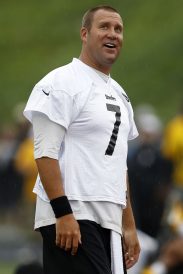
That’s one of the reasons why quarterback Ben Roethlisberger pulled himself out of a game at Seattle a couple of years ago.
And he’s been an outspoken proponent of players not trying to trick the system to assess concussions.
Roethlisberger admits that’s one of the reasons why he openly considered retirement in the offseason before eventually deciding to return for a 14th season.
He has three children under the age of four with his wife, Ashley, and wants to be physically able to do things with them and remember those events when he’s finished with football.
“I want to be able to play catch with my kids when I’m older,” Roethlisberger told Steelers.com.
“I want to be able to go to games. I want to be able to coach them at home and do fun things like that.”
While the recent CTE study is scary and even was used by Baltimore guard John Urschel, a former Penn State player, as his reason for retiring earlier this week after just three NFL seasons, players are hopeful the game isn’t affected in a negative way.
“Urschel just retired and he was a good guard,” said Foster. “We’ll see what happens with the sport.”
For young players breaking into the NFL, such as the Steelers’ Tyler Matakevich, they know the risks. But they believe the benefits outweigh the other factors.
“I try not to,” the second-year linebacker said when asked if he thinks about the possibility of developing CTE. “The more stuff that comes out about it, it’s there in the back of your mind. For right now, I’m just trying to have fun living the dream.”
The 24-year-old Matakevich doesn’t have any children. But he said when he does, he wouldn’t hesitate to let them play football.
“Yeah, absolutely,” he said. “I mean he can do whatever he wants. But, yeah.”
Therein lies the issue for many of the players. They have played for so long and nobody knows for sure why some guys develop issues and others do not. So little is known about concussions and their long-term effects that many players choose to keep playing and hope they are one of the lucky ones.
And if they aren’t, well, they feel the rewards were worth the risk.
“This is what we do,” said Foster.
“It’s something I hope that when I’m older, my wife and kids make sure I’m OK. I continue to train myself mentally for certain things so that I don’t become dormant (mentally) with how I live my life.”