

High school teams take passing interest with talented quarterbacks
Burgettstown head coach Mark Druga remembers, only a few years ago, when bringing in a system resembling a run-and-shoot offense was frowned upon in high school football.
That was during a time when teams flanked out one or two wide receivers simply to spread out a defense or to keep a smaller player away from massive linemen. Those were the days when Power-I offenses with workhorse tailbacks were the norm throughout the WPIAL.
Quarterbacks, in those days, were only on the field to hand off the football to the tailback.
These days, high school football teams that are sticking with run-heavy offenses are getting passed on the field and in the standings. The game has changed and high school offenses need quarterbacks who can pass. A dual-threat quarterback is even better.
“It’s not new to the sport, it’s just new to the area,” said Charleroi head coach Donnie Militzer. “I graduated high school in 1998, and if you had a 1,000-yard passer it was rare. The game is totally evolving.”
The evolution has not only made passing an accepted manner of moving the football but also the most effective way of scoring and forcing defensive backs to not only cover but also tackle.
“The hardest thing to do is cover,” said South Fayette head coach Joe Rossi, who doesn’t shy away from spreading it out and running an up-tempo pace.
“We aren’t usually an overly big group. For us to be able to compete with teams, that is our method of attack. Guys in the National Football League make millions of dollars if they can cover. It’s a tough thing to do.”
It’s no longer considered cutting edge to switch to a spread offense. It’s also a headache to stopping them as teams routinely put up 40-point games.
“The best athletes have to play defensive back,” Druga explained. “The tough part about it is, they are still in charge of stopping the run. Now, they can’t solely be focused on just that.”
Quarterbacks of many local teams have picked apart opposing secondaries this season.
Charleroi junior quarterback Geno Pellegrini is tied for second in the WPIAL in passing. He has completed 116 of 195 passes for 2,333 yards and 24 touchdowns for the Cougars, who average 41.8 points per game.
South Fayette’s Drew Saxton, who eclipsed 6,000 passing yards in his career earlier this season and is among the top-10 passers in WPIAL history, has completed 128 of 198 passes for 2,203 yards and 28 touchdowns. The undefeated Lions average 44.5 points per game.
Even Washington, which has been known for running the football behind huge offensive linemen, has opened up the playbook for first-year starting quarterback Zack Swartz. The sophomore has passed for 1,420 yards and 20 touchdowns. The Prexies average 44.7 points per game.
“In today’s age of football, we have a lot of kids with speed and talent,” Militzer said. “The ability to get athletes the ball in space is everything.”
Seven-on-seven camps throughout the summer months have become wildly popular, providing teams the opportunity to understand passing concepts and develop timing, according to Militzer.
“It helps greatly with timing and rapport,” he said. “They are able to understand where one another will be. They can make adjustments to different coverages, sight adjustments at the line of scrimmage that aren’t necessarily common at the high school level.”
Not all teams have abandoned running the football. Several local players are scattered among the WPIAL rushing leaders, including Trinity’s Joey Koroly with 1,807 yards, Beth-Center’s Dominic Fundy (1,647) and Washington’s Nick Welsh (1,554). And Mapletown’s Dylan Rush was leading the WPIAL in rushing with 1,464 yards before missing the final three games of the season with an injury. Rush even set the WPIAL single-game rushing record this year with 524 yards.
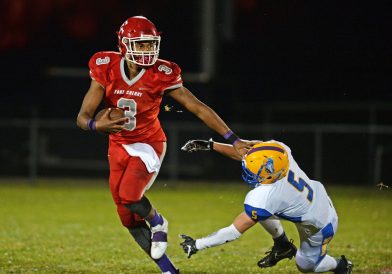
However, Fort Cherry’s Ryhan Culberson is the ultimate dual-threat quarterback, the prototype of what many high school coaches are looking for in the modern game. Culberson is in the top 10 of the WPIAL in rushing with 1,396 yards, but he also has passed for eight touchdowns, which not long ago would have been considered a landmark passing season for a high school quarterback.
“The game evolves at the college level and it trickles down,” Militzer said. “I fell in love with the spread when I was at Washington & Jefferson College as the running backs coach. What you look to do, when trying to stop a passing game, is take away one or two patterns they like and get pressure on a quarterback. If a team has a good offensive line that knows how to pick up blitzes, then it makes it very difficult.”