

Title IX was a game-changer for female athletes

This is the first in a three-part series about women in athletics.
Donna DeMarino Sanft arrived at the University of Pittsburgh in the fall of 1970 fresh from three consecutive state championships in gymnastics at Monessen High School.
These were new surroundings and circumstances to be sure.
“We had an amazing gymnastics team at Monessen,” she said. “We won every year. We were respected and people noticed us.
“When I arrived at Pitt, it was not that way. Women’s gymnastics wasn’t under the athletic department; it was under the physical education department. We bought our own uniforms. We didn’t have the support we should have had from the university.”
That atmosphere was similar for women’s athletics across the country.
Then came Title IX
Not until June 23, 1972 did Title IX became a federal law – an amendment to the Civil Rights Act of 1964. It consisted of only 37 words, mandating change in American education by making discrimination based on sex illegal. It increased access and opportunities for women in athletics.
Title IX began the process of bringing females and athletics toward a more level playing field with their male counterparts.
The benefits have led to female athletes becoming more important and relevant in high school, college and professional athletics – initially as participants and coaches and today as high-level administrators, executives, commissioners of major college conferences and as writers, reporters, analysts and broadcasters.
More women are leading high school and collegiate athletic departments, others are playing significant roles.
After 45 years, Title IX remains one of the turning points for females and athletics in the United States.
Many will tell you, and statistics will support their theory, that there remains more to do to truly have females playing an equal part with males in big-time athletics.
In some minds, “The Old-Boys Network” remains and needs to be busted once and for all to allow women all the opportunities afforded to men.
But the strides made are not lost on the women involved in athletics at the collegiate and professional levels.
“I think, in almost all things, women have advanced,” said Christine Blaine, director of marketing and communication for the Washington Wild Things baseball team. “When I was in high school and grade school, women did not participate in sports.
“Since that time, women not only participate and coach, they have moved into roles that just were not attainable before that time. Title IX spurred things on. This ball started to roll for women and sports. The culture began to change when women started playing sports.”
According to a report released earlier this year by the NCAA – 45 Years of Title IX: The Status of Women in Intercollegiate Athletics – the girls high school sports participation rate is 10 times greater than it was when Title IX was passed. That is more than 1,000 percent. But the current participation rate for girls never reached the boys’ 1971-72 level, which was 3,666,927 in June of 1970, 324,591 more than girls had in 2016.
The report also noted that in 2015-2016 more than 3.3 million girls high school athletes made up the recruiting pool to fill nearly 209,500 roster spots on NCAA championship sports teams.
In addition, 211,886 females participated in NCAA sports in 2016 – up from 64,390 in 1982, 94,922 in 1992 and 195,657 in 2012.
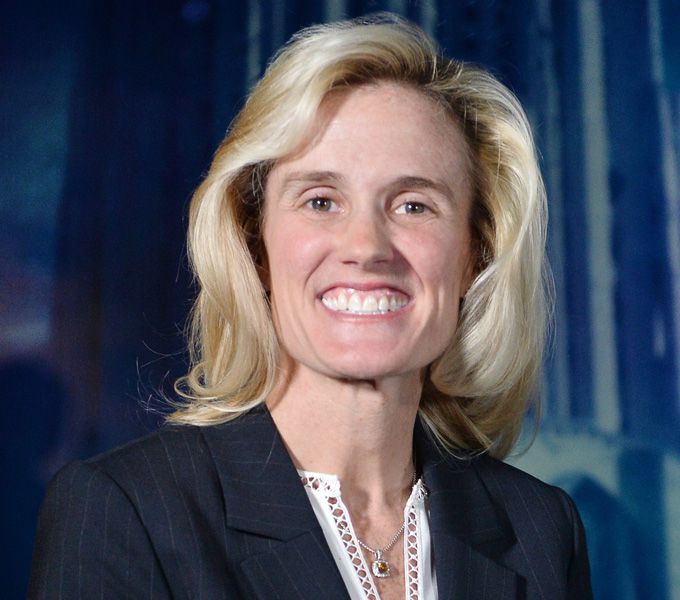
Heather Lyke
“Without question, Title IX was instrumental in all of this,” said Heather Lyke, athletic director at Pitt. “It allowed for an avenue and opportunities for women to be perceived differently.
“There would be no progression of opportunities without Title IX. Now, there are virtually no limits. We’ve come a long way and there is a long way to go.”
Lyke’s hiring at Pitt opened some eyes. She is the university’s first female athletic director, though Sanft did serve as Pitt’s interim AD during her career as an athletic administrator.
In addition to Lyke, other females named as Division I athletic directors in the first half of 2017 include Samantha Huge at William & Mary, Desiree Reed-Francois at UNLV, Mary Ellen Gillespie at Hartford, Marie Tutie of San Jose State and Donna Woodruff at Loyola of Maryland.
Patti Phillips, chief executive officer of Women Leaders In College Sports – a leadership organization that attempts to empower, develop and advance the success of women – said the progress is evident in terms of females gaining positions as athletic directors and commissioners across the nation.
She pointed to the first seven months of this year, when 27 women were hired into those roles, across all divisions, thus matching the number of women named to Division I athletic director roles, at six.
“To further illustrate the point, in 2016, 37 women advanced to AD or commissioner roles, which was up 94.7 percent from 2012,” Phillips said. “This is especially heartening to us at Women Leaders – to see our members landing these big jobs proves to us that the leadership training we provide, some in partnership with the NCAA, is effective. But we can only do one piece and we have a long way to go.”
According to NCAA Research, the trend is moving up among the number of female commissioners in the last 10 years. Fewer than one-third of NCAA conference commissioners are women. The percentage of women commissioners is highest in NCAA Division III. However, the greatest jump comes in Division I, where 31 percent of commissioners are females, up 21 percent from 2008.
“As we continue to fill the pipeline with qualified women, we will continue to see more women in the top seats, if that’s what they choose,” Phillips said. “For true equity, however, we need a cultural shift. There are still many qualified women who haven’t gotten the top jobs, and the representation within our industry is far too low. Only 14.3 percent of NCAA Division I institutions have women athletic directors or commissioners, 17.2 percent of Division II and 32.9 percent of Division III.”
Women beyond the playing field
LaRhonda Burley, the senior manager of partners services, NFL Players Association and until recently the senior director of partnership for the Washington Redskins, is part of a growing group of females leading departments in professional organizations that are becoming more impactful with business matters off the field and with fans and groups.
“My view is from the operational side,” Burley said. “I have seen more women become involved in the revenue generation and revenue support side of the operation of franchises.
“A lot of this goes back to the road paved for us by Title IX. For the longest time, I never recognized I was at a disadvantage. I believed in what I had experienced and the background I had on paper. I always believed people would focus on the ‘cans’ of potential employees and not the ‘cannots.'”
Mia White, Customer Relationship Management (CRM) Manager for the Miami Heat, a Monessen native and graduate of Geibel Catholic and Carnegie Mellon University, agrees with Burley that females are viewed differently than in the past and that they can bring new ideas and strategies into the front office.
“I think it is awesome what is happening for women,” White said. “You look around the world and into the gene pool and I think people are looking at situations a lot differently. A lot of doors have been opened for women in sports. There are a lot of smart people out there, regardless of gender. If that person is good enough, no matter male or female, why wouldn’t an organization not want to bring that person in?
“I can definitely say that the ‘old boys network’ is still a thing in sports, but not as much. People now look for so much more and so much more diversity. There is so much technology out there. The thinking has to be different. The status quo isn’t enough. You need to think differently when hiring. It’s good to introduce those with different perspectives and backgrounds.”
Pleased with the progress
Sanft has seen the change in athletics and the entrance of women into important positions in collegiate and professional sports.
Her playing, coaching and administrative career spans the 45 years of Title IX.
And while she entered Pitt at a time when females were only an afterthought in the sports world, she is pleased with the progress and the strides that have been made.
“In 1974, Pitt moved women’s athletics from the guidance of the physical education department to the athletic department,” Sanft said. “Cas Myslinski (former Pitt athletic director) knew I felt how unfair things were. I give Cas credit. He helped us make strides. He did a lot to advance women’s athletics. He knew I would push things and he responded.
“In 1974, (women) were just getting in on the ground floor. It was definitely a different world then. There were hardly any females involved in athletics. But that started something 45 years ago.
“I wasn’t in it for myself or out of some ambition. I did it because I loved sports. I loved being an athlete and I respected and enjoyed the process of doing things every day. I was involved in athletics almost my whole career. I do feel I had to prove myself each day. It was a good fit for me. It was very motivating to feel challenged every day.”