

Title IX: Still more mountains to climb
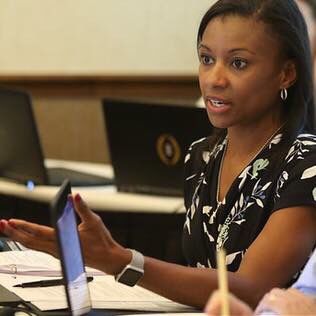
Laila Brock-1
Laila Brock’s success in a male-dominated field makes her a shining example for women around the country.
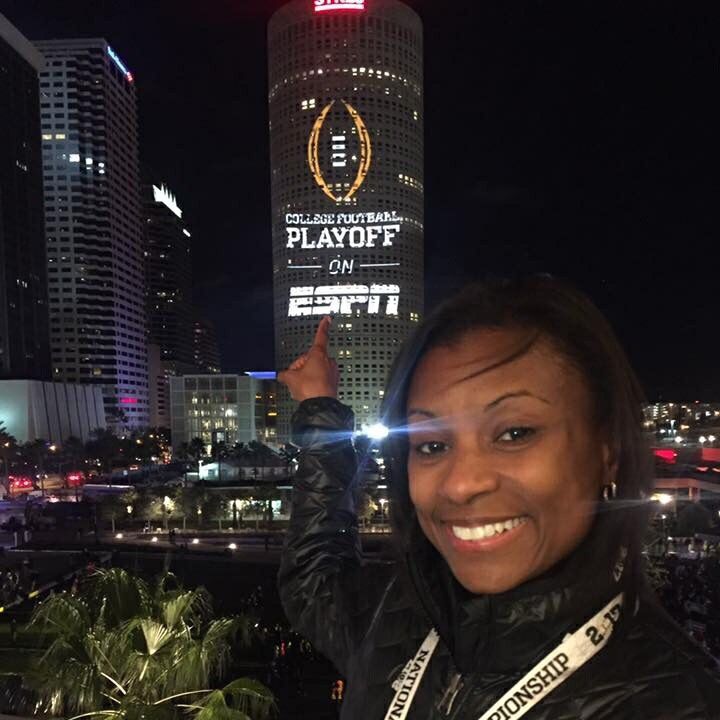
Multiple-time WPIAL and state track champion Laila Brock is now employed as senior director of operations and logistics for the College Football Playoff.
Final part of a three-part series
Laila Brock is one of the greatest sprinters in Washington High School history.
She is a multiple-time WPIAL and state track champion.
Today, she is running with the boys, the big boys of college football.
And Brock is tough to keep up with.
She is senior director of operations and logistics for the College Football Playoff – second in command.
Brock never played football, which is the reason often used when not hiring a woman for a high-level administrative position in college sports, but she has a handle on the needs of teams and coaches when they reach the four-team playoff that leads to the NCAA Division I championship.
“My job is to know what they want, when they want it and how to make everyone involved as comfortable as possible,” Brock said. “It’s my job to gain their trust and for them to understand that I do have the knowledge and experience to make this a great experience.
She admits it is not always easy dealing with high-profile coaches – many of whom have their own way on their campus.
“I have to be knowledgeable,” she said. “I have to know to gain the credibility necessary for me to succeed in my job.”
Dan Burt, the women’s basketball coach at Duquesne University and a Trinity graduate, said Brock is a shining example for women around the country.
“She’s one step from running the College Football Playoff,” Burt said. “She runs the day-to-day operations. Think about that. She’s smart and a success. That’s a future athletic director at a Power-5 school. She can write her own ticket.
“We’ve seen a big change. Young women are given more responsibility. And the reasons of the past that limited women in the eyes of some, such as lack of football and fundraising experience, do not have as much relevance now. But I think strides still need to be made. Until we as a society really see women as leaders in the workforce and the world, we still have a glass ceiling.”
Women of power
Ellen Harvey is a 1973 graduate of Immaculate Conception High School in Washington. She has enjoyed a long career in the harness racing industry. Like Brock, she has to deal with, and often lead, men who dominate her industry.
Harvey is executive director of harness racing communications for the U.S. Trotting Association. She has held many positions in the industry.
“I don’t think any man gave me a job because I was female,” Harvey said. “I hope I got them because I am good at what I do. Some of those jobs had been held by men. In some cases, men don’t like to be pressed by women. Some of it per-sists to this day.
“I do think this trend of women being considered for and gaining some of these jobs will continue. I was the first woman racing publicist. The generations who came after me do not see restrictions or limitations. But we as a society are still hung up by images we see on television.”
Dr. Wendy Snodgrass was named Clarion University’s athletic director earlier this year. She is a Trinity High School graduate and was a swimmer at Westminster.
She said seeing Heather Lyke at Pitt and Sandy Barbour at Penn State – both athletic directors for their respective schools – is evidence for all females that women can achieve significant roles in athletic administration.
“Since the early 1970s, women have been involved in sports,” Snodgrass said. “We’re at the stage now where almost everyone is more comfortable in having women in charge of athletic departments.
“I think we’re seeing this in all professions. People are looking at credentials rather than gender. It’s refreshing to know we have had strong women before us.”
Jennifer Lastik is senior vice president of events at Central Florida Sports Commission and a Greensburg native.
She says it’s all about knowledge and people seeing tangible evidence that a woman has credibility.
“You’re going to have networks in any industry,” Lastik said. “It’s good to find sponsors and mentors. But if you have and exhibit a strong work ethic and expertise, people are willing to listen and follow. In that sense, I don’t think there is a bias against women leading.”
Recently, Carla Williams was named athletic director at the University of Virginia, making her the first African American woman to hold such a position among schools in the Power Five conferences.
Dr. Karen Hjerpe, athletic director at California University, believes that if women take advantage of what is available to them, the gains will continue and women will become even more of a force in sports.
“There are a lot of opportunities available for females looking at ways to be successful,” Hjerpe said. “They have opportunities to be trained and gain experience. When you get more knowledge, you are adding value.”
Pitt football Coach Pat Narduzzi, who was part of the university’s search committee that hired Lyke, said the key is finding the right fit and right person.
“It doesn’t matter what the gender is,” Narduzzi said. “The right person is the one to hire. Heather Lyke was that person for Pitt. She was the best fit. No doubt about it. You have to base your choice on the best candidate.”
Where are female coaches?
According to the NCAA, the percentage of women coaching women is spiraling downward. While females are becoming more prevalent as commissioners and athletic directors, more men are coaching women’s teams.
Forty-five years ago, women coached more than 90 percent of college women’s teams. In 2017, females coach fewer than half of them.
NCAA research shows that in 2016, more women played college sports than ever before, but only slightly more than 40 percent of NCAA women’s teams had a female head coach. That is down from 55 percent in 1981 – the year NCAA women’s championships were initiated.
Title IX sparked the increase in varsity women’s teams and programs with more financial support and resources.
Athletic departments were consolidated, mostly with male athletic directors. While female athletics gained in numbers and popularity, coaching jobs became more attractive, important and financially lucrative. Those jobs attracted more coaches, including men. While there are females coaching in professional football and basketball, and those who have become officials in college and professional sports, females have never made such gains coaching on the male sports side.
“There are several factors,” said Jina DeRubbo, the Washington & Jefferson College women’s basketball coach and assistant athletic director. “Women struggle to find a balance. Women have family matters to deal with. They are time-consuming.
“Women coaches make a better living than they used to. It’s so difficult for men to get men’s jobs. That’s why they have come over to coach women. I made a decision that I could both coach and be a mom. It’s tough. Division III gives me the chance to have more balance. You hire good people and have them do what they are asked to do. I’ve had my moments. I didn’t think I could do it. Sometimes, it’s insanity. And when I had twins. Oh, my gosh. But I’ve always had support from the administration.
“One day, I was watching a game on TV and my son asked me why I didn’t have one of those jobs that I could be on TV. I told him, ‘I decided to be your mom instead.’ “
Burt said men are attracted to female sports in college because, “the quality of life is much better.”
Cary Kolat, head wrestling coach at Campbell University, worked with the U.S. women’s team in the world championships earlier this year. He leads a men’s team but enjoys coaching female wrestlers.
“They are coachable,” Kolat said of the women. “It’s enjoyable. They ask a lot of questions. They like to learn. They want to know, ‘Why.'”
“Any guy who has come over to coach women knows how much the women want to be coached and that they want to learn,” Burt said. “There’s a better quality of life, no doubt about it.
“We have to understand this, too. A lot of females could coach men. Pat Summit’s not the only one who could have done it. Tara VanDerveer at Stanford is one of the best coaches in the country. She certainly could coach men. There’s a lot of females out there who could. But there is still a glass ceiling.”
Breaking the ceiling
Jessica Mendoza is part of ESPN’s Major League Baseball coverage. She has been an analyst since 2015.
A number of other women have risen in the fields of sports writing, reporting and broadcasting at every level.
Most recently, Kara Lawson, former standout basketball player at Tennessee, U.S. Olympian and one of the top basketball analysts in the industry, became the primary analyst for her hometown Washington Wizards in the NBA. She is the second female with that broadcasting status.
Lawson has worked as in-studio and game analyst for ESPN’s basketball coverage the past several years.
Her rise to the NBA is significant.
“It has me feeling encouraged,” Lawson said. “I wanted to be a coach or athletic director. I began to wonder if I would get this kind of opportunity. My work is not done.
“All the opportunities I have been given allowed me to get better, improve and learn. You have to own your circumstances. I have had to deal with some things being a woman. But I grew up in a time not knowing any other way but seeking and gaining these opportunities. I am fortunate to grow up when I did and not feel limitations.”
In conclusion
Val Ackerman, the Big East Commissioner, is a lawyer and she has an obvious handle on how to reach the top.
She worked in the NBA, was the head of the WNBA, and has been involved in international sports.
The path to the top for women is clear.
“You make sacrifices,” Ackerman said. “You build relationships. It’s not overnight. It’s a bit of a marathon. When you’re dealing with strong personalities, you have to be skillful. You have to be the expert. The person or people you are dealing with has to respect your knowledge base and expertise. They have to know that you know what you are talking about. If not, you’re doomed.
“If there is mutual respect and the delivery is good, you know what to say and how to say it. And you understand how to build a relationship of trust and collaboration. It can work, and work well.”