

‘Wizard of Waynesburg’ delivered wins, life lessons
WAYNESBURG – More than 30 years later, those who saw it still talk about it.
It’s the 1980s and the Waynesburg College men’s basketball team is partaking in an activity that nobody is looking forward to – a five-mile run along Purman Run under a baking early September heat.
The head coach, Rudy Marisa, heard from an assistant that his players were in the gym lobby, grumbling.
Upon hearing about his players’ complaints regarding improper footwear for the task, Marisa was indignant.
“Oh, you don’t have the right shoes?” Marisa, the son of an Austrian coal miner, asked his team. “I didn’t have shoes growing up.”
“That was exaggerating a little bit,” Marisa remembers.
But only a little bit.
Marisa, who only a week earlier had hernia surgery, was determined to teach the young men a lesson.
In his 50s, the coach decided to complete the run with his players … in dress shoes.
Halfway through the run, Marisa thought his message wasn’t sinking in. His players just weren’t getting it. So he removed his dress shoes, and finished the run barefoot.
“I felt embarrassed,” Harold Hamlin, one of Marisa’s standout players, recalled. “He ran it with no problem, and I struggled with it.”
After that, Marisa put his shoes back on, got in his car, and drove. Practice was finished; another lesson was delivered. There would be many more from the “Wizard of Waynesburg,” the greatest basketball coach in school history.
The Wizard
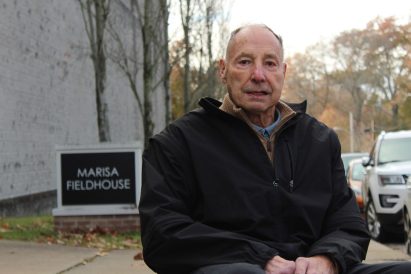
Today, Marisa, 85 years old, is worn down, his body hindered by two back operations and treatment for prostate cancer that led to his retirement from coaching in 2003.
He doesn’t hear well, and walks with the assistance of a cane.
Yet, in his face, there are still remnants of the man whose tactics evoke memories of Mickey Goldmill, the grizzled boxing trainer from the Rocky series.
In a career that started only months after the moon landing, and lasted through eras of disco, grunge music and Y2K paranoia, Marisa won 565 games and led his team to seven NAIA District 18 championships and the 1988 NAIA Final Four, where Dick Vitale called the semifinal game for ESPN.
Sitting in his 2015 Chevy Traverse on a late fall afternoon, he downplays his accomplishments.
“I’m not John Wooden,” he says.
No, Marisa isn’t the ‘Wizard of Westwood,’ but the ‘Wizard of Waynesburg’ has a ring to it.
Before the wizard had a chance to wave his wand, football and wrestling ruled Waynesburg athletics, and basketball was a 27th cousin by comparison, having never had a winning season between 1951 and 1969.
The football team, meanwhile, won the NAIA national championship in 1966, just three years before Marisa came to Waynesburg, and wrestling was always a power under the tutelage of coaches Bucky Murdouck and Clayton Kettering.
The crowds at basketball games, Larry Marshall, who played from 1964-68 before becoming Marisa’s top assistant for 24 years, remembers, were pathetic.
“We’d have home games, and there would be six, seven people there,” Marshall said, without a trace of sarcasm in his voice.
Eventually, what is now the Rudy Marisa Fieldhouse would be packed most nights.
Before Marisa arrived, however, attendance wouldn’t have been enough to fill a dorm room. But fortunes were about to change because of a simple request.
In the early 1960s, Marisa, while coaching at Albert Gallatin High School, started a basketball camp that he would continue for decades.
“I rented the gymnasium facilities to run a summer camp,” Marisa remembers. “I was a high school coach … I asked if I could rent the facilities, and (Waynesburg allowed me to), and I got to know the (athletic director) during the camp.”
The relationship between Marisa and Waynesburg remained solid, and ultimately, Waynesburg offered him the mop to clean up an 18-year mess.
And he was ready for it, because his entire life was an uphill battle.
Humble start
Marisa prepared to play college basketball by chopping down a tree.
He didn’t do this to build strength, but rather to create a hoop to shoot in.
The tree served as the post. Marisa’s father built the backboard, and ashes from the Pennsylvania State Highway Department made up the court.
This was what the Marisa family had to make do with in Fredericktown.
Rudy Sr. immigrated to the United States in the late 1910s. Once he arrived in America, he sweated it out for 48 years in the coal mines, where the chances of death were greater than those of financial prosperity. He never attended junior’s games. There was no time. But nonetheless, both he and his wife, Lilly, instilled values that would mold their youngest of five children.
“You don’t cheat people,” Rudy Jr. said. “You do your best. You work hard, even if it meant going down in a hole in a coal mine and working like a slave for almost no money.”
Rudy Jr. played both basketball and football growing up, and claimed to not be good at either one. Nonetheless, he loved sports, and when he went to Penn State in 1952, he tried out for the Nittany Lions’ basketball team.
Marisa remembers that 150 students tried out for the team, and fewer than a handful made the cut. He knew his athletic prowess wasn’t going to make anyone’s mouth water, so he had to find other ways to get noticed.
The best way he knew how to do that? Running.
He’d run on the golf course. He’d run on the highway. Anything he could do to get coaches to notice him, he’d try. And it worked. Marisa stuck it out for the Nittany Lions until graduation, his career highlighted by a 1954 Final Four appearance, the only one in school history.
Now, as a coach, he had to get noticed again. To do that, Marisa had to win. And win he did.
First at Dunbar Township High School (1958-60) then at Albert Gallatin (1960-66). After two years away from coaching and one as an assistant at Trinity, Marisa had to win at Waynesburg.
Throughout the 1970s, the Yellow Jackets became formidable. Marisa’s first team in 1969-70 posted a 10-13 record.
By the end of the decade, Waynesburg’s golden years were about to begin. Soon, largely because of Marisa’s mind, the college basketball whipping boys would be the ones that held the lasso. Starting with the 1978-79 season, Waynesburg averaged 23.5 wins per season over a 10-year run.
Marisa’s way
When Vince Lombardi coached the Packers, Green Bay ran on ‘Lombardi Time.’ Marisa embraced the same concept. If a player wasn’t in his seat at the start of a meeting, that was too bad. Marisa locked the doors.
Some of Marisa’s players appreciated the man in the moment. Tim McConnell, who would become one of the best WPIAL basketball coaches of all time, was one of them.
Like Marisa, McConnell, a 5-7 point guard, wasn’t blessed with great physical talent. But he had the heart of a mountain lion, and the intensity of a badger.
“I absolutely thrived on the way he coached me and the things that he expected out of me and the leader he wanted me to be,” McConnell said. “It’s helped me in my coaching career to play under him and learn under him.”
For others, like Darrin Walls, who is Waynesburg’s all-time leading scorer, Marisa’s teaching took awhile to appreciate.
“I respected him,” he said. “I didn’t always like him. I didn’t always agree with his tactics.”
Marisa didn’t care if his players loved him while they were playing.
“They could fall in love with their girlfriends,” he said.
What mattered to him was that his teaching would make a difference in their lives after basketball.
“I suspected that no matter what I did to them I was the only one doing it,” Marisa said. “So I was a novelty in their life, and 20 years later, they were going to appreciate it.”
Today, Walls, who has been working at UPMC for 17 years, has been late for work just one time. He owes that to Marisa. Now in his 50s, Walls sees what he struggled to see in his 20s.
“I love that man to death,” he said.
The end
After the 1988 Final Four season, the glory days of Waynesburg basketball slowly came to an end.
There were still great moments sprinkled throughout Marisa’s last 15 years, such as his 500th win in 1999 and a Presidents’ Athletic Conference championship in 1996. But now in the NCAA, the Jackets are no longer a national championship contender.
Less than two months before the 2003-04 season started, Marisa stepped down.
A few years before that decision, Rudy’s granddaughter, Makenna, was born.
She doesn’t remember any of the 565 wins, or the intense locker room speeches where Marisa let his players know that he’d be more than ready to suit up and take the court with them if he could.
Mainly, she sees him as grandpa, a man, sweeter than honey, whose difficulty of hearing makes for some interesting interactions in crowded restaurants. But Rudy passed down his basketball knowledge, particularly of jump shots, and years after retirement, helped Makenna earn a basketball scholarship at her grandfather’s alma mater, where she starts as a freshman.
“So many people have come up to me and told me how much my grandfather has impacted their lives,” she said. “I know there was one guy who named his kid after my grandpa. So it’s pretty cool to hear those stories.”
Legacy
Because of the Fieldhouse, every student at Waynesburg knows the name Rudy Marisa. The way he sees it, however, is that as the years go on, the meaning of that name dies down.
“I don’t think my name or any coaching accomplishments have been remembered all that much,” he said. “Students don’t have to remember the name, and they don’t.”
But that doesn’t matter to Marisa. What matters is that the name on the building will allow Makenna and his 13 other grandchildren to know that their grandfather made an impact.
“For them to be able to come up here and see the sign allows them to think that their grandfather had done something good,” he said.