

Looking back: Yellow Jackets’ 1966 NAIA national title was honey of a season
Observer-Reporter
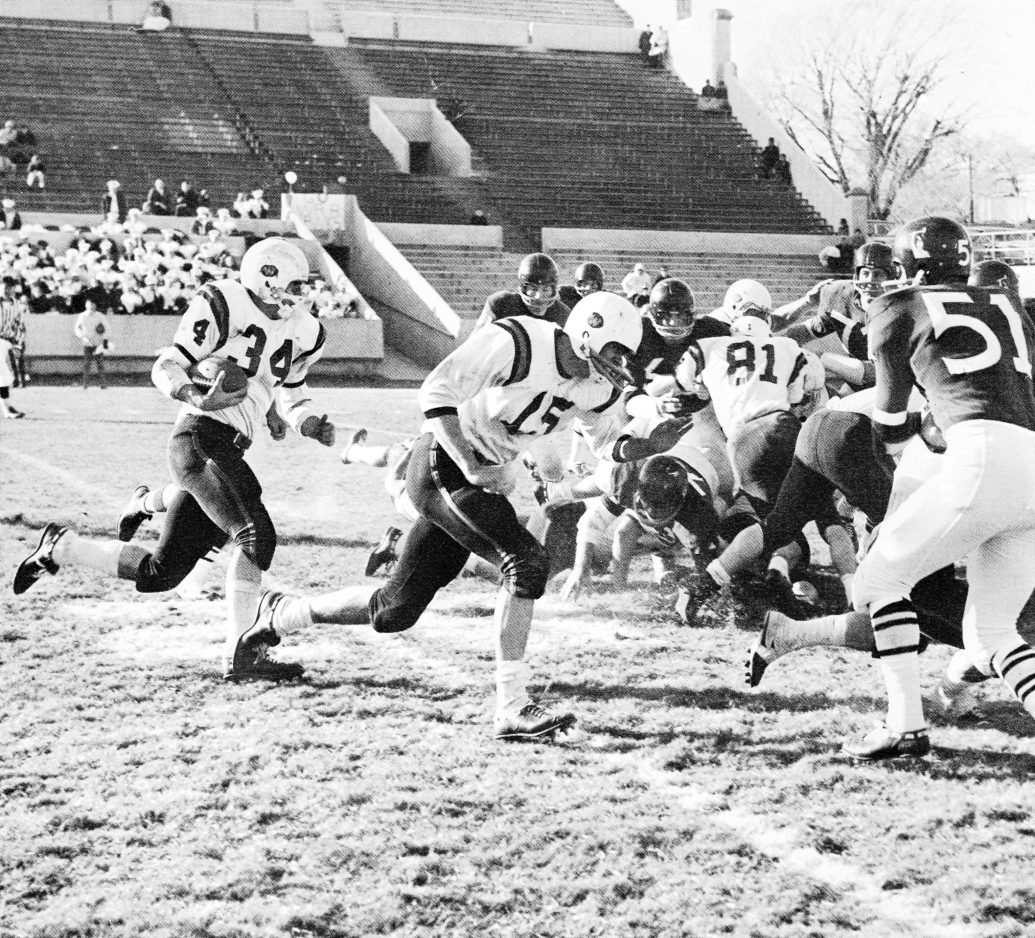
Tailback Rich Dahar follows the blocking of quarterback Don Paull during the 1966 NAIA national championship game against Wisconsin-Whitewater. Dahar rushed for a title-game record 233 yards on 41 carries.
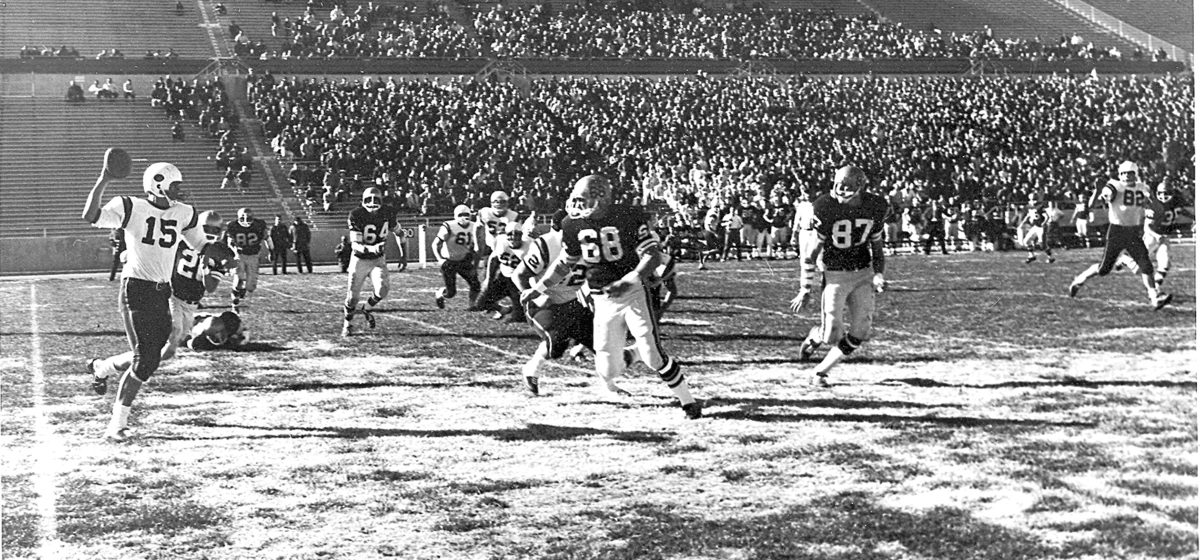
Quarterback Don Paull throws while on the run against New Mexico Highlands in the NAIA semifinals.
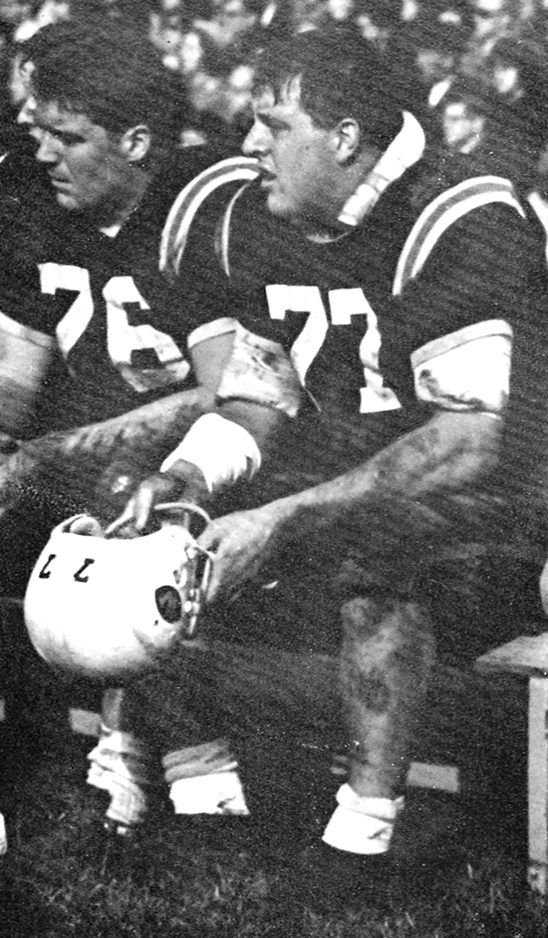
Defensive linemen Joe Righetti (76) and Fran Bednot. Righetti, a Beth-Center graduate, played for the Cleveland Browns.
It has been 55 years.
Some are still here. Some are gone.
Most moved on from football after college. Three played in the NFL.
Many came from Pennsylvania, from Uniontown, Glassport, Irwin, Avella and McDonald, among other towns. Others came from Ohio, New Jersey, New York and Maryland.
They used two quarterbacks, both freshmen. One was more of a runner, the other loved to throw.
We might never see it happen again – a national championship football team from Waynesburg University. Current Waynesburg students and recent graduates might have a hard time believing it happened. Even those there struggle to fully comprehend that, yes, it was real and, no, they weren’t dreaming.
The year 1966 was a wild time in American history. Parents lost their sons in Vietnam, Dr. Martin Luther King preached for a better world. The Beatles still made hits. Sandy Koufax still threw a baseball. Muhammed Ali fought for his right to fight.
Waynesburg was fairly secluded from all the chaos in the world, and it had a heck of a football team.
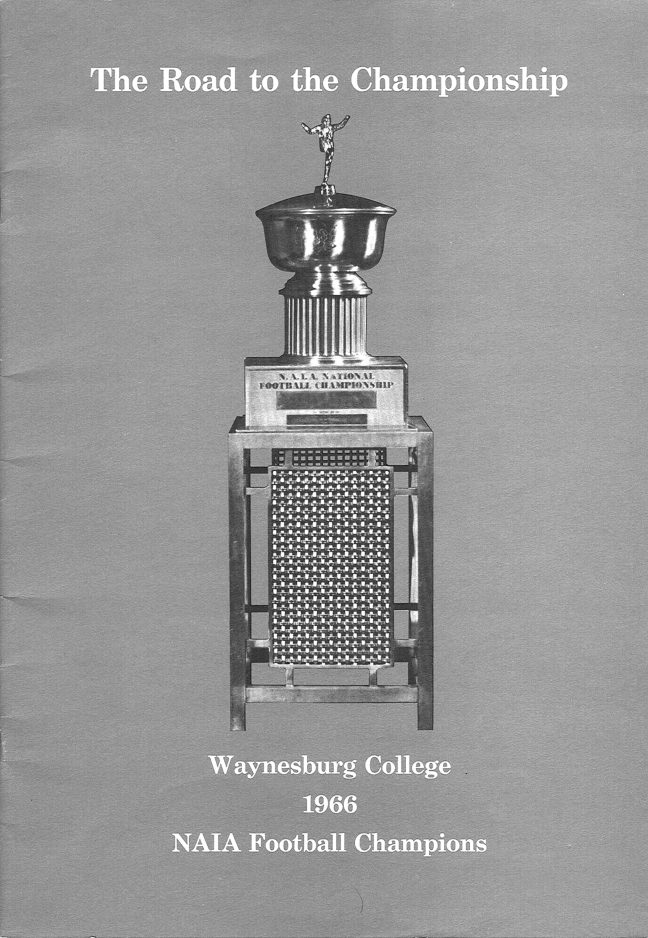
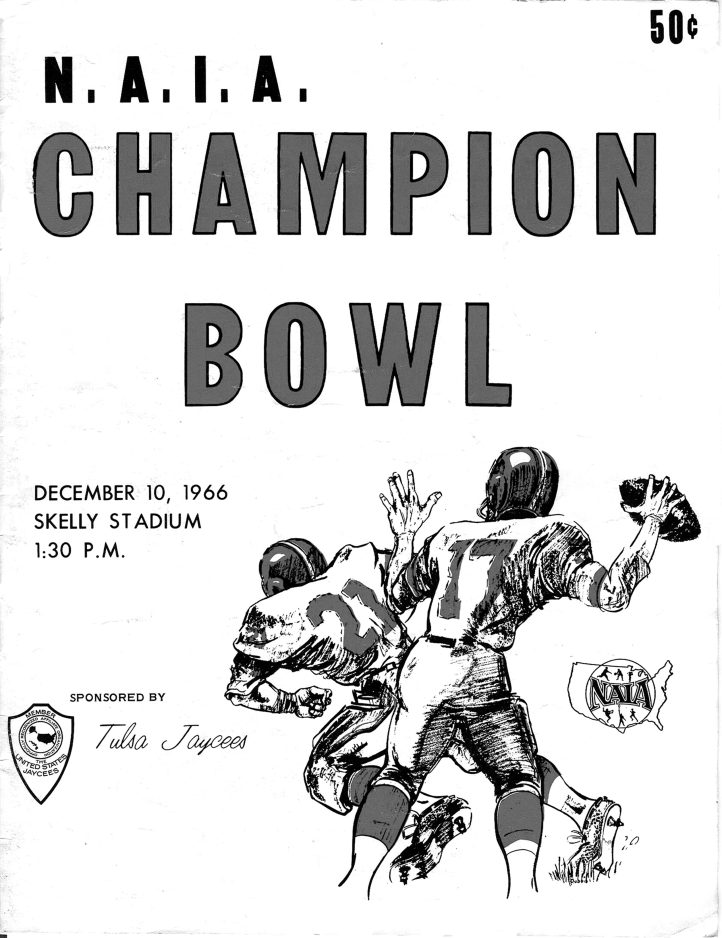
On Dec. 10 of that year, in Tulsa, Oklahoma, the Waynesburg College Yellow Jackets became NAIA national champions.
The players who are still here are in their 70s now. Some still get together, whether it be at the school’s Homecoming game or at an annual golf outing that’s had various locations, such as Hilton Head, Ocean City, Myrtle Beach and Pinehurst.
“Every time we get together,” running back Rich Dahar, now 74, said, “we’re talking about the championship games, and how it happened, how we got there.”
Gaining Mo-mentum
Heading into the 1960s, Waynesburg football was a loser.
In 1959, the Yellow Jackets won once. In 1960, they won zero.
Then, almost overnight, things turned around. Under coach Peter Mazzaferro, the Yellow Jackets went 6-2 in ’61 and 5-3 in ’62. Mazzaferro left after the ’63 season, and his replacement was a gruff former Cleveland Brown named Michael “Mo” Scarry.
His last name was pronounced “scary,” and it fitted his coaching style.
“Mo was a yeller,” said wide receiver Don Herrmann, who played nine seasons in the NFL.
“He was tough as nails,” Dahar said.
As Dahar remembers, with rare exceptions, when a player got hurt during practice, Scarry would move the ball 10 yards and keep practice going while the training staff took care of the injured Jacket.
Whether or not Scarry’s coaching methods would fly today is unknown, but what is known is that he was a winner. His teams went 6-2 in ’63, 5-4 in ’64 and 6-2-1 in ’65. His star was quarterback Harry Theofiledes, who went on to play for the Washington Redskins.
Scarry knew how to teach and had a special knack for developing linemen. He played center for Paul Brown in 1946 and ’47, and went on to be the defensive line coach for the undefeated 1972 Miami Dolphins.
“Everything I ever accomplished in football, I owe to him,” said Joe Righetti, a defensive lineman who went on to play two seasons with the Cleveland Browns before a kidney injury ended his football career.
Scarry was good enough for the NFL to take notice. The Washington Redskins hired Scarry to be their defensive line coach, beginning a nearly 20-year run of coaching NFL linemen, the last 15 spent from 1970-85 under Shula. Scarry was a father figure to the young men of Waynesburg. And they hated to see him go.
“I think, to a man, everybody was really disappointed,” Righetti said. “I only knew Mo for that one year, and the other guys obviously had more time with him. But I think we were all very disappointed he was leaving.”
Precision, perfection
13 wins, 29 losses.
That was Carl DePasqua’s record in four years as head coach at Pitt. Football fans in Western Pennsylvania probably remember him for losing, if they remember him at all.
Those who played for him at Waynesburg know better.
DePasqua had the same winning mentality as Scarry but a different personality. Scarry screamed, DePasqua calmed. He simply told his players they could be better.
“Carl was different than Mo,” Righetti remembers. “He was much more jovial in a sense that there was work to be done at practice, but he tried to have a little fun along the way with it. He was demanding but not in the same way Mo was. He wasn’t nearly as intimidating as Mo.”
The methods were different, but DePasqua but got his messages across.
“What Carl brought was precision to our football team,” Dahar said. “He said, ‘If the left guard steps forward with his left foot, the whole line steps forward with their left foot.’ We did everything in sync. It was just that precise.”
DePasqua had a talented roster at Waynesburg. Three future NFL players – Herrmann, Righetti and a defensive back from Brooklyn named Dave Smith – who led the Steelers in receiving yards for the 1971 season – were in place.
In total, 24 lettermen returned from the ’65 team that went 6-2-1 and won a conference championship.
The Jackets started the DePasqua era with back-to-back shutouts over Slippery Rock (31-0) and Susquehanna (6-0). In the next six games, the Waynesburg never allowed more than seven points and won all six by an average of nearly 26 points. For three weeks in October, Waynesburg steamrolled its opponents by a combined score of 112-7.
The Jackets finally got a test against West Virginia Wesleyan. Freshman quarterback John Huntey came on in relief of fellow freshman Don Paull. With Huntey being more of a passer, he used his strength to hit Herrmann with 46 seconds left for the winning score, and the Jackets survived their Homecoming game with a 13-7 win.
It wouldn’t be Huntey’s last – nor his most memorable – contribution to the ’66 Yellow Jackets.
Waynesburg squeaked out its next two games – 7-6 over Findlay and 14-13 over Westminster – to finish the regular season undefeated.
As Herrmann remembers, the school had two choices – accept an invitation to the Tangerine Bowl – what has become the modern-day Citrus Bowl – or play a mini-playoff for a chance at an NAIA national title.
Waynesburg chose the latter.
In a football movie, the climax always comes in the championship game.
Whether the good guys win (Remember the Titans) or fall just short (Friday Night Lights), the game that everybody remembers most of all is the championship.
But real life seldom mirrors Hollywood. For the ’66 Jackets, the season’s climactic moment happened two weeks before the championship, against New Mexico Highlands.
“It was definitely the most exciting game I ever played in,” Righetti said
Led by runningback Carl Garrett – the AFL Rookie of the Year with the Boston Patriots in 1969 who went on to play eight seasons in the NFL – New Mexico Highlands jumped all over the Jackets and led 20-0 late in the second quarter.
Enter Huntey.
He always dreamed of playing quarterback.
From Glassport, Huntey grew up watching his relatives shine. His cousin, Richie Lucas, was a star at Penn State and finished second in the Heisman Trophy voting in 1959, and Richie’s brother, Kenny, played the same position at Pitt.
The son of a steelworker, Huntey came to Waynesburg in the fall of ’66, and spent a lot of time watching his classmate, Paull, run the offense.
But Paull was a runner. Down by three touchdowns, Waynesburg needed a passer.
Huntey was that guy.
“I just felt like this was why I was there,” Huntey said.
Huntey’s touchdown pass to Herrmann sparked the Jackets. They then scored 17 unanswered points to start the second half and jumped ahead, 24-20. New Mexico Highlands jumped back in front, however, with three minutes left.
It was 27-24.
With seconds left, a halfback pass from Dahar to tight end Bob Miltenberger won it.
The Jackets were going to the national championship game against Wisconsin-Whitewater.
Dahar’s day
It was only close for a half.
Waynesburg’s players remember their team was bigger and better than Wisconsin-Whitewater.
The Jackets went into halftime up 20-13 behind touchdown runs from Paull and fullback Rich Ripepi, and another touchdown pass from Dahar, who had the day of his life.
He was born on Christmas Day. That’s ironic because nothing in his life had ever been gifted to him.
His father was recruited to play football at Notre Dame by Knute Rockne and then became a heavyweight boxing champion both at Notre Dame and in the Navy. His father, an “uncontrolled diabetic,” in Rich’s words, died when Rich was 14.
He battled injuries all through college.
This championship game, however, was the gift Dahar deserved – 41 carries. 233 yards. Three touchdowns on the ground, another on the air as Waynesburg won 42-21.
After college, Rich Dahar put his football days behind him, went to Pitt Dental School, and became “Dr. Dahar.” On this day, however, with multiple NFL players on the field, Dahar stole the show.
“All I remember is that I just kept wanting to run the ball,” he said.
“They wanted to be the No. 1 team,” DePasqua told reporters afterward. “The kids just did a magnificent job.”
“It was a typical Waynesburg performance for a team that more or less has to be considered a Cinderella team.”
Right place, time
Soon, Waynesburg football turned back into a pumpkin.
DePasqua coached the Yellow Jackets to an 8-1 record in 1967, then left to be an assistant for the Pittsburgh Steelers before moving to Pitt a year later.
Paull drowned at the age of 21 in 1970, not long before graduation.
DePasqua lived to be 93 before he died this past September.
Not all the players are still here. But those who are will never forget ’66.
“If I had to do it all over again, I’d go right back there,” Herrmann, now 74 and retired, said. “I’d go right back there because of the lessons I learned there. If I would have gone someplace else, maybe I wouldn’t have gotten married to my wife. It was just … God put me in the right place at the right time.
“When we talk to each other on the phone, we end the conversation by saying ‘I love you,'” Dahar, who will be 75 this Christmas and is still working as an orthodontist outside of Pittsburgh, said. “That’s how these guys are. Great people.”