

Independent thinker: Wild Things manager has paid his dues, waited for opportunity
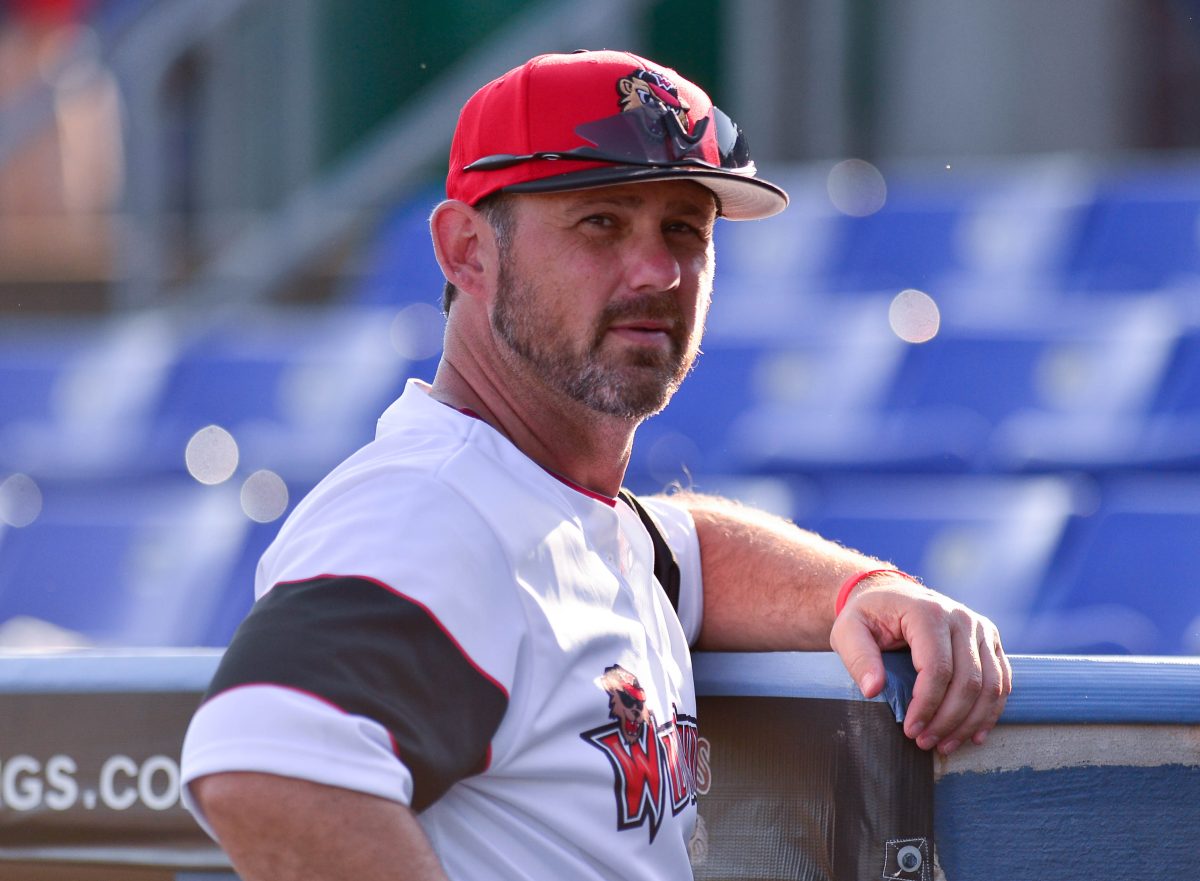
Ed Thompson/For the Observer-Reporter
Tom Vaeth has guided the Wild Things to two consecutive division titles. He was named the Frontier League’s Manager of the Year.

Ed Thompson/For the Observer-Reporter
Wild Things manager Tom Vaeth has watched his team get off to a 12-14 start.
Tom Vaeth’s stay in independent baseball was supposed to last four months, or so he thought.
Spend a summer in Winnipeg and then return to a major league organization, preferably working in player development.
Fast forward almost two decades and Vaeth is still in the independent ranks, where careers are either starting or being kept on life support as players hope to beat the odds and get signed by a major league organization.
And Vaeth is happy where his career has taken him because for the first time in the pro ranks he’s calling the shots on the field.
Vaeth is the first-year manager of the Washington Wild Things. A 48-year-old Maryland native, Vaeth spent 17 seasons as the hitting coach of the Winnipeg Goldeyes, who play in the independent American Association. This is his first managerial job, though Vaeth served as acting manager for about 100 games in Winnipeg.
Before Winnipeg, Vaeth spent five years working for the Baltimore Orioles.
“I thought it was going to be a four-month gig,” Vaeth said of his time in Winnipeg. “I came right from a big-league job with the Baltimore Orioles. When my contract talks with them broke down in spring training of 2003, the gentleman who is the manager in Winnipeg now, Rick Forney, we knew each other and he had been asking me about coming to Winnipeg. I said there was no way I was going to Winnipeg, leaving a big-league job. I didn’t know much about independent ball. I thought it was a beer league. I didn’t want to do that.
“When the contract talks broke down, Mike Flanagan, who was one of the Orioles’ co-general managers at the time, said take the job in Winnipeg, add it to your resume and come back here at the end of the season and it will be much better. Eighteen years later, here we are.”
Paying his dues
Vaeth got to Washington because Gregg Langbehn, who managed the Wild Things since 2017, retired last offseason. Vaeth was hired in January and became the Wild Things’ 10th manager in franchise history, which dates back to 2002.
Vaeth came to Washington with an extensive baseball background. He has coached at the junior college and Division I levels, served as a bullpen catcher and also scouted for two major league teams.
A natural righthander, Vaeth worked in player development for the Orioles and for five years part of his duties was to throw batting practice at Camden Yards, where he was referred to as “The Freak” after teaching himself to throw lefthanded to help raise his value within the organization. After all, ambidextrous batting practice pitchers are hard to find.
Vaeth was born in Baltimore and currently resides in Orleans, Ontario, a suburb of Ottawa. He has ties to Pennsylvania as his mother resides in Littlestown in the central part of the state.
A catcher as a player, Vaeth played two years at the junior college level before an injury derailed his playing career. A Miami Marlins scout suggested to Vaeth that he should pursue a career in scouting. He spent four years in evaluating prospects before joining the Orioles and eventually moving on to independent baseball.
So why does a guy with a major league player development background continue to work in the independent ranks?
“That’s an easy answer,” Vaeth says quickly. “There is nobody looking over your shoulder, telling you what to do, who to play, who to keep. You don’t get that in affiliated ball. There’s an allure to building your own roster, making your own player moves. Most of all, I enjoy helping someone achieve their goal of prolonging their career.
“I feel like I’ve paid a lot of dues. A lot of my friends in the baseball circles feel the same way – my becoming a manager is long overdue. It’s a natural progression in your career. I’m no different than those guys sitting (in the clubhouse). We all want to continue moving up. Being the hitting coach was great. I really enjoyed it, but for me this was just a natural move to make.”
During his time in Winnipeg, Vaeth was part of three league championship teams. His hitters finished in the top five of the league in team batting average 15 times in 17 years.
Several former Goldeyes have followed Vaeth to Washington. Outfielder Grant Heyman, infielder Andrew Sohn and pitcher McKenzie Mills all played in Winnipeg.
“I like guys with big, athletic bodies. I like guys who have the ability to move. I like speed and high-IQ ballplayers,” Vaeth said. “I like guys who know how to play the game and match my passion and energy.”
Winning habits
For somebody to be an assistant coach for more than a decade is rare in independent baseball. Most coaches either move into a manager’s role or quickly move out of the pro ranks. You couldn’t blame Vaeth if he thought his time to be a manager would never come. Going from the guy who makes suggestions during games to the guy who makes the decisions was a difficult move. Vaeth found that many independent teams were more interested in hiring former major leaguers or giving ex-managers second or third opportunities than taking a chance on a hitting coach.
He interviewed for several managerial jobs in independent ball and was even told that he had the job with the American Association’s Cleburne Railroaders in Cleburne, Texas, for 2019 before a last-minute backroom deal was made that cost him his big break.
“I was told we’ll get you a flight next week to Texas. We want you to get down here and sign a contract and hold a press conference, the whole nine yards,” Vaeth explained. “I said ‘OK, great.’ This was at the time of the yearend league meetings. Cleburne had just been sold but it had not been announced or voted on by the league owners, which was a big part of the league meetings. One other thing going on at the time was Wichita was leaving the league to go back to having an affiliated team in a new ballpark. At the meetings, and this is the story I have been told, at about 1:30 in the morning, the GM in Wichita struck a deal with the new owner in Cleburne, saying if you hire me I’ll bring my former people in with me and give you all my players. It was driven by, if you want my players, this is what has to happen.
“The next morning, while on a fishing trip, I got back to shore to where my phone got service and it just blew up with voicemails and text messages. One of the last messages was from the guy who was the outgoing GM at Cleburne and he was very solemn. He said, ‘A deal was made last night and I knew nothing about this. I am very sorry.’
“I was always the guy who was being told they finished second or third in the process and any team would be lucky to have you as their manager,” he continued. “You can only hear that so many times before you’re tired of that. But the thing that is really frustrating is you watch the same people get hired to get fired over and over. Hired, fired, hired, fired. There is a reason that happens – they’re not the right person for the job.”
Vaeth stayed in Winnipeg in 2019 and the coronavirus pandemic shut down minor league baseball in 2020, giving him a chance to re-evaluate his coaching future. He took a job working for Amazon near his home.
“I had no problem being away from the game,” he said. “I wouldn’t come back as a hitting coach. I left Winnipeg on my terms. If I wasn’t going to get a manager’s job, then I was content going into the real world. Last summer was the first time in 25 years that I could go fish as much as I wanted and be a normal person.”
However, when the Wild Things’ job opened, Vaeth believed the fit was right for him. His task is to accomplish what his nine predecessors couldn’t: bring Washington its first league championship.
So far, the results have been a mixed bag. Like every team in the Frontier League, the Wild Things are trying to find their identity early in the season. They took a 12-14 record into Friday night’s game at Tri-City but that mark might be deceiving. They’ve played all but five of their games against teams with .500 or better records and Lake Erie (12-14) is the lone team with a losing mark that the Wild Things have played.
“We won three championships in Winnipeg but that wasn’t a case of being the best manger or hitting coach that summer,” Vaeth said. “You have to have some luck and get some breaks along the way. But no team will put more work into this than we will. If you’re going to be here all summer, then why not win it, right? Every one of these players will get the same message. There are two types of habits that players can have – winning habits and losing habits. We will not develop losing habits here.”