

1971 Pirates were special in many ways
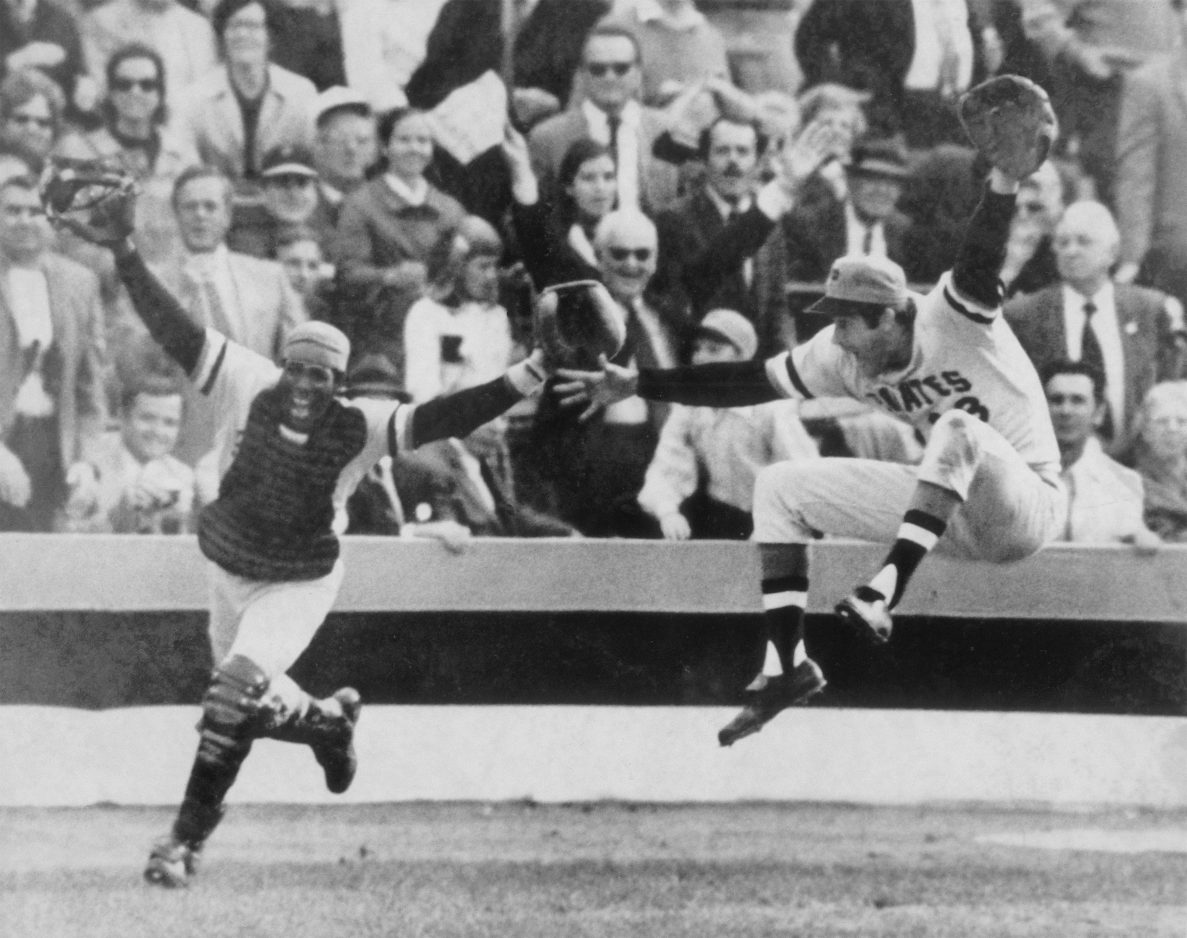
Rusty Kennedy
Pittsburgh Pirates catcher Manny Sanguillen and pitcher Steve Blass celebrate as Blass completes a Game 7 victory to win the 1971 World Series over the Baltimore Orioles at Memorial Stadium. The 1972 season would not have a happy ending.
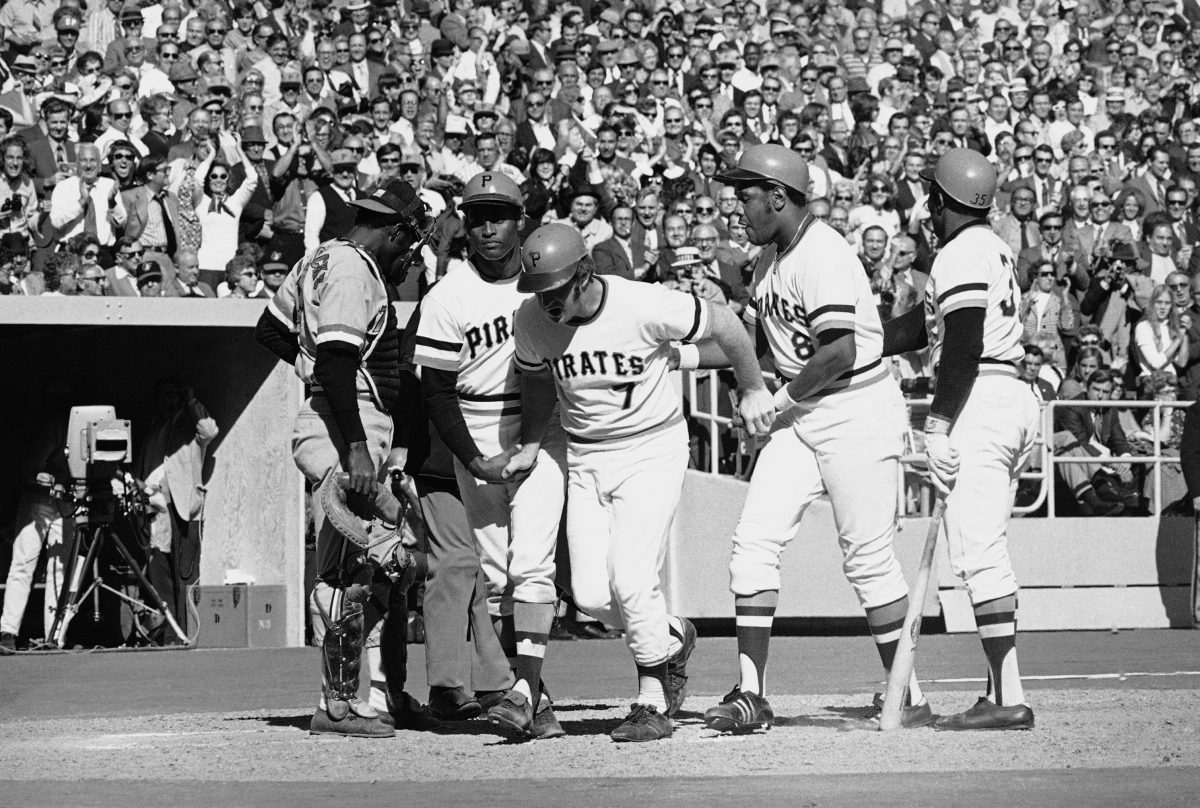
Anonymous
Pittsburgh’s Bob Robertson (7) is congratulated by teammates Roberto Clemente, second from left, Willie Stargell (8) and Manny Sanguillen, right, after hitting a home run in the 1971 World Series.
Once upon a time, the Pirates were good.
Really good.
They were so good that their fans expected at least to be in contention for the National League East Division championship each year of the 1970s. They were right. The Pirates were in contention all 10 seasons.
An NL title or World Series championship were also realistic and anticipated.
That was the Pirates of the 1970s.
The Pirates were division champions six times during the decade.
In their worst season of the decade, they finished in third place – 80-82 and 2-1/2 games out of first place behind the upstart New York Mets.
They were runnersup to Philadelphia three straight seasons (1976-1978) before winning the World Series in 1979.
The 1971 Pirates entered spring training with a belief that they were the best team in the NL East and a certain contender for the National League and World Series championships.
Fresh off the organization’s first division title in 1970 and despite being swept in the 1970 NLCS by the Cincinnati Reds, the Pirates were a talented cast featuring three future Hall of Fame players – right fielder Roberto Clemente, left fielder Willie Stargell and second baseman Bill Mazeroski. They also were bolstered by center fielder-first baseman Al Oliver – who some think belongs in the Hall of Fame – and manager Danny Murtaugh, who has never received the serious HOF consideration his career accomplishments suggest he should.
The result was a National League East Division championship, a National League Championship Series victory over the San Francisco Giants and a World Series title by defeating the Baltimore Orioles in seven games.
The last part of the 1960s, the Pirates loaded up the farm system,” said Steve Blass, whose command performances in Games 3 and 7 of the World Series helped turn and then cement the Series win. “You had to wait your turn. Everyone saw that talent coming.
“We were adding young kids like Bob Robertson, Richie Hebner, Al Oliver, Dave Cash and Bruce Kison to a team with outstanding, great players. We knew we were coming on as a team. The 1971 team just came together. We knew we were going to be pretty good.
“We felt good even after being swept by the (Cincinnati) Reds in the 1970 NLCS.”
Oliver said the Pirates were a confident team moving on from that NLCS defeat. Nothing would sway their belief in one another nor the overall strength of the team.
“We were a confident team,” Oliver said. “We all wanted to play every day. That wasn’t going to be possible. So, we all submerged our egos and decided if we were going to win big, we had to make sacrifices. We felt as a group that we were primed to win at the least the National League East in 1971. Honestly, we felt we were contenders for the National and World Series championships.
“The Pirates, as a group, believed it was possible to be the best team in the division for the next four or five years. It’s just the way we were and how we felt.”
Cash, who took over the starting second base job from Mazeroski in 1971, said that Murtaugh was a key to utilizing all the talent at hand day-in and day-out.
“Danny knew he had a lot of talent,” Cash said. “He maneuvered things to suit us every day. He had Maz, Jose Pagan, Gene Clines and Vic Davalillo on that bench. He used Gene Alley and Jackie Hernandez at shortstop and Milt May to backup Manny (Sanguillen) at catcher. It was a great mix of people and players, and we had underrated pitching.
“It was an honor to play for that team and be part of such a special group. We had veterans who were universally respected. We made some great accomplishments with some great leaders. I never played on a more talented team the rest of my career. It was special what we did.”
Lineup made history
The 1971 Pirates were a younger team than most realize. In their most-used lineup, the Pirates had two 23-year-olds in Cash and Hebner, and two 24-year-olds in Robertson and Oliver. Sanguillen was 27. Alley (30), Stargell (31) and Clemente (36) were the old men of the starting nine.
On their bench, the Pirates had Clines (24), Stennett (22), and rookie catcher Milt May (20). The oldest guy on the team was third baseman Jose Pagan. They had Bob Moose (23) and Bruce Kison (21) in the starting rotation.
They were probably the most diverse team in the big leagues with 13 players of Latin or African-American descent.
Murtaugh engineered a first in MLB history on Sept. 1 that year, having the Pirates field an all-Black lineup of African-American and Latino players.
The historic game was played between the Pirates and the Philadelphia Phillies – who would become their rivals – at Three Rivers Stadium.
The Pirates entered the game with a record of 81-56 and were in first place in the National League East by 4½ games over the St. Louis Cardinals. The Phillies were 20 games under .500 and in last place in the division.
The Pirates’ starting lineup included second baseman Rennie Stennett, center fielder Clines, Clemente in right field, Stargell in left field, Sanguillen at catcher followed by Cash at third base, Oliver at first base, Hernandez at shortstop and Dock Ellis was the pitcher.
Murtaugh likely did not realize the lineup he presented would become historic.
Oliver said that he had not noticed the lineup until an inning or two into the game when Cash came up to him and said, “Hey Scoop, we’ve got all brothers out there.”
Ellis was not at his best and lasted just into the second inning, replaced by Bob Moose. He didn’t last long either and Murtaugh called on hard-throwing Bob Veale, which again meant the team was fielding an all-Black lineup.
The Pirates ended up winning the game.
Ironically, there was no media coverage in Pittsburgh of the historic lineup because all the newspapers were on strike. The Philadelphia newspapers gave the event little coverage.
The one news service that did focus on the lineup was United Press International, which helped publicize the lineup because several newspapers around the country picked up the wire story.
In the UPI story, Murtaugh was quoted as saying, “When it comes to making out the lineup, I’m colorblind, and my athletes know it. They don’t know it because I told them. They know it because they’re familiar with how I operate.
“The best men in our organization are the ones who are here. And the ones who are here all play, depending on when the circumstances present themselves.”
Blass said the diversity of the team was just one aspect that helped turn the team into a world championship team. Murtaugh knew how to use every man to the team’s advantage.
“Danny treated it with the respect it deserved but didn’t act like it was as big of a deal as they were making it. He just put out the nine best Pirates for that game – as he did every game – and didn’t care if they were white, Black, Latino, whatever. It was a tremendous response to that whole thing, which was a big deal.”
Slaying Giants
The Pirates won the division with a 97-65 record, were in first place for 131 days, had their biggest lead in the standings (11 games) on July 24, were most games over .500 at 34 on Sept. 24 and were never under .500. Their longest winning streak was 11 and longest losing streak was four.
Only the New York Mets and Giants won the season series against them. The Pirates lost 10 of 18 to New York and nine of 12 to San Francisco.
Standing in the way of their first World Series appearance was the Giants. Like the Pirates, they featured four future Hall of Famers in center fielder Willie Mays, first baseman Willie McCovey and starting pitchers Juan Marichal and Gaylord Perry.
San Francisco also had a solid cast around the standouts including outfielders Bobby Bonds and Ken Henderson and second baseman Tito Fuentes.
The Giants also had pitching depth behind Perry.
San Francisco took Game 1, 5-4, as neither Perry nor Blass came through. The series turned, however in Game 2 as Robertson blasted three home runs to lead a 9-4 win.
The Pirates won the next two as Bob Johnson outdueled Marichal in Game 3, Hebner hit a late home run and closer Dave Giusti earned the save.
In Game 4, Blass and Perry failed again, but the Pirates broke a 5-5 tie to go on and win 9-5. Kison and Giusti pitched seven scoreless innings in relief and the Pirates were off to the World Series.
Baltimore had four 20-game win pitchers and a solid lineup. The Orioles, who won the first two games, also had future Hall of Famers in pitcher Jim Palmer, third baseman Brooks Robinson, outfielder Frank Robinson and manager Earl Weaver.
Blass turned the World Series with an outstanding performance in Game 3. Robertson hit a pivotal three-run home run, after being given the bunt sign, and the Pirates won, 5-1.
Pittsburgh won the next two, 4-3, in Game 4, the first night game in World Series history and 4-0 in Game 5. In Game 4, Pirates starter Luke Walker was pulled early in favor of Kison. He teamed with Giusti to close down Baltimore. Murtaugh turned to Nelson Briles to pitch Game 5 over Blass and Dock Ellis. Briles was fantastic and Robertson delivered another home run as the Pirates took control.
After an Orioles win in Game 6, the Pirates turned to Blass and he delivered. Clemente, the Series MVP, hit a home run and added another late to help the Pirates win, 2-1, and capture the World Series.
“Our ballclub knew how to win,” Robertson said. “We had the drive to be champions. I’m glad to have been part of it. We had a great bench, and everyone contributed to the championship. We felt all along we could do it.”
May said Murtaugh was a master at guiding the Pirates and the contributions of everyone was huge in the march to the World Series.
“I was a rookie and I was confident,” May said. “It was a talented team and we learned from each other. Game 7 came down to Steve throwing a great game. We all believed in him and he just was fantastic.”
Said Blass: “I was blessed. That team was so special. It’s given me a nice feeling and a lifetime of memories.”