

Get ready for gobbler season
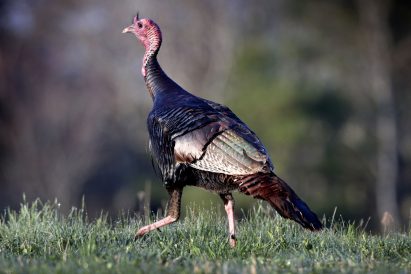
HARRISBURG – Timing alone would make it special. Pennsylvania’s upcoming spring gobbler season – the state’s only big-game hunt outside of fall and winter – takes place when the world seems new, freshly green and alive.
This year’s season begins on April 23 with a one-day hunt for junior and youth mentored hunters, then runs from April 30 to May 31 for everyone else.
But it has a lot more going for it than just that.
Gobbler hunting is huge on excitement, too. There are few things as thrilling as calling in a wary turkey. No wonder more than 150,000 hunters take to forests and fields each spring to chase these birds.
Plenty of opportunity awaits them, as usual. Game Commission turkey biologist Mary Jo Casalena said the statewide flock – always among the largest anywhere in the East – is likely bigger right now than at any time in the last few years.
She credited that increase to a number of factors.
First, 2021’s recruitment – influx of new turkeys into the population – was very good, courtesy of warm, dry weather last spring and, in places, lots of cicadas to eat. Survey work revealed 3.1 poults per hen, on average, statewide.
“That was our highest ratio since we began monitoring recruitment,” Casalena said.
A smaller-than-usual spring 2021 harvest and shorter fall turkey seasons in some Wildlife Management Units (WMUs), coupled with a statewide elimination of rifles for fall turkey hunting, also surely boosted flocks.
“That should all translate into a lot of high-spirited jakes on the landscape,” Casalena said. “Hunters should find a larger-than-normal percentage of older, 3-year-old turkeys out there, too. So there’s certainly reason for optimism again this year.”
Those birds won’t necessarily be easy to harvest; neither jakes nor older birds typically are as vocal as 2-year-olds, she added. But hunters can up their odds of tangling with a tom turkey by preparing before opening day.
Casalena recommends scouting, looking either for actual birds, turkey sign such as droppings, feathers, scratchings and tracks, or at least places where turkeys might be, like openings close to and easily accessible from roosting areas where gobblers prefer to strut.
All the while, back home, practice calling.
“The most important call is the hen yelp,” Casalena said. “The hunter wants to imitate a hen to attract the gobbler to come within range. After that it’s a matter of practicing and learning other calls like the different cackles and purrs and understanding when to use each. Friction calls have great sound and pitch, while mouth calls are the most convenient, especially when being still is important.”
None of that guarantees success, of course. About 15 percent of hunters harvested one gobbler last spring overall. About 18 percent of the near-record 25,210 people who bought a special spring turkey license, or second gobbler tag, took a second. Those figures are comparable to long-term averages.
But the only hunters to fill their tags are those who go out and hunt. So this spring, visit turkey country and see what happens.
“There’s never a bad time to be in the woods, especially when getting out offers the chance to square off with one of our amazing if unpredictable gobblers,” Casalena said.
All participants in the youth hunt must be accompanied by adults as required by law. Hunting hours during the youth hunt end at noon. Junior hunters and mentored youth also may participate in the statewide spring gobbler season.
Hunting hours begin one-half hour before sunrise and end at noon for the first two weeks of the statewide season (April 30 through May 14). Hunters are asked to be out of the woods by 1 p.m. when hunting hours end at noon. This is to minimize disturbance of nesting hens.
From May 16 through May 31, hunting hours are from one-half hour before sunrise until one-half hour after sunset. The all-day season allows more opportunity at the point in the season when hunting pressure is lower and nesting hens are less likely to abandon nests.
During the spring gobbler season, hunters may use manually operated or semiautomatic shotguns limited to a three-shell capacity in the chamber and magazine combined. Muzzleloading shotguns, crossbows and long, recurve and compound bows also are permitted. For a complete list of regulations, consult the Pennsylvania Hunting & Trapping Digest, available on the agency’s website.
nly bearded birds may be harvested during the spring season, and hunting is permitted by calling only. Hunters should refrain from knowingly harvesting bearded hens because they do nest and raise broods.
There is no requirement for hunters to wear fluorescent orange during the spring turkey season, though wearing it is recommended while moving.
Blinds used while turkey hunting must be manufactured with manmade materials of sufficient density to block movement within the blind from an observer outside the blind. Blinds must completely enclose the hunter on all four sides and from above. It is unlawful to hunt turkeys from blinds made of natural materials such as logs, tree branches and piled rocks.
Blinds that represent the fanned tail of a gobbler do not hide all hunter movement, and therefore are unlawful to use in Pennsylvania.
It is unlawful, as well as unsafe, to stalk turkeys or turkey sounds. All hunters need to wait patiently and properly identify their targets prior to pulling the trigger. When in a stationary position, a hunter should sit with his or her back against a large tree, rock or other barrier that shields movement and offers protection from others who might approach from the rear.
Turkey hunters should not wear clothing that contains black, like the color found on a turkey’s body, or red, white or blue, like those on a turkey’s head.