

Public asked to report turkey flocks
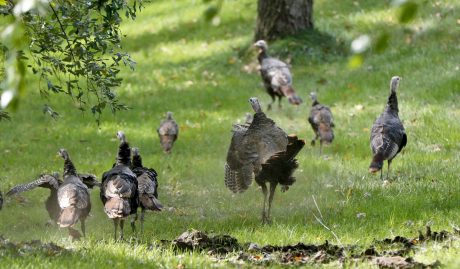
HARRISBURG – The Pennsylvania Game Commission is asking for the public’s help finding turkey flocks to trap for ongoing projects.
The agency is encouraging Pennsylvanians to report the location of any turkey flocks they see between now and March 15. Information is being collected online at https://pgcdatacollection.pa.gov/TurkeyBroodSurvey.
Visitors to that webpage will be asked to provide the date of the sighting, the location, and the type of land (public, private or unknown) where birds are seen, among other things.
Game Commission crews will visit sites to assess them for the potential to trap turkeys. Turkeys will not be moved; they’ll simply be leg banded and released on site. In four Wildlife Management Units (WMUs) some also will be outfitted with GPS transmitters, then released back on site to be monitored over time.
Trapping turkeys during winter is part of our ongoing population monitoring as well as a large-scale turkey study.
Just like the last three winters, the Game Commission will put leg bands on male turkeys statewide. Hunters who harvest one of those turkeys, or people who find one dead, are asked to report the band number by either calling the toll-free number or emailing the Game Commission using the email address on the band. New on this year’s leg bands is a website for directly reporting the information into the database.
“These data give us information on annual survival rates and annual spring harvest rates for our population model and provides the person reporting information on when and approximately where it was banded,” said Mary Jo Casalena, the Game Commission’s turkey biologist.
These studies are being done in partnership with Penn State University and the University of Pennsylvania’s Wildlife Futures Program.
The population and movement portion of that work is looking at how landscape and weather impact hen nest rates, nest success, poult survival, predation, habitat use and movement. The disease portion of the study is examining how disease prevalence varies based on landscape and impacts things like the survival and nesting rates of hens of different ages. This is accomplished by collecting blood, tracheal, feces and skin from turkeys that receive backpack-style transmitters at the time of capture.
The study will continue next winter for both males and females, and continue through 2025 for hens, so that in the end, the Game Commission will monitor more than 400 females and more than 200 males.
Researchers from Penn State University and the University of Pennsylvania’s Wildlife Futures Program will interpret the data collected. Biologists from Maryland, New Jersey and Ohio joined the study this year as well.
“It is the largest turkey project we’ve ever conducted, with the hope of answering many questions regarding current turkey population dynamics,” Casalena said.