

Notice: Undefined offset: 0 in /usr/web/cs-washington.ogdennews.com/wp-content/themes/News_Core_2023_WashCluster/includes/single/single_post_meta_query.php on line 43
Notice: Trying to get property 'paywall' of non-object in /usr/web/cs-washington.ogdennews.com/wp-content/themes/News_Core_2023_WashCluster/includes/single/single_post_meta_query.php on line 43
Chapter 6: A call to action
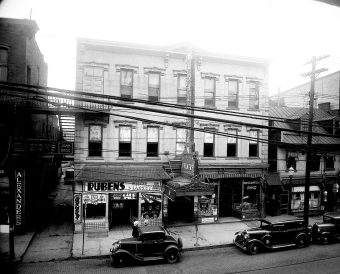
The story so far: In Chapter 5, Daniel Forrest fails in his attempt to cover up the suicide of a teenager in a bedroom he maintained in his theater. Spikes Innis and Forrest are arrested. The theater manager is later freed for lack of evidence, but his troubles have only just begun.
On the Sunday morning that followed the hearing for those involved in the death of teenager Frances Martin, the Rev. Pressly Thompson, pastor of Second Presbyterian Church, delivered a sermon decrying the moral conditions in Washington. It was a theme repeated in pulpits all over town that day and through the remainder of winter.
The next day, on Monday, Feb. 18, borough council directed its solicitor to draw up an ordinance giving police the power to raid brothels and speakeasies. Police had claimed that they, unlike constables, lacked the authority to conduct such raids. Many residents believed, however, that police were reluctant to bust establishments they were paid under the table to protect.
A group of church women, whom The Washington Observer referred to as “the most respectable women in town,” announced a boycott of the Lyric Theatre, calling it a “vicious place and one which should be shunned by all respectable people, both young and old.” The women were critical of the Day Nursery association for sponsoring a fundraising presentation of “Cinderella” in the theater a few days earlier. The association explained the venue had been booked months earlier and due to extensive advertising could not be changed. The entire town was swept up in a sense of indignation over the activity at the Lyric Theatre and the many other seedy public places that Frances’ death had brought into the light.
But Joshua Forrest, father of the disgraced manager of the Lyric, was outraged for another reason. Reeling from the damage to his family’s reputation, on Feb. 19 he filed suit against Observer Publishing Co., seeking $10,000 in damages. The suit claimed that The Washington Observer, in publishing news of Daniel Forrest’s arrest for maintaining a bawdy house, did so “falsely, maliciously, wickedly and illegally.”
The following day, an Observer editorial, in a veiled reference to the lawsuit, declared:
“We shall always have wickedness with us in some form or other. Providence perhaps has in its workings, brought this community face to face with the present deplorable state of affairs, the half of which the Observer has not told and cannot tell in print. Many of our best citizens are familiar with them. And because they have this knowledge and have acquainted themselves with the situation, they are aroused to the need of concerted action for the betterment of conditions. When the citizens as a whole, of every condition in life, almost unanimously condemn the practices which have been exposed, and urge us to go forward with the work, we would be false in our mission and to the best interests of this community if we did not continue our influence to uproot the evils. We assure our readers and the people of this community that we will continue to expose the evil and to call to the attention of those in authority the prevalence of crime, wherever it may be, and in this we are no respector of persons, whatever the consequences may be. …”
In printing this statement, the young newspaper publisher and owner of the Observer, John L. Stewart, gave notice to politicians, police, citizens of varying repute and Joshua Forrest himself that the newspaper would champion the cause of community betterment, and not be bullied by lawsuits while doing so.
Though there was not enough evidence to try Daniel Forrest initially, testimony at a juvenile hearing for Anna Watson gave pause to the district attorney and provided yet more ammunition for the group of church women promoting the boycott of the Lyric.
Anna, the girl who was with Frances Martin in her final hours, was believed at the time of the inquest to be about 16 years old. She was actually just 13 at the time she was propositioned by Daniel Forrest and seduced by Amos Martin in the infamous bedroom above the Lyric Theatre.
The hearing before Judge James Franklin Taylor was held to determine what should be done with the child. “The story told by the father of the girl was a pitiful one and showed how completely the child had been under the influences responsible for the existence of the notorious room over the box office,” The Observer reported.
He said his daughter had been incorrigible for some time and that he was not able to make her go to school. He said he did not know her to stay out all night, except when she stayed at the places she was working. He was placing her in the hands of the juvenile court so that it might “get her in an institution where she could receive a proper training.”
Judge Taylor asked the probation officer to try to find a suitable home for Anna outside Washington. The girl had objected to going to Morganza and expressed a wish to get out of town so she might be free from her old companions and associations and start a new life. She was later placed in the Rescue Home for Girls in Pittsburgh.
Anna Watson’s fateful visit to the room above the theater on the night of Feb. 2, 1907, may well have saved her from a miserable adolescence. Many Washington girls, some the same age as Anna, who should have been going to school were instead working in filthy brothels.
The church women, with the help of their preachers’ sermons, kept the pressure on the Lyric Theatre and its manager. On March 8, Edith Rick, a renowned Pittsburgh orator accustomed to performing before packed houses, was to make her first appearance in Washington in her monologue, “Hearts and Faces,” which was heavily advertised. By 8:15 p.m., only six patrons had entered the theater. After waiting in vain until 9 o’clock, manager Daniel Forrest called off the performance and closed the doors.
The boycott had been successful.
Washington’s council took action later in March, approving fines for those operating gambling dens or brothels of not more than $50 or 30 days in jail. The Washington Observer reacted with indignation. The newspaper and many citizens expected council to ban such places and run the operators out of town. “Instead of doing this the council has done the very opposite,” an editorial on March 20 read. “It has in reality passed a measure of regulation. In other words it might be considered a license to conduct these places upon the payment of $50 every once in a while, the periods being determined by the chief of police. … We do not want these places of vice and iniquity regulated. We want them prohibited.”
The last word of that editorial would be repeated over and over again in the coming years. More and more people would be won over to the idea of prohibiting the sale and consumption of alcohol. Locally, politicians found support of temperance to be nearly a requirement for office. Prohibition became a popular political movement that would culminate in the ratification of the 18th amendment in January 1919. In Washington, Frances Martin’s death had given a push to this cause.
Weak ordinances or not, Daniel Forrest was practically run out of town. All shows at the Lyric for the remainder of March were canceled and it was announced that management would be taken over on April 1 by Nixon Zimmerman & Co., which declared that the Lyric “would be all that the best people of the community desired it should be.”
Pittsburgh’s Samuel Nixon and Fred Zimmerman had teamed up with the New York theatrical production team of Marcus Klaw and A.L. Erlanger to form the Theatrical Syndicate, which in 1907 and for another decade would monopolize theater bookings throughout the United States. The theater in Washington, soon to be called the Nixon, would get only the shows selected by that syndicate.
Forrest, disgraced and fearful of more charges to be brought against him, left town, never to return. He settled in Kenton, Ohio, where he remarried and entered the retail and wholesale tobacco business. He suffered a stroke in 1916 and another in 1917, which killed him at the age of 47. Though his siblings and parents survived him, only his brother, Earle, showed up for his funeral.
Irene Martin, Frances’ mother, wished to have her child’s body brought to Indiana, Pa., for burial, but the expense was too great. The boyfriend, John “Spikes” Innis, offered to help out and, with the help of his and Frances’ former employer, tin-mill owner W.T. Griffiths, purchased a plot in Washington Cemetery, where Frances lies today, her grave unmarked on a sun-splashed hillside.
Innis would come to rest in the same cemetery 23 years later. He had been working as a watchman at the Highland Glass plant when he died on July 20, 1930, at the age of 51. He left a wife, Sarah, and four children.
Washington would not be reformed overnight. Its battle to save its young from sexual promiscuity and disease and from the ravages of drugs and alcohol would go on – a fight still being waged today. But the death in the room above the Lyric Theatre that fateful night brought the town back to reality from its reverie of growth and progress. Evil had moved into the neighborhood.
The Lyric Theatre would live on, by other names. After a few years as the Nixon, it became the Globe and later the Washington Theatre. It would undergo two major renovations and would end its life as the Penn Theatre, falling to the wrecking ball in the mid 1970s as part of the Bassettown redevelopment project.
Where the Lyric once stood is now a city parking lot. The brick wall of 78 North Main St. faces the lot, and on it can be seen where windows and a doorway have been bricked over.
It was through one of these portals that the body of Frances Martin was carried in the darkness on that frigid morning so very long ago. Visit that wall by moonlight and the quiet of night, and you might hear young Dr. Shannon’s hurrying footsteps padding through the snow and coming around the corner, and the whispering of conspirators.
Close your eyes, and you might sense that ancient grief, remorse and panic.
The End