

Notice: Undefined variable: paywall_console_msg in /usr/web/cs-washington.ogdennews.com/wp-content/themes/News_Core_2023_WashCluster/includes/single/single_post_meta_query.php on line 71
Notice: Undefined offset: 0 in /usr/web/cs-washington.ogdennews.com/wp-content/themes/News_Core_2023_WashCluster/single.php on line 18
Notice: Trying to get property 'cat_ID' of non-object in /usr/web/cs-washington.ogdennews.com/wp-content/themes/News_Core_2023_WashCluster/single.php on line 18
No Place to Call Home: an overview
Notice: Undefined offset: 0 in /usr/web/cs-washington.ogdennews.com/wp-content/themes/News_Core_2023_WashCluster/includes/single/strategically_placed_photos_article.php on line 412
Notice: Trying to get property 'term_id' of non-object in /usr/web/cs-washington.ogdennews.com/wp-content/themes/News_Core_2023_WashCluster/includes/single/strategically_placed_photos_article.php on line 412
Paul Nemenz, Tim Cumer and Leona Zitkovich may have wildly different backgrounds, but they share a common bond.
They are homeless.
And we at the newspaper have come to consider all of them friends.
There’s Paul, a soft-spoken, affable man with gentle eyes and a kind heart whose immaculate appearance defies the stereotypical image of homelessness.
“You can be homeless, but you don’t need to look homeless,” he says. “You can at least make an effort.”
A battlefield paramedic in Vietnam, Paul bears mental scars from the war. His return from service was met not with a hero’s reception but with indifference, contempt even, from the American public.
“Those of us who were not wounded physically were wounded mentally,” he said.
His close buddy Tim, whose nine grandkids affectionately call him “Hobo Pap,” was an over-the-road truck driver who eventually lost his truck to an addiction to drugs, which he still battles.
“I’ve been homeless off and on for a long time,” Cumer says. “I used to live a three-bedroom house. I had nice stuff.”
And anyone who frequents downtown Washington likely knows Leona. She’s the petite woman with leathering skin and disheveled hair who bides her time by walking the city streets and picking up litter.
She’s grappled with skirmishes of her own in the form of mental illness for a good part of her adult life.
Leona’s tough, though, and isn’t looking for pity. While she has what she calls plenty of stress, she lives life with an attitude that most would do well by adopting: “You’ve got to get to the solution, settle the problem and move on.”
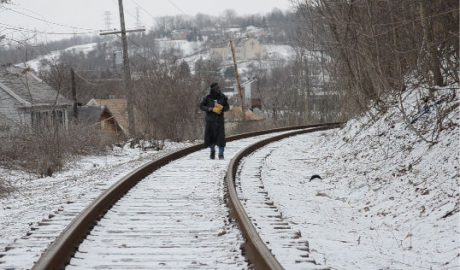
Paul, Tim and Leona were wary of the WeCare Street Outreach volunteers who, four years ago, first ventured into their “homes”: makeshift camps carved out of discarded mattresses and cardboard along creeks and railroad tracks, underneath bridges and behind the cover of brush, oftentimes just steps away from busy city thoroughfares. The goal was to reach out to the unsheltered homeless in need of basic medical care, food and toiletries but lacking the wherewithal to get help on their own.
Slowly, they began to trust the volunteers. As the days and months passed, we began to realize that these people had real stories, real problems that needed to be shared.
We started asking questions, not just of them, but of the people and the agencies empowered to make a difference.
We learned that most of the people on the streets do not choose homelessness as a lifestyle. It chooses them, whether the result of mental illness, substance abuse or job loss.
The annual point-in-time survey of homeless conducted in Washington County counted 186 homeless people in 2012 and 180 in 2011. In neighboring Greene County, census takers found just one homeless person last year, down considerably from 40 in 2011.
We were disturbed to learn that many are veterans. Nationwide, 62,000 veterans are homeless on any given night. Many are unaware of the benefits that service to their country entitles them.
Senior citizens, too, are at risk. Unable to afford rising rents and having less access to health care as budgets are slashed, more and more are aging into homelessness.
Equally troubling: More families are seeking emergency shelter. According to the National Alliance to End Homelessness, 41 percent of the homeless population is made up of families.
“No one is immune to the problems that cause homelessness,” said Jennifer Johnson, housing/homeless coordinator at the Washington County Department of Human Services.
Ashley Bishop can attest to that. At the age of 18, she suddenly found herself alone and without a place to call home after a suicide attempt. Today, she is living on her own in Waynesburg, thanks to the support she found at the Family Shelter in Washington.
“Look, there are a lot of reasons people become homeless,” she said, “and it is not always because of something they did. Sometimes it’s just the circumstances.”
A shortage in public housing only compounds the problem.
More than 100 families are on waiting lists in Washington County, and as many as 600 units are needed in Greene, if one study is accurate. That doesn’t include burgeoning waiting lists for Section 8 Housing.
There’s also a dearth of emergency housing. Greene County has no emergency shelters, so those who without warning find themselves homeless are sent to Washington, exacerbating an already overburdened system.
If it were not for nonprofit agencies like the City Mission, Connect Inc. and Family Promise, to name a few, more primitive homeless campsites would be dotting the landscape.
The location of Washington and its proximity to two interstates make it a logical drop-off point for folks down on their luck and in need of a hot and a cot.
And, with an increased transient population comes an increase in crime.
Washington police don’t track the number of crimes committed by the homeless or transients, but routinely field complaints from city business owners frustrated with panhandlers, public drunkenness and loitering.
The contingent of homeless that asks for money, making customers uneasy, or that steals has an affect on merchants’ bottom line as well as a neighborhood’s reputation.
The newspaper doesn’t pretend to have the answers. Instead, it seeks to create awareness with its yearlong project, “No Place to Call Home,” which examines the issue in-depth. Today’s edition kicks off the first of three installments in the ongoing series.
In connection with the initiative, and in partnership with Washington Health System, we have established funds at the Washington County Community Foundation and the Community Foundation of Greene County to raise money for homeless services.
At the end of the year, agencies that provide homeless services will be invited to apply for the money, and grants will be awarded in early 2014.
As our homeless friend Paul Nemenz said, “The heartbeat of every community is its citizens. Everybody needs to pitch in. That’s what it’s all about.”
To read more in the No Place to Call Home series, please visit click here.