

Notice: Undefined offset: 0 in /usr/web/cs-washington.ogdennews.com/wp-content/themes/News_Core_2023_WashCluster/includes/single/single_post_meta_query.php on line 43
Notice: Trying to get property 'paywall' of non-object in /usr/web/cs-washington.ogdennews.com/wp-content/themes/News_Core_2023_WashCluster/includes/single/single_post_meta_query.php on line 43
Respite care a welcome break for caregivers
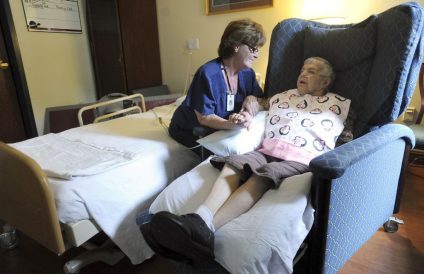
Aday in the life of Teresa Moore can be quite exhausting.
On weekdays, the 40-year-old Canonsburg woman is up at 4:50 a.m. She immediately showers and starts getting ready for work. At 5:30, she wakes her 79-year-old mother, Dora Moore. Teresa dresses her, makes her breakfast and gives Dora her medication. Then Teresa finishes dressing herself.
When she’s done, both mother and daughter are out the door: Dora heading to the Washington County Health Center Adult Day Center, and Teresa driving to Pittsburgh, where she is director of the registration department at Western Psychiatric Institute and Clinic.
Teresa leaves Pittsburgh at 3:30 p.m., picks up her mother from the Adult Day Center, arriving between 4:15 and 4:30 p.m., and the two go home and have dinner. At 8 o’clock, Dora goes to bed, and Teresa begins to work on her online college assignments. She is completing a bachelor’s degree in business.
On the weekends, Teresa catches up on housework and yard work, in addition to caring for Dora. If she needs to run errands, she’ll either take Dora with her, or she’ll enlist the help of a friend to sit with her mother.
“She’s easy,” Teresa said. “It’s not that she’s difficult. She just doesn’t communicate well. She’ll walk from point A to point B. I’ve been with people who are irate or don’t sit still. She’s more laid back. She doesn’t wander, and she doesn’t get up. Praise God, I do get a good night’s sleep.”
Dora has Alzheimer’s disease. She has lived with Teresa for the past four years, and when Teresa’s father died two years ago, Teresa became Dora’s primary caregiver.
“A lot of people have said I couldn’t do what you’re doing,” Teresa said. “I’m doing things every day that I said when I get to that point, I won’t be able to do it. Now I’m over that hurdle. It definitely defines who I am as a person. I’m proud of who I am as a person.”
There are times, though, that Teresa does need a break, and when she does, she has turned to overnight respite care, a program that provides temporary relief to those who care for family members who otherwise might require placement in a facility outside the home.
Studies have shown that respite programs help sustain family caregivers’ well-being, avoid or delay out-of-home placement and reduce the likelihood of abuse and neglect.
“Our job is to give the caregiver time to relax and take care of themselves. Most times, they forget to think about themselves,” said Christina Wehner, director of social services at the Washington County Health Center, which offers overnight respite care.
Teresa hasn’t put Dora in overnight respite care that often, just a couple times in the last two years, and until Teresa took a weeklong vacation to Aruba in May, three nights was the most Dora had ever been away from home.
Dora was fine with the short stays, but the weeklong stay was more than she – or Teresa – could handle. By the time Dora came home, she was suffering from “severe confusion.”
“For me, it wasn’t worth it,” Teresa said. “I spent a month trying to get her back to baseline.”
It wasn’t the care that Dora received at the Washington County Health Center. It’s just that Dora has become a slave to her routine. “She’s used to our routine, and she’s so attached to me. I’m with her every day. I knew it would be rough,” Teresa said.
Midway through her vacation, Teresa spoke to friend back home, who told her that Dora was having trouble adjusting. She also told Teresa, “You’re going to come back, and she’s going to look different.”
“I enjoyed half my vacation,” Teresa said. “If I would do something like that again, I’d probably take her with me or have someone come to the house.”
Or, she said, wait until circumstances change.
However, Teresa would not hesitate to use respite care if she would like to go out of town for a long weekend.
“Our goal is the same as any family member’s goal: to help them stay home as long as they can,” Wehner said. “We try to pick up where they left off as best as we can. We will never be as good as the family caregiver, but we’ll make as smooth of a transition as possible.”
Respite care, however, is not cheap, and, as a general rule, is not covered by insurance. Wehner said some long-term care insurance contains respite-care provisions, and some doctors can do a direct-admit with specific documentation.
At the Washington County Health Center, overnight respite care ranges between $250 and $300, which is in line with other facilities across the country, and the fee is determined by the level of care required. Alzheimer’s and dementia patients who need a secure environment are on the upper end of the scale.
Even though Wehner said “it’s a scary number,” the fee compares favorably with in-home temporary 24-hour care – without the responsibility of arranging home care or worries about reliability. Nevertheless, the fee is cost-prohibitive for many family caregivers, Wehner said.
Betty Brooks of McDonald does not have to worry about respite-care fees. She is entitled to five free days of overnight respite care per month for her 86-year-old mother, Anna Snatchko of Burgettstown, because Anna is under hospice care. However, Betty, who is Anna’s primary caregiver, has taken advantage of it sparingly for her mother.
Like Dora Moore, Anna is used to her routine, and she becomes easily confused when she leaves her home for extended periods of time. After a two-day stay at the Donnell House in Washington in early July, Anna was lethargic and uncooperative for a day or so after she returned home.
In addition, Betty has had ample help with Anna, sharing daytime duties with her daughter, Katie Fehl, and her niece, Kara Snatchko, so the need for respite care has not been sufficient. However, Kara is no longer involved with Anna’s care.
“So far, so good. We’ll see how things pan out,” said Betty, noting that if Anna’s care becomes too much for just the two of them, Betty may consider her monthly respite-care options. “But I won’t put her in for a week.”
Even though respite care must be arranged in advance, some facilities cannot guarantee a bed will be available on the patient’s arrival date. The Donnell House, for example, has just eight patient rooms. If a bed is not open, it has contracted with other facilities that offer respite care.
Wehner said family caregivers must provide enough clothes for their loved ones’ overnight stays, as well as their medication list, requirements, likes and dislikes.
“If they are able to be taken care of at home, as a team of us, we should be able to take care of them here,” she said.