

Notice: Undefined offset: 0 in /usr/web/cs-washington.ogdennews.com/wp-content/themes/News_Core_2023_WashCluster/includes/single/single_post_meta_query.php on line 43
Notice: Trying to get property 'paywall' of non-object in /usr/web/cs-washington.ogdennews.com/wp-content/themes/News_Core_2023_WashCluster/includes/single/single_post_meta_query.php on line 43
Research findings offer hope for treating Alzheimer’s
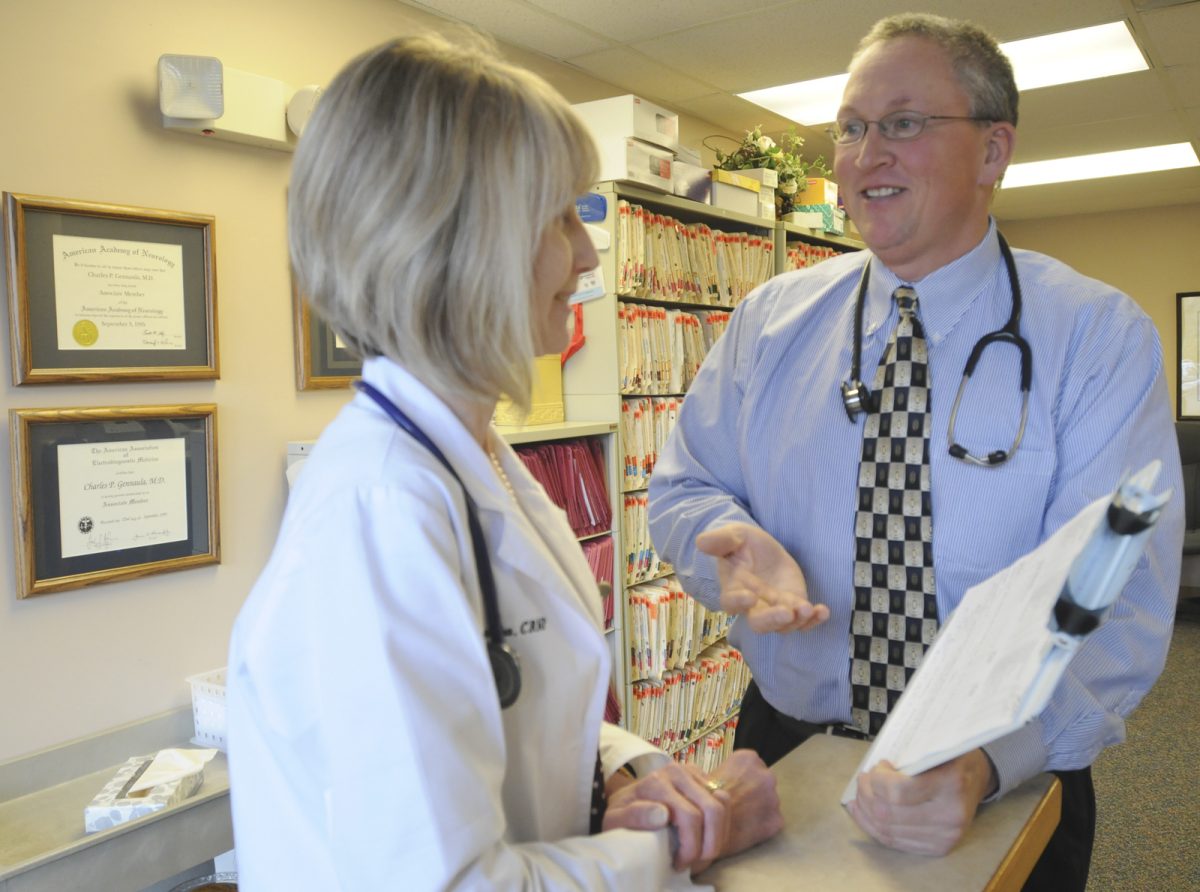
Dr. Charles P. Gennaula reviews a patient’s file with certified nurse practitioner Patty Zamiska in his office in Belle Vernon.

Jennie Smith, left, and Helen Oreski share a laugh during song hour at Center in the Woods, California. Oreski was diagnosed with dementia more than a year ago.
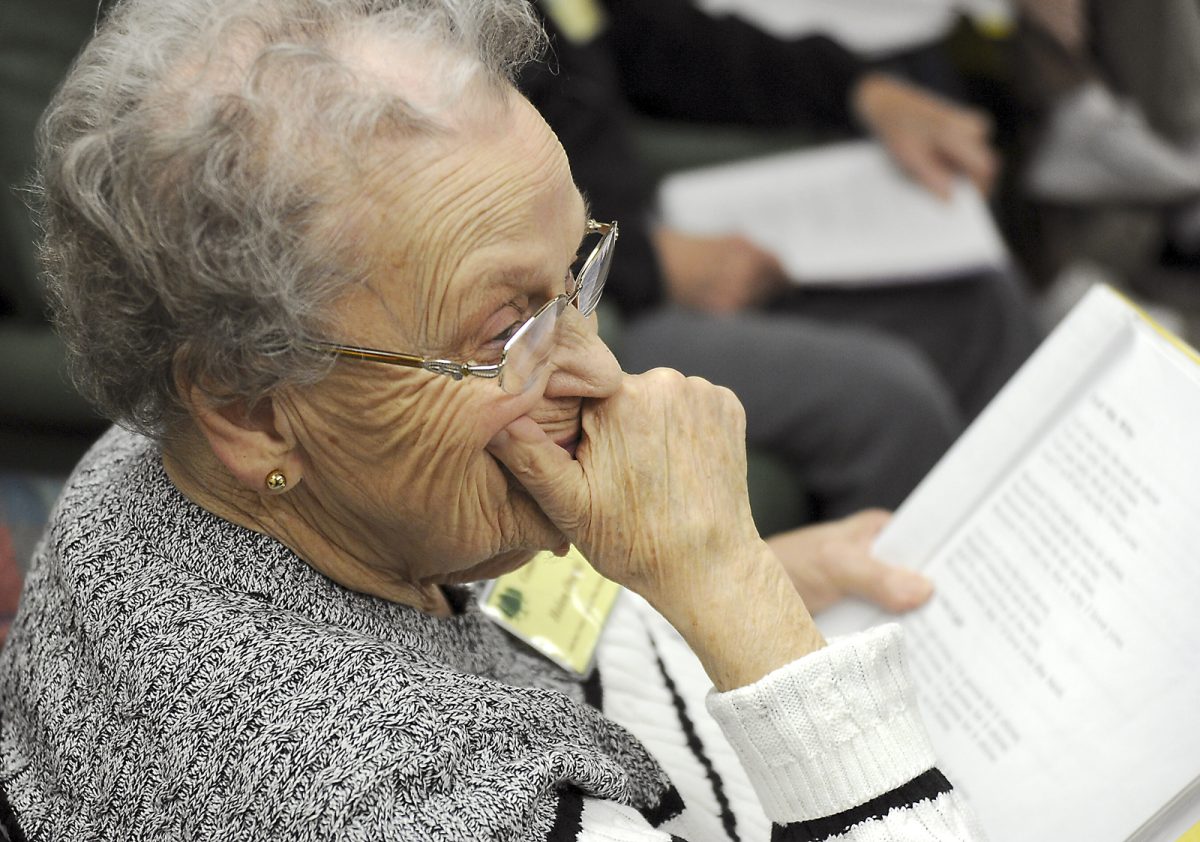
Helen Oreski pauses during a song hour activity at Center in the Woods in California.
Marlene Oreski said she welcomes breakthrough research this year by Harvard stem-cell scientists, something that offers hope for treating Alzheimer’s disease. But it wouldn’t benefit her mother.
“It certainly is good news,” said Marlene, a retired Carroll Township schoolteacher, in response to news in March that the researchers, Tracy Young-Pearse and Christina Muratore, had created the types of neurons that are damaged by the disease from skin cells of patients with early-onset Alzheimer’s.
Marlene said her mother, Helen Oreski, 93, was diagnosed with dementia more than a year ago, and its symptoms have worsened to the point where she now has problems with mobility and recognizing her relatives.
“It would be too late for her,” Marlene said, speaking of any better dementia or Alzheimer’s medication that could come out of new research findings.
The Harvard study could lead to developing improved treatment regimens for Alzheimer’s before those who are at risk for the disease begin to exhibit its symptoms, much like how physicians treat heart disease early with high blood pressure medication, said Eric McDade, a UPMC neurologist in Pittsburgh,
“We have to be cautiously optimistic, but we have reason to be hopeful,” McDade said.
“The hope is to develop a model that mimics Alzheimer’s and to be able to draft treatments quicker,” he said.
He said the research could speed up the time it takes for the Federal Drug Administration to approve Alzheimer’s drugs.
Another breakthrough in research announced last month, also known as “Alzheimer’s in a dish,” involved Boston researchers Doo Yeon Kim and Rudolph E. Tanzi figuring out how to grow human brain cells in a gel and watch them develop structures of the disease in a petri dish.
The story joined a string of recent headlines about new discoveries in Alzheimer’s research.
The University of Cambridge, England, said in July a study there theorized that reducing such risk factors as smoking and not getting enough exercise could prevent 1 in 3 cases of Alzheimer’s, the BBC reported.
Research by John O’Keefe, a U.S.-British scientist, and a couple from Norway, May-Britt and Edvard Moser, won the team a Nobel Prize in medicine last month for its discovery of the brain’s navigation system that offered hope for treating Alzheimer’s.
Meanwhile, David Knopman of the Mayo Clinic announced that researchers were trying to look at ways to recognize Alzheimer’s early by examining changes in a patient’s retina or sense of smell, The Wall Street Journal reported in July.
McDade said new research findings are benefiting from President Obama’s decision to increase research funding over the past several years for Alzheimer’s. This year the funding for research and support saw a record-setting $122 million increase.
“Maybe we can prevent it from happening or put it off for five years,” McDade said.
Charles P. Gennaula, a neurologist at Mon Valley Hospital, said stories on breakthrough Alzheimer’s research have come and gone for many years.
“The majority of these stories you hear about are attempts to get more research money and then they just die,” Gennaula said.
He said various Alzheimer’s treatments that are due out of the FDA in the next few years do offer some hope that physicians might be able to “slow it down.”