

Notice: Undefined offset: 0 in /usr/web/cs-washington.ogdennews.com/wp-content/themes/News_Core_2023_WashCluster/includes/single/single_post_meta_query.php on line 43
Notice: Trying to get property 'paywall' of non-object in /usr/web/cs-washington.ogdennews.com/wp-content/themes/News_Core_2023_WashCluster/includes/single/single_post_meta_query.php on line 43
The verdict is mixed on ‘brain games’ as a protective agent
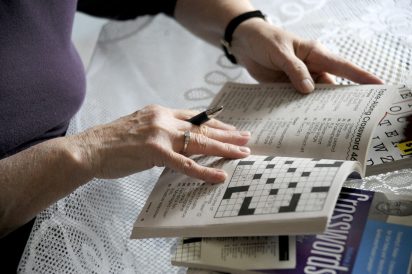
Having lost her husband to dementia rooted in Parkinson’s Disease and seeing a grandmother’s cognition erode under an onslaught of mini-strokes, Patricia Lyle is all too aware of the need to keep mind and body healthy.
With at least one eye on that goal, the 76-year-old Washington resident volunteers at the book shop of Citizens Library, and devours mystery novels and the latest literary tidings from Garrison Keillor. Until she was 60, Lyle also was an avid roller skater, though artificial hips put an end to that part of her fitness regimen.
Lyle has also become a devoted enthusiast of word games and crossword puzzles.
“I always liked to read,” Lyle said. “And when my husband became ill, I started to do word games, and it helped pass the time. And I really liked it.”
Over the last several years, as awareness of Alzheimer’s disease and dementia has increased along with the number of older Americans diagnosed with these afflictions, games from chess to Sudoko have been recommended as ways to ward off Alzheimer’s or dementia, or, at the very least, boost the functioning of individuals who are stumbling into forgetfulness.
In fact, on its web page, the Alzheimer’s Association states that “research has found that keeping the brain active seems to increase its vitality and may build its reserves of brain cells and connections,” and “higher levels of education appear to be somewhat protective against Alzheimer’s, possibly because brain cells and their connections are stronger.”
It concludes, “Well-educated individuals can still get Alzheimer’s, but symptoms may appear later because of this protective effort.”
But recently the consensus on the effectiveness of so-called “brain games” in keeping Alzheimer’s and dementia at bay has become more muddled. When contacted by email about Alzheimer’s and brain games, Samuel Gandy, a doctor who specializes in Alzheimer’s disease and neurology at Mount Sinai Hospital in New York, was dismissive: “There is zero evidence for any of them,” he said. “It’s 100 percent hype.”
Though less blunt, a statement issued last month jointly by Stanford University’s Center for Longevity and the Max Planck Institute for Human Development and endorsed by 69 scientists and researchers, looked askance on products being hawked that promise improvement to faltering cognition.
In their view, “claims promoting brain games are frequently exaggerated and at times misleading.” They conclude that more research needs to be done on how cognitive functioning in older adults can be fortified, and “in the absence of clear evidence, the recommendation of the group … is that individuals lead physically active, intellectually challenging and socially engaged lives, in ways that work for them.”
More to the point, if people engage in a certain task repeatedly, they will inevitably get better at it, according to Beth Snitz, a professor of neurology at the University of Pittsburgh. What’s not so clear is whether overall cognition improves as a result.
Whether brain games forestall dementia or Alzheimer’s is “a critical question everyone wants answered,” Snitz pointed out.
Even among older adults who show no sign of Alzheimer’s disease or dementia, remembering details of long-ago events, or even where they parked in the lot of a big-box store, can become less reliable simply because the brain has aged, like other parts of the body, and the parts of the brain that process information function less efficiently. In those adults, brain “training” can have a lasting positive effect, as per a study released earlier this year by the National Institute on Aging.
Another fresh study, this one conducted at the Cleveland Clinic, suggests that physical exercise might help slow the progression of Alzheimer’s disease, even if there’s general agreement that there remains no silver bullet to cure it or prevent it.
“That is one of the very sad things about the disease – there is nothing you can do,” said Lisa Hamer Jenkins, the dementia coordinator in the Pittsburgh office of Community LIFE, an adult day health center. “It hits all educational levels, all socioeconomic levels … Nobody is safe.”
But Jenkins nevertheless has her clients engage in various types of physical and mental exercise, and sees the benefits that both yield.
“Really, there are so many things you can do – read a book, watch ‘Jeopardy,'” she said. “You use it or you lose it.”