

Notice: Undefined offset: 0 in /usr/web/cs-washington.ogdennews.com/wp-content/themes/News_Core_2023_WashCluster/includes/single/single_post_meta_query.php on line 43
Notice: Trying to get property 'paywall' of non-object in /usr/web/cs-washington.ogdennews.com/wp-content/themes/News_Core_2023_WashCluster/includes/single/single_post_meta_query.php on line 43
Family discussions key to treating dementia patients
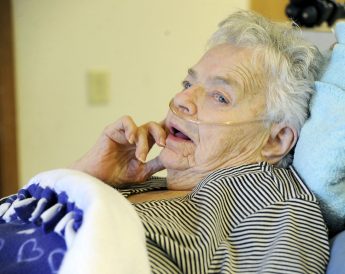
Planning end-of-life treatments for people diagnosed with Alzheimer’s or other forms of dementia can be a torturous process for their loved ones, but those decisions should be made in the earliest stages of the disease, if possible, experts say.
“It’s such a minefield; we really stress working with your physician,” said Clay Jacobs of the Alzheimer’s Association Greater Pennsylvania Chapter. “It’s important to have that discussion, and have it early. (Relatives) making decisions later are not always sure what their loved ones would want.”
Disagreements among adult children when a parent is no longer able to make decisions for themselves can cause rifts within families. That’s why routine discussions and planning with all relatives in consultation with a doctor is vital for caring for a person with dementia.
“I think the one thing you want to do is have a family meeting early on with the patient and their family,” said Dr. Judy Black, senior medical director of Highmark’s senior markets. “Make sure the patient is included before they get to the stage where they can’t make decisions. What’s important to them?”
Those early discussions “set the stage” for families to meet in the future as the disease progresses to make more difficult judgments as scope of treatment changes and the patient can no longer make decisions or care for themselves.
“It’s really important to get everyone on board,” Black said. “Families feel that there is not much they can do to help their loved ones.”
Betty Brooks, who is the primary caregiver for her mother, Anna Snatchko, has found herself in difficult situations when making decisions for her mother. Brooks stays with her mother, who turns 87 on Friday, six nights a week in a one-bedroom apartment in Burgettstown.
“They deal with me because I deal with my mom,” Brooks said of her brothers. “They’re not going to cause headaches for me because they know I’m here doing what I am for my mom. They don’t cause too many problems.”
But there are disagreements within the family, especially between Brooks and at least one of her brothers, Roger Snatchko, 61, of Bavington, about the dozen or so supplements and vitamins Brooks gives to their mother each day in the form of pills.
“Are these supplements actually helping her dementia? Then she gets offensive when I question her,” Roger Snatchko said. “This is what is keeping her alive? Are you serious? I just hope it’s not hurting my mother because she’s having trouble swallowing.”
Brooks can easily rattle off the daily list of supplements and vitamins that include fish oil, alpha lipoic acid, melatonin, D-Ribose, magnesium, folic acid, multi-vitamins, among others. He mother is beginning to have trouble swallowing the pills, Brooks said, so she’s now investigating whether to cut back on the regimen or begin using gummies and powders instead.
“A doctor has to tell me she needs this stuff to keep going,” Roger Snatchko said. “But when she’s not improving, why are you shoving it down her throat?”
Brooks has a simple answer: “Because she’s my mom.”
She had an interesting exchange recently when a nurse working for a local hospice center also questioned why she was giving her mother those supplements and vitamins.
“Well, you know that’s kind of a waste,” Brooks recounted the hospice nurse saying.
“Are you ready to fight?” Brooks half-jokingly responded.
“He just seems to think that’s senseless,” she said, “but I don’t.”
But Brooks admitted nothing she has tried so far has slowed the progression of her mother’s dementia. Still, she wants to do everything in her power to keep her healthy physically and make her as comfortable as possible.
“All of them think I’m crazy, and why am I doing that?” Brooks said. “Supplements aren’t cheap. I think it’s worth it. They don’t.”
Black, who is also a member of the Alzheimer’s Association Greater Pennsylvania Chapter’s board of directors, said families need to continue speaking about treatment plans and the risks associated with them as they make decisions for any person in advanced stages of dementia and Alzheimer’s. She stressed that no supplements should be given if they counteract prescription medications.
“Make sure they’re comfortable and well-cared for,” Black said. “Maintain the medications that provide comfort and stop any that don’t.”
Jacobs said the Alzheimer’s Association works to dispel the myths associated with some “miracle pills” that claim to help dementia patients, and the organization only promotes supplements, such as Omega 3, that have gone through rigorous testing and are proven to be effective. Ultimately, Jacobs said he understands how families often feel powerless and are willing to do anything they think might help a loved one.
“If it provides a better quality of life, we support that,” Jacobs said. “With this disease, we see the person changing. It’s hard. Some families often wish it would just end because they’re grieving and watching their loved one change.”